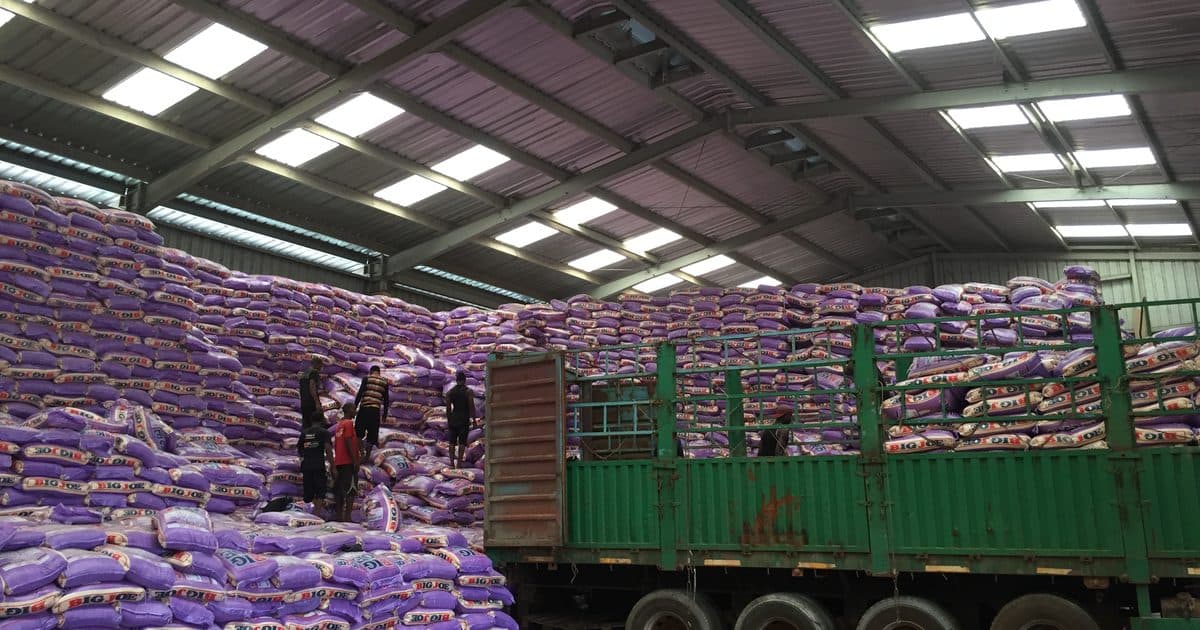
Rice is the most consumed cereal in Senegal, and the country does not grow enough of it. In 2025 it imported 1.47 million tonnes, worth 336.7 billion CFA francs, according to the national statistics agency, ANSD. Senegal is Africa's third largest rice importer, after Nigeria and Côte d'Ivoire. And Mali, a large producer, imports too, mostly through the port of Dakar.
Here is what to know before importing rice into Senegal or Mali in 2026: where it comes from, which rice to buy for which market, the regulated prices, the permits, and the route from the port to Bamako.
Take action
- Get your rice trucked from the port of Dakar to Bamako: write to us on WhatsApp.
- Talk to our freight team: quotation within one working day.
Rice imports in Senegal in figures
| Indicator | Value | Source |
|---|---|---|
| Imports in 2025 | 1.47 million tonnes, 336.7 billion CFA francs | ANSD |
| Imports in 2024 | 1.38 million tonnes | ANSD |
| Imports forecast for 2026/27 | 1.76 million tonnes | US Department of Agriculture |
| Consumption forecast for 2026/27 | 2.35 million tonnes | US Department of Agriculture |
| Local output forecast for 2026/27 | 670,000 tonnes of milled rice | US Department of Agriculture |
| Security stock held by the private sector | about 200,000 tonnes | US Department of Agriculture |
ANSD counts calendar years and the US Department of Agriculture marketing years, so the two series do not match exactly, but they tell the same story: Senegal imports about two and a half times what it grows, and demand rises with the population.
Where does Senegal's imported rice come from?
In 2025, four countries supplied most of the rice imported into Senegal:
| Origin | Share of 2025 imports |
|---|---|
| India | 42 % |
| Brazil | 19 % |
| Thailand | 18 % |
| Pakistan | 13 % |
Indian rice is mostly broken: 69 % of imports from India. India banned exports of 100 % broken rice in September 2022; Senegal was among the countries allowed to receive it by exemption, and the ban was lifted on 7 March 2025. Brazil's rise to second supplier shows importers spreading their origins.
Broken rice: the product of the Senegalese market
The Senegalese market splits into four: local rice, ordinary non fragrant rice from India and other origins, standard fragrant rice and premium fragrant rice. The most consumed is ordinary non fragrant broken rice, because it is the cheapest. In March 2026, at retail, local rice cost about a quarter more than imported Indian rice.
Mali does not eat the same rice. Malian consumers prefer rice with 25 to 35 % brokens, which makes up 70 % of consumption, against 20 % for 100 % broken rice. An importer buying for both Dakar and Bamako therefore orders two different products.
Rice prices in Senegal in 2026
The price of ordinary broken rice is capped. Since 6 January 2026, the government has set the retail price of ordinary non fragrant broken rice at 300 CFA francs a kilo in the Dakar region, down from 350. In the other regions, the cap adds a transport differential, set region by region by the consumer councils.
Local rice has its own price. In November 2025, the state and the rice sector signed an agreement fixing the ex mill price of local white rice, and traders committed to buying the volumes available at production sites.
The world price remains jumpy. The FAO All Rice Price Index rose 1.4 % in September 2026 on weather concerns, and an erratic monsoon in India weighs on production forecasts. For an importer, the gap between the world price and the retail cap decides the margin.
The rules for importing rice into Senegal
- The import declaration. Every rice import requires a food import declaration, the DIPA. The government uses it to regulate: it suspended DIPA issuance for rice for one month from 8 July 2026, to clear about 37,000 tonnes of local rice stuck in the mills, as it had already done in November 2025.
- Quotas tied to local rice. Since July 2026, operators must show their purchases of local rice before obtaining new import quotas.
- Customs duties. Rice falls under the ECOWAS common external tariff, plus community levies. The government also uses duties to weigh on prices: according to the Senegalese press in April 2025, the cut in the price of ordinary broken rice relied in part on suspending customs duty and VAT on that rice. The regime can change from one season to the next: have your forwarder confirm it before each order, and read our article on customs valuation in West Africa.
- The price cap. It applies to the whole distribution chain. The market regulation agency, ARM, monitors prices and stocks, including the security stock held by importers.
Rice imports in Mali
Mali grows a lot of rice: 1.9 million tonnes of milled rice in 2025/26, up 7.4 %. But it consumes 2.35 million tonnes and imports the difference: about 475,000 tonnes forecast for 2026/27, down 5 % thanks to larger stocks. The government aims to nearly double its paddy output by 2030.
Mali's imported rice comes mostly through Dakar. Most of it is transhipped at the port and trucked up to Bamako. Senegal also re-exports about 80,000 tonnes of rice a year, with Mali as the first destination. At retail, rice cost about 0.79 dollars a kilo in Mali in February 2026, against 0.91 dollars a year earlier, thanks to a good harvest.
Getting rice to Bamako: the steps
- Pick the right rice for the right market: 100 % broken for Dakar, 25 to 35 % brokens for Bamako.
- Buy FOB or CIF Dakar, with inspection at loading. Our article on FOB vs CIF helps you choose, and the one on SGS inspection costs gives the price.
- Clear the cargo through the port of Dakar, containerised or break bulk, then decide where to unpack: see devanning in Dakar or sending the container to Bamako.
- Transit to Mali under the ECOWAS inter-state road transit regime (TRIE), without paying Senegalese duties.
- Do not overload. A rice truck loaded beyond the axle limit risks being held: see half of Senegal's trucks run overloaded. For the route in 2026, read shipping to Mali under blockade.
Frequently asked questions
How much rice does Senegal import?
1.47 million tonnes in 2025, worth 336.7 billion CFA francs, according to ANSD, against 1.38 million tonnes in 2024.
Where does Senegal's imported rice come from?
In 2025, from India (42 %), Brazil (19 %), Thailand (18 %) and Pakistan (13 %). Indian rice is mostly broken.
What is the price of rice in Senegal in 2026?
Ordinary non fragrant broken rice is capped at 300 CFA francs a kilo at retail in the Dakar region since 6 January 2026; other regions add a transport differential.
Do you need a licence to import rice into Senegal?
Yes: a food import declaration (DIPA) for each import. Since July 2026, new quotas are tied to prior purchases of local rice.
How does rice reach Mali?
Most of the rice Mali imports arrives at the port of Dakar and is trucked to Bamako, in transit under the TRIE regime.
What we do
GraceRoad organises rice transport from the port of Dakar to inland Senegal and to Bamako, in full truckloads or groupage, with verified hauliers and transit follow up. Tell us your cargo, the origin and the destination: the quotation comes within one working day.
Request a quotation on WhatsApp or write to our team.
Read next: small importers and part loads in Dakar and Senegal groundnuts and peanuts in 2026.
Sources: Ecofin Agency, 4 August 2026, and Invest-Time, citing ANSD (2024 and 2025 rice imports by volume and value); US Department of Agriculture, Foreign Agricultural Service, Grain and Feed Annual, Dakar, 21 April 2026 (import, consumption, production and stock forecasts for Senegal and Mali, 2025 origin shares, share of broken rice in Indian imports, market segments, March 2026 retail prices, 6 January 2026 cap, November 2025 local rice agreement, Malian consumer preferences, transhipment through Dakar, prices in Mali, Senegalese re-exports); S&P Global, 7 March 2025 (India lifts its ban on 100 % broken rice exports); Prime Minister's office of Senegal, release on the broken rice price cut, and allAfrica, January 2026 (regional caps in Thiès and Tambacounda); Le Soleil, Seneweb and Senego, July 2026 (suspension of rice DIPAs from 8 July, 37,000 tonnes of local rice, quotas tied to local rice purchases); Ecofin Agency, 10 July 2026 (similar measure in November 2025); allAfrica, 3 April 2025 (broken rice price cut, suspension of duty and VAT); FAO Food Price Index, October 2026 (September 2026 rice index, production forecasts).