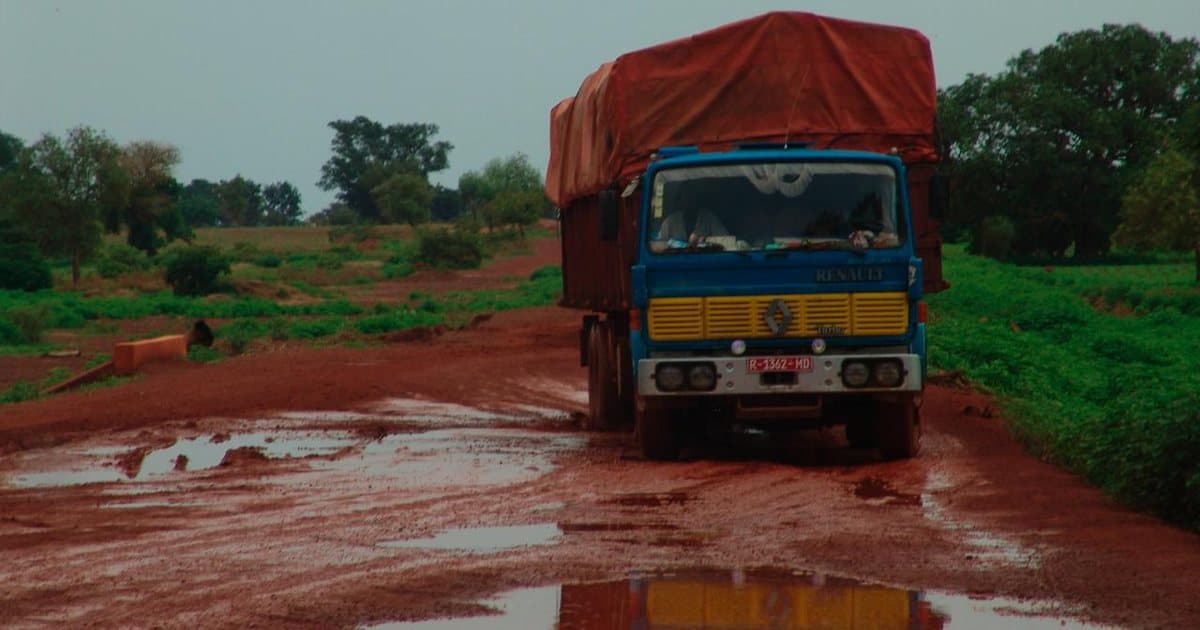
On 3 September 2025, Jama'at Nusrat al-Islam wal-Muslimin, the al-Qaeda affiliate active across the Sahel, declared a blockade on fuel bound for Mali. A year later it has not been lifted. It has changed shape, eased early in 2026, and been reimposed at the end of April. For any company supplying Mali through Dakar, it has become the first fact in every file.
This piece does not comment on the military situation. It gathers what public figures say about the corridor, and what a shipper can do with them.
What happened
The first tanker convoys were attacked in September 2025 in the Kayes region, on the road from Senegal. In October the attacks spread south around Sikasso, on the routes from Côte d'Ivoire. By the end of the month, with fuel short, the government closed schools across the country for two weeks.
From late October the Malian army ran escorted convoys. According to the Institute for Security Studies (ISS), they brought in 200 to 300 tankers a week. On 1 May 2026 Mali's trade directorate announced that 830 tankers had reached Bamako. Over the whole period, more than 300 tankers have been destroyed.
On 25 April 2026 coordinated attacks hit several towns, and the blockade on the capital was reimposed within days. In July the Senegalese truckers' union counted at least 15 Senegalese trucks burned, with several hundred vehicles stuck or abandoned on some roads.
What it costs Senegal
The story is about Mali, but Senegal pays too. Mali took 26.5 percent of Senegal's exports in 2024, worth 802.8 billion CFA francs. In normal times the Dakar corridor carries most of Mali's foreign trade, with close to a thousand heavy trucks a day.
Between September and November 2025, the port of Dakar saw around 120 Mali bound containers held up every day. By late November more than 2,000 were waiting in port, a loss ISS puts at 15 billion CFA francs a month for the Senegalese economy. By February 2026 the flow had reversed: about 4,000 empty containers were stuck in Bamako, with drivers refusing to take the road back.
Which roads still carry cargo
The historic route runs through Kidira, Diboli, Kayes, Diéma and Kita. It has suffered most since April. Freight has shifted heavily to the southern branch, through Tambacounda, Kédougou, Saraya and the Moussala border post, then Kéniéba and Kita. The Senegalese Shippers' Council calls it a massive reorientation.
The southern branch has its own limits. A joint inspection on 13 August 2026 found a queue of about 15 kilometres of trucks at Moussala, around ten kilometres of unpaved road, and almost no parking areas. The rate per truck, which used to sit around 1.4 million CFA francs, was trading between 3.6 and 4 million CFA francs in August according to the Malian press.
Other gateways are not safe havens. The Abidjan corridor carried 1.47 million tonnes to Mali in 2025, yet the Sikasso road saw tanker attacks from October 2025. Conakry remains an option for some flows. No route is safe by default. Each one is judged on the week's information.
What changes for a shipper
Price. Truck rates have nearly tripled at times. A quote given in July is not necessarily valid in September.
Transit time. Convoys, border queues and detours mean there is no standard transit time between Dakar and Bamako any more. A carrier who promises a firm date with no conditions is taking a risk, or passing one to you.
The container. A container that goes up to Bamako may stay there, and detention charges run every day until it is returned to the line. Devanning in Dakar and loading the cargo onto flatbeds or curtainsiders lets you return the box and stop the clock.
Insurance. This is the point most often missed. In the marine insurance market, war risks on cargo are normally covered only while the goods are at sea, not during inland carriage. Terrorism, on the other hand, can be covered on land under the strikes and terrorism clauses, if the policy includes them. Read your policy, declare the route, and get written confirmation from the insurer before the truck leaves.
The contract. A fixed delivered price to Bamako for six months makes little sense in these conditions. A clause that adjusts freight to the route actually taken keeps every detour from becoming a dispute.
What works in practice
Split the volume. Several regular lots expose you less than one large consignment on a single convoy. A loss stays a partial loss.
Hold stock upstream. Keeping goods in Dakar under bond and releasing them when the road opens costs less than a truck stuck at the border. We described the method in forward stock in a bonded warehouse.
Choose the route every week. North, south or another port: the call is made with the carriers driving the road, not on a map.
Track every truck. Knowing where the vehicle is, hour by hour, changes the conversation with your customer, your insurer and the authorities.
Respect the drivers. They carry the risk. No deadline justifies pushing drivers onto a road they refuse, or leaving them without news through a wait of several days.
What we do
No truck leaves for Mali until we have checked that day's route with our partner carriers. We tell you what we know about the road, rather than a date we cannot keep. Our quote states the planned route and how the price moves if the route changes. Every assigned truck is tracked, and you can see where it is.
Mali remains a market we serve. We serve it with this week's numbers, not with the ones from before September 2025.
Read next: your goods are waiting at a border post and humanitarian logistics in the Sahel.
Sources: Institute for Security Studies (ISS Africa), Felix Fodé Bongono, 4 June 2026 (containers held in Dakar, monthly losses, tankers destroyed, escorted convoys, empty containers in Bamako, Mali's share of Senegalese exports, Abidjan corridor volumes, blockade reimposed at the end of April 2026); Mali Directorate General of Trade, Consumer Affairs and Competition, announcement of 1 May 2026 (830 tankers); Senegalese truckers' union and Senegalese Shippers' Council, statements reported by the Senegalese and Malian press in July and August 2026 (burned vehicles, shift to the southern branch, Moussala queue, truck rates); reporting on the blockade by Reuters, Al Jazeera and Bellingcat (timeline of the September and October 2025 attacks).