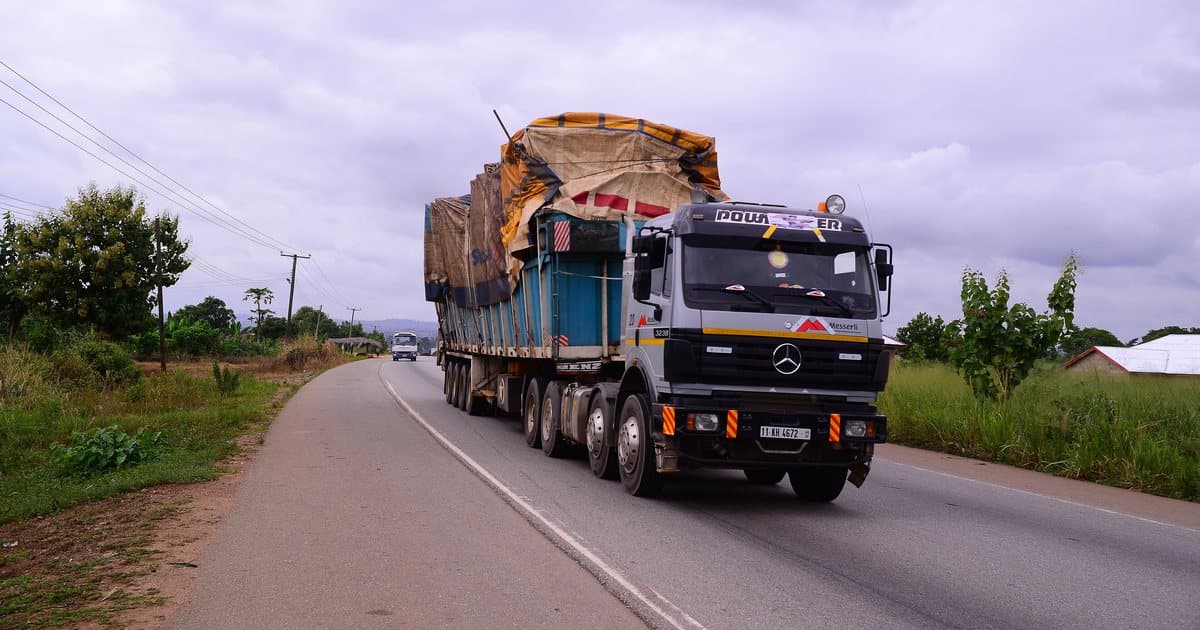
On 1 July 2026, Senegal's Ministry of Infrastructure opened a national workshop on axle loads with a number nobody in the room disputed. In April, of 148,885 trucks checked at the country's weigh stations, 47.71 percent were overloaded. The ministry's secretary general called the situation worrying and unsustainable.
The method matters more than the headline. That percentage is counted after a 20 percent tolerance. A truck recorded as overloaded is not slightly over the limit. It is at least a fifth over.
What makes it striking is that the number had been falling. In 2013 the ministry measured 66 percent of trucks overloaded. By the end of 2015 it was 32 percent, and 29 percent in the first quarter of 2016. Ten years later it is back to nearly one truck in two, and the target set when controls began, below 10 percent within five years, was never reached.
What the rule says
The reference text is UEMOA Regulation 14/2005, adopted in Bamako on 16 December 2005. It harmonises the control of vehicle dimensions, weight and axle load across the eight member states of the West African Economic and Monetary Union, and sets two ceilings every shipper should know: 11.5 tonnes per axle and 51 tonnes gross for the heaviest combinations.
Senegal outsourced enforcement in July 2012 to a concession holder, Afrique Pesage, for twenty years. The country now runs 24 fixed weigh stations and five mobile units. The port of Dakar has weighed outgoing trucks since February 2011 and offloads the excess when an overload is confirmed, and sites that ship more than 200,000 tonnes a year have been listed so that they weigh what leaves their gates.
Senegal still applies a 20 percent tolerance, where the regional Lomé declaration calls for 15. In July the ministry announced three measures: a gradual cut in that tolerance, sanctions brought into line with UEMOA standards, and mandatory offloading of overloaded trucks.
Why the axle matters more than the gross weight
Road engineers do not look at what a truck weighs. They look at what each axle does to the pavement, and the rule of thumb they use comes from the large American road tests of the late 1950s, the AASHO tests: pavement wear rises roughly with the fourth power of the axle load.
The arithmetic is blunt. An axle at 13.8 tonnes, which is 11.5 plus the 20 percent tolerance, wears the road about twice as fast as a legal one. At 16 tonnes it is close to four times. The tolerance on its own doubles the damage before a single fine is written.
That explains another figure from the ministry. Trucks in extreme overload, more than 40 percent above the permitted weight, were only about a tenth of overloaded trucks but caused more than half of the recorded damage. The state spends at least 45 billion CFA francs a year maintaining its network, and deterioration of the regional road network rose by 32 percent between 2022 and 2023.
What overloading costs the shipper
It is tempting to see this as the carrier's problem. The carrier pays the fine and loses the truck for a day, while the shipper has had a good price. That view does not survive contact with a real shipment.
An offload stops your cargo. A truck stopped for overloading has to unload the excess, which leaves on another vehicle at the carrier's expense. Between the stop, finding a second truck and the transfer, a day goes quickly, longer when the station is far from a town. Your goods are handled twice, on a surface that was never meant for it.
The paperwork no longer matches the load. Part of the consignment is now travelling under a different plate. Under inter state transit, where the vehicle and the weight are declared, that split gets resolved at a customs office, not at the roadside.
The insurer has an argument. An overloaded truck brakes worse, overheats its tyres and rolls more easily on a bend. After a loss, the insurer has grounds to contest the claim: the policy covers lawful carriage, and an overloaded truck is not that.
A cheap rate is a rate on credit. This is the least visible point, and the one that matters most to anyone buying transport over a year.
The arithmetic of a quote that looks too good
Take an articulated combination with a permitted gross weight of 51 tonnes that weighs around 16 tonnes empty. It can legally carry about 35 tonnes. You have 600 tonnes of cement for Bamako.
At the legal payload you need 18 trucks. Loaded to 50 tonnes, you need 12. Those six trucks are the whole gap between the two quotes. At the same price per truck, the cost per tonne falls by 30 percent without anyone working better.
The fine does not close the gap. In 2016 the ministry reported that since the end of 2013 it had applied an 80 percent reduction to the statutory fines, which put the fine at 4,000 CFA francs per overloaded tonne on domestic trips and 12,000 on international ones. On that scale, fifteen extra tonnes cost 180,000 CFA francs, far less than an extra truck to Bamako. As long as breaking the rule costs less than following it, the honest carrier loses the tender.
That is exactly what the government now says it will change. The day the tolerance drops and the fines are aligned, a rate built on overloading jumps overnight, because the same tonnage needs more trucks. An annual contract signed at that rate becomes a dispute waiting to happen.
Three questions before you sign
Which vehicle, and what permitted gross weight? It is on the registration document. The number and layout of axles set the legal load, within the 51 tonne ceiling.
What does it weigh empty? Legal payload is permitted gross weight minus unladen weight. If the quote assumes more tonnes per truck, the difference is the overload.
What weight is on the consignment note? The declared weight has to be the real weight. A note that says 30 tonnes for a truck carrying 48 protects you from nothing at a weigh station or after an accident.
Those questions take five minutes. They let you compare two quotes on the same basis, instead of comparing a carrier who follows the law with one who relies on the tolerance of the weigh stations.
What we do
We price every job on the legal payload of the vehicle, based on the registration document we check before any truck is assigned. The weight on the consignment note is the weight loaded. We do not quote a job that only works overloaded. Our price can look higher on the day of the quote. It looks much better on the day the truck arrives without having been offloaded on the way.
If you are planning a large volume into Senegal or on to Mali, send us the tonnage, the commodity and the destination. We will tell you how many trucks it really takes.
Read next: your goods are waiting at a border post and why the inland leg costs more than the ocean.
Sources: Senegal Press Agency (APS), national workshop on the implementation of Regulation 14, Dakar, 1 July 2026 (148,885 trucks checked in April 2026, 47.71 percent overloaded, 20 percent tolerance, 24 fixed stations and five mobile units, 32 percent rise in regional network deterioration); Le Soleil, 2 July 2026 (announced measures); UEMOA Regulation 14/2005/CM/UEMOA of 16 December 2005; Senegal Ministry of Infrastructure, Land Transport and Opening Up, "State of implementation of axle load control in Senegal", Conakry, 27 September 2016 (Afrique Pesage concession, overload rates 2013 to 2016, fine schedule, extreme overload, weighing at the port of Dakar); AASHO Road Test, 1958 to 1960 (fourth power law).