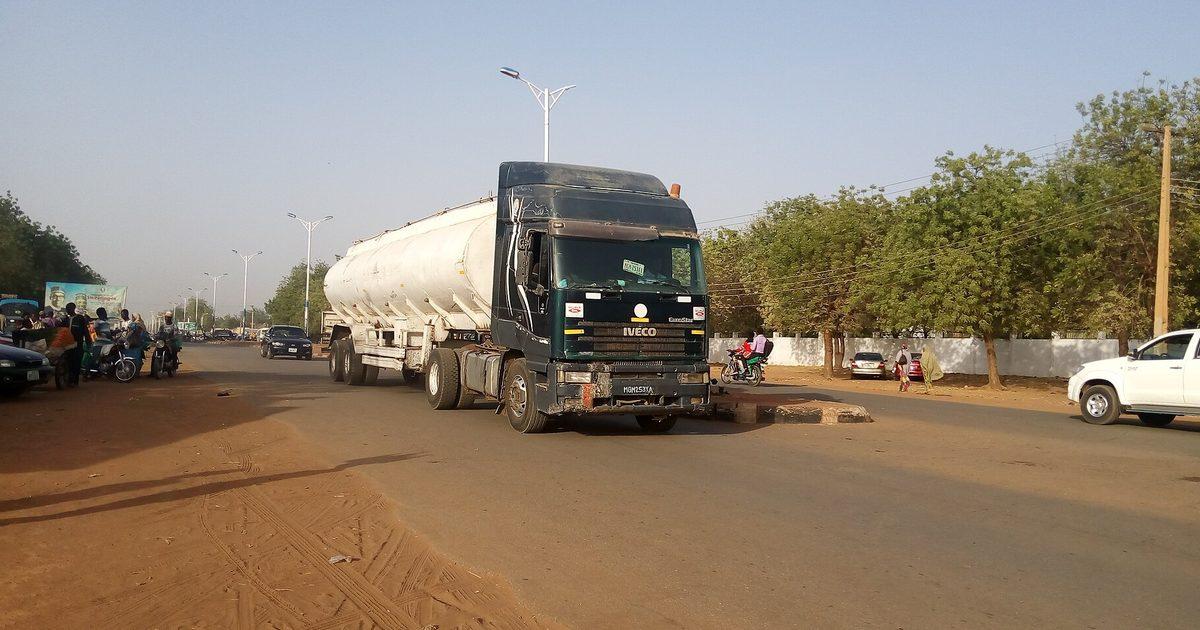
On international markets, a diesel cargo is bought and sold again while the ship is still at sea. The buyer does not order a product that does not exist yet: they buy a known quantity, already loaded, already moving, and they change where it goes.
Nothing like that exists on West African roads. To get a delivery, a buyer orders from a distributor, who waits for a slot at the depot, looks for a truck, has it loaded, then sends it. Meanwhile the station's tank runs dry, the mine's generators run on reserve, and the project waits.
We are building the road equivalent of the cargo sold at sea: a fleet of fuel tankers already loaded, leaving five ports, which the buyer pays for instantly on our secured platform and takes control of, to redirect the load to their own site.
Take action
- Reserve a loaded fuel tanker: message us on WhatsApp.
- See our fuel offer: products, delivery, pricing and payment.
The time lost between the depot and the tank
Fuel is rarely missing from the depots. It goes missing in the chain that links them to stations and sites.
In Benin, in November 2026, the director general of the state depots (Dépôts pétroliers du Bénin) explained the long queues at filling stations while stating that depot stocks were not exhausted. Between the depot and the station sits a logistics chain that starts with the distributor's order, and a station sized for a few delivery trucks must enlarge its fleet when its sales multiply. At the same time, a litre was selling at 1,000 to 1,200 CFA francs on the parallel market in some areas, against 750 at the pump.
In Guinea, during the shortages of March 2026, a litre sold for 20,000 Guinean francs and more on the black market in Conakry, against an official price of 12,000.
Each time the pattern is the same: the product exists, but not where it is needed, when it is needed. A truck that is already loaded and already moving removes the wait between order and delivery.
The project: selling fuel tankers the way cargoes are sold
Here is how the service we are setting up will work.
Trucks loaded in advance. Tankers are loaded at licensed port depots, with product meeting the ECOWAS 50 ppm sulphur standard and its certificate of analysis.
Sealed and tracked. Every compartment is sealed at loading, and the seal numbers are written on the delivery note. Every truck is tracked by GPS.
Listed one by one. On the GraceRoad platform, each truck is a lot: the product, the quantity in litres at 15 °C, the loading depot, the truck's position, and the delivered price to your address.
Paid instantly. You choose a truck and pay for it instantly on the secured platform. As soon as payment is confirmed, the truck is yours.
Redirected by the buyer. You take control of the truck: you become the owner of the load and you redirect it to your tank, your filling station, your depot or your site. You follow it until delivery.
Delivered and checked. On arrival: intact seals, dipping, a sample, a signed delivery note.
Rolling stock does not mean trucks driving in circles. A loaded truck waits in a secured park close to where fuel is consumed, or travels towards the area where it will be delivered.
Five loading ports
Dakar
SENSTOCK, Senegal's leading hydrocarbon storage operator, holds more than 284,000 cubic metres in three interconnected depots around Dakar. The port reports 290,000 cubic metres of hydrocarbon storage within its precinct, all operators combined. In Senegal, a station pays its distributor 740.5 CFA francs a litre of diesel under the official price structure of 7 November 2026.
Conakry
Since the explosion at the Kaloum depot in Conakry in December 2023, every supply tension has triggered rushes on filling stations. The state holds the litre at 12,000 Guinean francs, an effort the Minister of Economy and Finance put at 5,489.7 billion Guinean francs, lost revenue and provision included, in the revised 2026 budget. Stock that is already loaded is exactly what is missing when the queue forms.
Abidjan
At the Abidjan-Vridi terminal, GESTOCI operates 324,000 cubic metres. In July 2026, Côte d'Ivoire's Minister of Mines, Petroleum and Energy gave the pace: 650 trucks loaded a day at Abidjan and Yamoussoukro, with a target of 1,800 by 2030, and bottom loading meant to cut loading time from 45 to 15 minutes.
Lomé
COMPEL, the Lomé petroleum complex, offers about 244,000 cubic metres of capacity, a jetty for 250 metre vessels and truck loading bays. In September 2026, the West African Development Bank approved 37 billion CFA francs to add 170,000 cubic metres. In Togo, diesel has cost 766 CFA francs a litre at the pump since 11 September 2026.
Cotonou
Inside the port, Octogone Stockage de Produits Pétroliers operates a 54,000 tonne hydrocarbon depot. The state depots process orders from licensed operators, who then truck the product to their stations. The country has nearly 500 filling stations, against 215 in 2019, and demand is moving from the informal market to those stations.
What a truck holds
A 45,000 litre tanker is a semi-trailer, usually on three axles, split into five or six compartments. Full of diesel, it carries about 36.9 to 38 tonnes of product, plus the empty weight of the rig. Regulation no. 14/2005/CM/UEMOA caps the load at 11.5 tonnes per axle and the gross weight of the heaviest rigs at 51 tonnes: a truck only carries 45,000 litres of diesel if its empty weight allows it. We work through the numbers in our article on the 45,000 litre fuel tanker truck.
For you, that changes one thing: the quantity shown for each truck is the quantity actually loaded, in litres at 15 °C, not the tank's capacity.
Who it is for
- Independent filling stations, which lose customers as soon as the tank is empty.
- Mines and quarries, whose machines and generators never stop.
- Construction companies, whose projects move at the pace of their diesel.
- Industrial plants and power stations running on generators or boilers.
- Transport fleets that prefer their own tank to the pump.
- Distributors who need to top up a stock quickly.
What the law says
Fuel is not an ordinary commodity. Selling it requires a licence or an approval, depending on the country: we cover the rules in selling fuel in West Africa: who is allowed to?. Under this model, the sale and delivery go through our licensed partners where the law requires it.
On the buyer's side, you need somewhere to receive the product. In Senegal, law no. 98-31 requires any sale to a person without a storage tank to take place at a filling station, except for kerosene. A truck is therefore delivered into a compliant tank, a station or a depot.
The applicable duties and taxes, and the documents travelling with the truck, are stated before payment.
Where we stand
We are not starting from scratch. The GraceRoad platform already vets every partner carrier document by document, opens a file for every job, tracks the assigned trucks and takes payments that leave a record. Rolling fuel stock adds three things to that base: loading in advance, listing truck by truck, and transferring the truck to the buyer.
We are preparing the launch with a first batch of trucks from these five ports. The first buyers who tell us what they need, and where, will be served first.
Reserve your first trucks
Do you want to buy a fuel tanker that is already loaded, pay for it instantly and redirect its load to your station, your tank or your site? The project is under way: register now for the first trucks.
Filling station, mine, project, fleet or depot, on the coast or inland in Senegal, Guinea, Côte d'Ivoire, Togo or Benin: tell us the product, the volume per delivery, the frequency and the delivery site. We will let you know as soon as a truck matches your need.
Reserve a loaded fuel tanker on WhatsApp or see our fuel offer.
Are you a distributor, depot owner or petroleum haulier who wants to be part of this fleet? Write to us too.
Read next: buying the cargo and the truck in one click, buying diesel in bulk, from a tank truck to a full cargo and tank farms and tank terminals in West Africa, port by port.
Frequently asked questions
What is rolling fuel stock?
Stock that does not wait in a depot but in fuel tankers that are already loaded, sealed and tracked, ready to be sold and delivered. The buyer buys a truck, not an order still to be prepared.
Can I buy a single tanker of diesel?
Yes, that is the principle: each truck is one lot, sold to one buyer, delivered to one address.
How many litres does a diesel tanker truck hold?
The most common tank holds 45,000 litres. The quantity actually loaded depends on the rig's empty weight, since UEMOA regulation caps gross weight at 51 tonnes. Each truck is listed with its real quantity, in litres at 15 °C.
How can I be sure of quantity and quality?
Through the seals fitted at loading and written on the delivery note, the batch certificate of analysis, and checks on receipt: dipping, sampling, seal inspection. See our fuel delivery checklist.
Who can buy a loaded fuel tanker?
A filling station, a company or a distributor with a compliant tank to receive the product. The sale and delivery go through our licensed partners where the law requires it.
Which ports do the trucks leave from?
Dakar, Conakry, Abidjan, Lomé and Cotonou.
Sources: La Nouvelle Tribune, 19 November 2026 (statements by the director general of the Bénin state depots, number of stations); Bénin Web TV, 15 November 2026, and La Nouvelle Tribune, 19 November 2026 (parallel market prices in Benin); Investigatorguinee, 3 March 2026 (black market price in Conakry); Mosaiqueguinee, 8 November 2026 (Guinea's revised budget); SENSTOCK and Port autonome de Dakar (storage capacity); Energy Sector Regulatory Commission of Senegal, price structure from 7 November 2026; GESTOCI and Côte d'Ivoire Ministry of Mines, Petroleum and Energy, July 2026 (Vridi capacity, trucks loaded per day); COMPEL and West African Development Bank, September 2026 (capacity and expansion); KOACI, 11 September 2026 (pump prices in Togo); Octogone Stockage de Produits Pétroliers (Cotonou depot); regulation no. 14/2005/CM/UEMOA (axle load and gross weight); law no. 98-31 of 14 April 1998 (Senegal), article 14; ECOWAS harmonised fuel specifications (50 ppm sulphur). Depot capacities are detailed, with their sources, in our guide to West African tank terminals.