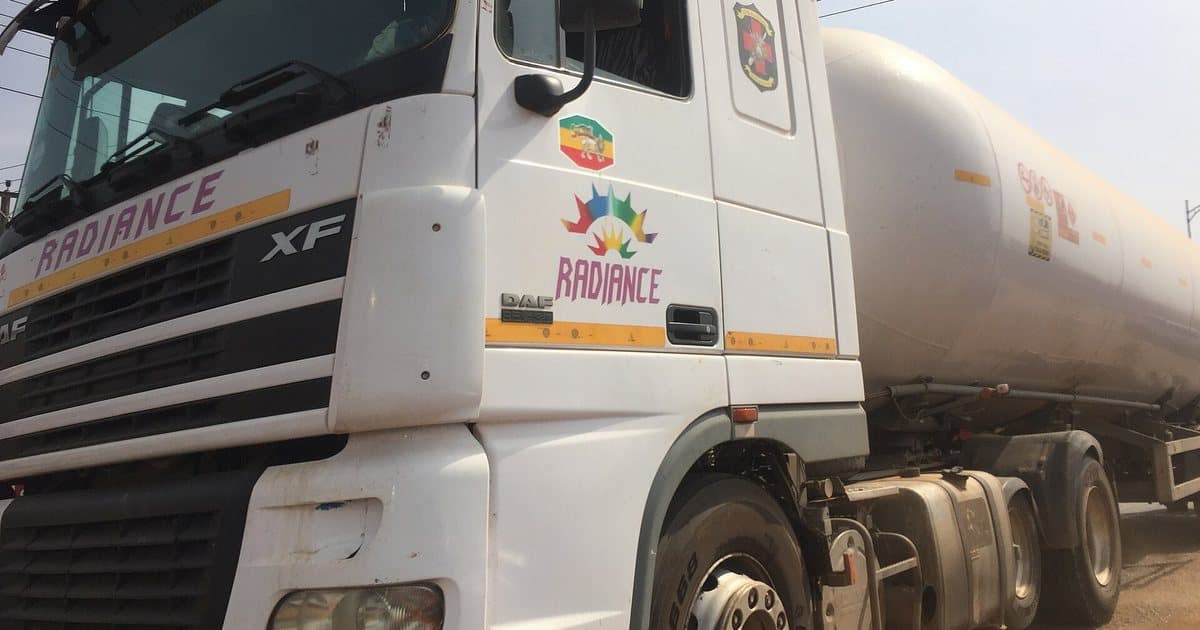
Between the refinery and your tank, fuel almost always goes through a depot. That is where it waits, where it is checked, and where road tankers load. A country short of depots, or whose depots sit far from the people who burn the fuel, lives at the pace of ships and convoys. Mali has learnt that the hard way since September 2025.
Here is who stores fuel in the main countries of the region, with what capacity, and what it means for a buyer.
Senegal: SENSTOCK
SENSTOCK, the Senegalese storage company, was formed in 2008 by merging storage activities and has been fully operational since 2010. It is the country's leading hydrocarbon storage operator, with more than 284 million litres of capacity, or 284,000 cubic metres, in three interconnected depots around Dakar:
- Mbao, the largest, fed by the neighbouring SAR refinery;
- the white products depot, which mainly receives imports and inter depot transfers;
- the black products depot at the port of Dakar, which receives tankers.
According to the company, its shareholders are Touba Oil (36.9 percent), TotalEnergies (28.7 percent), Puma Energy (18 percent) and SAR (16.4 percent). It works with licensed importers, distributors and hauliers.
Côte d'Ivoire: GESTOCI
GESTOCI, the Ivorian petroleum stock management company, was created by decree on 14 September 1983 to prevent supply disruptions. It operates:
- the Abidjan-Vridi petroleum terminal, 324,000 cubic metres;
- the Yamoussoukro depot, raised to 100,700 cubic metres in July 2026 when a new 20,000 cubic metre diesel tank came on stream. It serves the centre, north and west of the country, and neighbouring Mali and Burkina Faso;
- the Bouaké depot, 48,000 cubic metres, out of service since the 2002 crisis.
In July 2026 the Ivorian minister for mines, petroleum and energy gave the loading figures: 650 trucks a day at Abidjan and Yamoussoukro, with a target of 1,800 trucks a day by 2030. Bottom loading is meant to cut loading time from 45 to 15 minutes.
Ghana: BOST
In Ghana the state owned Bulk Oil Storage and Transportation company, BOST, operates six depots totalling 415,000 cubic metres, according to figures presented in April 2025: Accra Plains (215,000), Kumasi (87,000), Buipe (50,000), Bolga (46,500), Mami Water (17,000) and Akosombo (12,000). It also runs pipelines, including a multi product line from the Tema mooring point to Accra Plains. BOST has renewed a partnership with Burkina Faso's SONABHY to supply Burkina through its northern depots.
Burkina Faso: SONABHY
In Burkina Faso the national hydrocarbons company, SONABHY, holds the monopoly on importing and storing liquid fuels. On 24 January 2025 it inaugurated a 104,000 cubic metre depot at Péni, near Bobo-Dioulasso: five 20,000 cubic metre tanks and four of 1,000. It relieves the Bobo-Dioulasso depot and also serves neighbouring countries of the Alliance of Sahel States. We cover SONABHY and its equivalents in a dedicated article.
Mali: a 45 day security stock
Mali has neither a refinery nor access to the sea. After months of shortages, the authorities created a national security stock of petroleum products by ordinance on 10 April 2026, with the rules set by decree the same day:
- it covers unleaded petrol, jet fuel, diesel and butane;
- it equals 45 days of national consumption for each product;
- it is built by the state through the Malian Petroleum Products Office, in depots close to high consumption areas and far from supply sources;
- private operators may hold part of it, never more than half;
- it is funded by two parafiscal levies and can only be drawn on by decision of a strategic committee.
Guinea: leaving Kaloum
In Conakry, the explosion at the Kaloum depot in December 2023 left a mark: every supply scare now triggers a rush to filling stations. As early as 2023, the national petroleum company, SONAP, made rebuilding the depots a priority, with large new tanks planned at Moribaya, near Forécariah, about a hundred kilometres from the capital, and at Mandiana, in the Kankan region.
Our reading
The region is not investing enough where security is decided: inland. The big depots sit on the coast, because that is where ships arrive. But Mali, Burkina Faso and Niger consume fuel 1,000 kilometres away, at the end of roads that can be cut.
Mali's 2026 decree is a sound decision, provided the tanks exist. The Péni depot and the Yamoussoukro expansion point the right way: they bring stock closer to consumers. For a mine or a power plant the lesson is the same at a smaller scale: a few weeks of consumption in a tank on site is worth more than any supplier's promise.
Frequently asked questions
What is GESTOCI?
The Ivorian petroleum stock management company, created in 1983. It operates the Abidjan-Vridi terminal (324,000 cubic metres) and the Yamoussoukro depot (100,700 cubic metres since July 2026), which also supplies Mali and Burkina Faso.
What is SENSTOCK?
Senegal's leading hydrocarbon storage operator, with more than 284 million litres of capacity in three depots around Dakar.
What is a strategic fuel reserve?
A stock a state holds to ride out a supply disruption. In Mali, the April 2026 decree sets it at 45 days of consumption for each product.
How much storage does BOST have in Ghana?
415,000 cubic metres across six depots, according to April 2025 figures, including 215,000 at Accra Plains.
What we do
GraceRoad buys fuel from partners with their own depots in Côte d'Ivoire, Benin, Togo and Senegal and delivers it by road tanker to your site. For remote sites, we help you size a buffer stock and plan regular deliveries, with a fallback origin if a corridor closes.
Read next: West African refineries in 2026 and fuel shortages in West Africa: causes and solutions.
Sources: SENSTOCK, "About" page (history, capacity, depots, shareholders); Wikipedia, GESTOCI (creation, Abidjan-Vridi and Bouaké capacities); Agence ivoirienne de presse, 24 July 2026 (Yamoussoukro depot, loading capacity, 2030 target); Energy Chamber, 14 April 2025 (BOST depots and capacities, SONABHY partnership); Burkina 24, 24 January 2025 (Péni depot); Official Journal of Mali, 2026, no. 7 (ordinance 2026-014 and decree 2026-0184 of 10 April 2026 on the national security stock); Investigator Guinée, 3 March 2026 (Kaloum depot); Guinéenews, August 2023 (Moribaya and Mandiana projects).