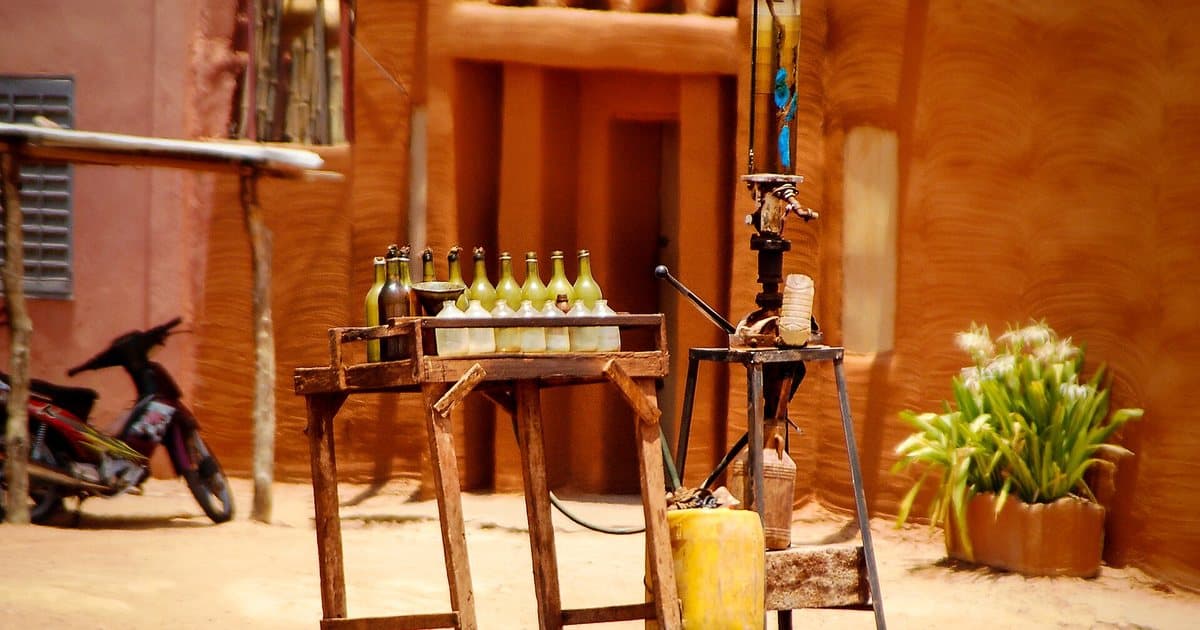
In March 2026, queues outside filling stations in Bamako stretched two to three kilometres. At the same time in Conakry, a litre of petrol resold on the black market for more than 20,000 Guinean francs, close to double the official price. A month earlier, some stations in Nouakchott had run dry just as the government had cut prices.
Three countries, three different causes, one result. Here is why fuel runs short in West Africa, what it costs, and what really protects against it.
The causes
1. The road is cut
Mali has neither a refinery nor access to the sea: all its fuel arrives by road tanker from Dakar, Abidjan, Lomé or Conakry. In early September 2025 the jihadist group JNIM, linked to Al-Qaeda, declared a ban on fuel imports into Mali. Since then, convoys have been attacked on the roads from Senegal and Côte d'Ivoire. According to the Institute for Security Studies, more than 300 road tankers had been destroyed by June 2026. Convoys now travel under military escort, whose cost rose from 600,000 to 800,000 CFA francs per convoy.
2. A distant shock
On 28 February 2026 the strikes on Iran and the blockade of the Strait of Hormuz sent Brent to 126 dollars a barrel in March. For countries that import all their refined fuel, a price shock quickly becomes a supply shock: cargoes get dearer and scarcer, and importers hesitate.
3. Fear
In Conakry in March 2026, the national petroleum company said stocks and cargoes on the way covered the country's needs. Queues formed anyway. The memory of the Kaloum depot explosion in December 2023 is enough to trigger precautionary buying at every rumour. A shortage can be born without any lack of product: it only takes everyone filling jerrycans on the same day.
4. Administered prices
When the state sets a selling price below cost, as in Senegal, where the government put the real cost of diesel at 1,044 CFA francs against 755 at the pump in August 2026, someone has to pay the gap. If subsidies are late, importers slow down. And a product sold cheaper than next door crosses the border.
5. Speculation
In Bamako in March 2026 the industry minister accused operators of speculating and hoarding, and capped sales at 600 litres per truck for 72 hours. In every shortage, part of the product disappears into private stocks, waiting for prices to rise.
The consequences
The power goes off. In Mali, part of the power fleet runs on diesel. In March 2026 some districts of Bamako went more than 24 hours without electricity, others received only 3 to 7 hours a day. Water followed, because some pumping stations depend on the grid.
Schools close. From 27 October to 9 November 2025 the Malian government suspended classes in all schools and universities because staff could no longer travel.
Prices soar outside the cities. The official diesel price in Bamako is 940 CFA francs a litre; in central and northern Mali it sells for 1,250 to 2,500 CFA francs.
Everything else follows. Transport costs more, so food does too. In March a motorcycle taxi driver in Conakry summed it up: at that price, you only work to pay for fuel.
Quality drops. The black market issues no certificate of analysis. Diluted or badly stored diesel damages engines, and that cost only shows up later.
The solutions
For governments
A real security stock. In April 2026 Mali created a national security stock of 45 days of consumption for petrol, diesel, jet fuel and butane. It is the right measure, provided the tanks are built and filled.
Inland depots. The 104,000 cubic metre Péni depot near Bobo-Dioulasso and the expansion of the Yamoussoukro depot to 100,700 cubic metres in 2026 bring stock closer to consumers.
Several corridors. A landlocked country served by a single port depends on a single road. Dakar, Abidjan, Lomé, Cotonou and Conakry must all be able to deliver.
Clear communication. Announcing real stock levels and cargo arrival dates defuses panic better than any cap.
For companies and remote sites
A buffer stock on site. A few weeks of consumption in a tank absorbs a delayed convoy or a cut road. For a mine or a power plant, it is the cheapest insurance there is.
A contract rather than spot buying. An announced monthly volume, a known price formula, a delivery schedule: the supplier reserves the product, and you are served before spot buyers.
A fallback origin. A contract that names two loading ports keeps delivering when one corridor closes.
Quality control. In a shortage more than ever, demand a certificate of analysis for every batch and have large volumes tested.
Our reading
West Africa's fuel shortages are not accidents. They are symptoms of supply chains that are too long, too concentrated and too thinly stocked. The region now refines enough fuel, thanks largely to Dangote; what it lacks are inland tanks, safe roads and contracts that bind.
The day a site in the Sahel always has six weeks of diesel in hand, a cut road becomes a logistics problem, no longer a crisis.
Frequently asked questions
Why is there a fuel shortage in Mali?
Because JNIM declared a blockade on fuel imports in September 2025 and attacks road tanker convoys coming from Senegal and Côte d'Ivoire. Mali has no refinery and no access to the sea.
What are the consequences of a fuel shortage?
Power cuts where plants run on diesel, water cuts, higher transport and food prices, a black market and fuel of doubtful quality. In Mali, schools even closed for two weeks in late 2025.
How can a company protect itself from fuel shortages?
With a buffer stock of several weeks on site, a supply contract with a schedule and a price formula, and a fallback origin. For a government: a security stock, inland depots and several corridors.
What is a strategic fuel reserve?
A reserve the state only touches in a crisis. In Mali, the April 2026 decree sets it at 45 days of consumption for each product.
What we do
GraceRoad delivers certified diesel and petrol to site from Côte d'Ivoire, Benin, Togo and Senegal, with GPS tracked trucks and fallback routes. We help remote sites size their buffer stock and plan deliveries ahead. Tell us your monthly consumption and delivery point.
Read next: shipping to Mali under blockade and fuel storage in West Africa.
Sources: allAfrica, 13 March 2026 (diesel shortage in Bamako, power and water cuts, 600 litre cap); Africanews, 27 October 2025 (school and university closures, JNIM blockade); allAfrica, 15 September 2025 (attacks on tanker convoys in the Kayes region); Institute for Security Studies, 4 June 2026 (tankers destroyed since September 2025); Mondafrique, April 2026 (escort costs, prices outside Bamako); Investigator Guinée and allAfrica, 3 March 2026 (Conakry shortage and black market, SONAP statement, Kaloum depot); Le360 Afrique, 4 February 2026 (dry stations in Nouakchott); Togo First, 27 May 2026 (Brent after 28 February); Government of Senegal, reported by Sénégal Direct (real cost of diesel); Official Journal of Mali, 2026, no. 7 (national security stock); Burkina 24, 24 January 2025, and Agence ivoirienne de presse, 24 July 2026 (Péni and Yamoussoukro depots).