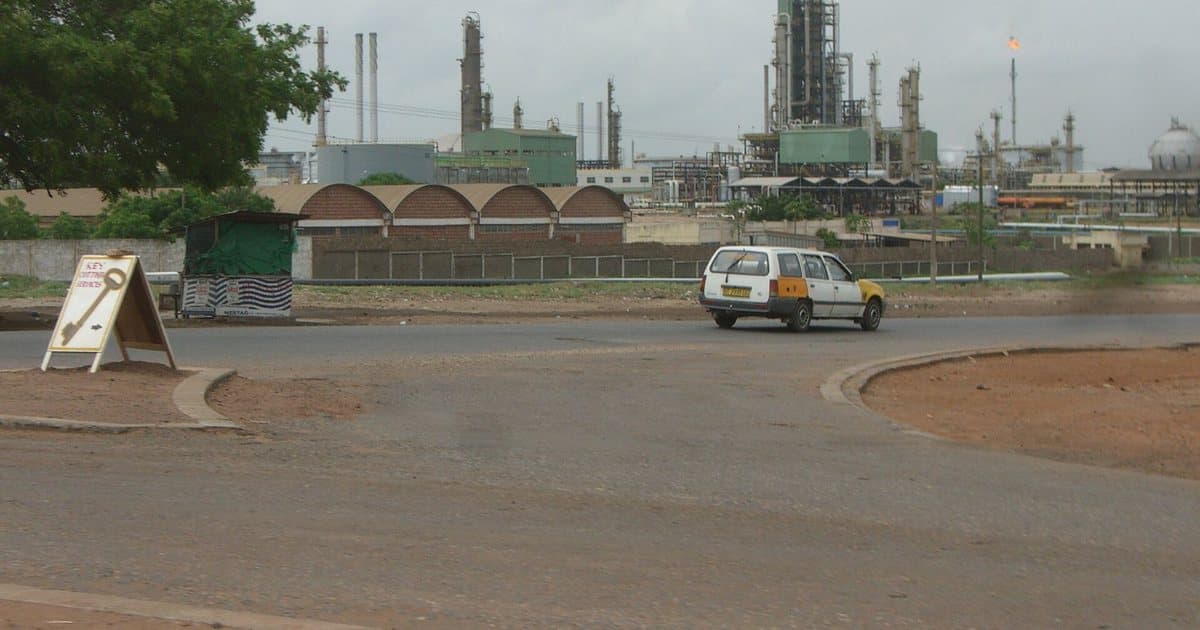
West Africa has produced crude oil for decades and has long imported almost all of its fuel. In 2026 the map is changing: a giant refinery runs at full rate in Nigeria, Ghana has restarted its own, Senegal is preparing a second unit. Yet half the countries of the region still have no refinery at all.
Here is the real status of each refinery, its capacity, and what it changes for anyone buying fuel in the region.
The table
Capacities are given in the unit each refinery publishes. For comparison, one million tonnes a year is roughly 20,000 barrels a day.
| Refinery | Country | Capacity | Status in 2026 |
|---|---|---|---|
| Dangote, Lekki | Nigeria | 650,000 barrels a day | At full capacity since February 2026 |
| Port Harcourt (NNPC) | Nigeria | 210,000 barrels a day (nameplate) | Shut |
| Warri (NNPC) | Nigeria | 125,000 barrels a day (nameplate) | Shut |
| Kaduna (NNPC) | Nigeria | 110,000 barrels a day (nameplate) | Shut |
| SIR, Abidjan | Côte d'Ivoire | 3.8 million tonnes a year | Running, 3.2 million tonnes produced in 2025 |
| Sentuo | Ghana | 40,000 barrels a day | Running, expansion towards 100,000 barrels a day |
| TOR, Tema | Ghana | 45,000 barrels a day (nameplate) | Restarted in 2026 after eight years |
| SAR, Mbao | Senegal | about 1.5 million tonnes a year | Running, second unit in preparation |
| SORAZ, Zinder | Niger | 20,000 barrels a day | Running since 2011 |
Mali, Burkina Faso, Guinea, Togo, Benin, the Gambia, Guinea-Bissau, Sierra Leone and Liberia have no operating refinery. All their fuel arrives already refined, by sea or by road.
Dangote, the giant redrawing the map
The Dangote refinery near Lagos reached 650,000 barrels a day in February 2026. On its own it refines more than all the other operating refineries in the region combined. It produces Euro 5 petrol and diesel and began exporting to Côte d'Ivoire, Ghana, Togo and Cameroon in March 2026. It has announced plans to double capacity to 1.4 million barrels a day and opened its shares to the Nigerian public on 14 September 2026.
We have written a full article on the question buyers ask most: who can buy its diesel, and how.
Nigeria's state refineries, shut
Port Harcourt, Warri and Kaduna consumed billions of dollars in successive rehabilitations without ever running reliably. In February 2026 NNPC's chief executive, Bashir Ojulari, justified shutting them down by "monumental losses", utilisation stuck around 50 to 55 percent, and mid grade products that were not worth the crude put into them. On 30 April 2026 NNPC signed a memorandum with China's Sanjiang Chemical to study a restart of Warri and Port Harcourt. By September no decision had been taken.
SIR, Abidjan
Société Ivoirienne de Raffinage has a capacity of 3.8 million tonnes of crude a year, about 76,000 barrels a day. In 2025 it produced only 3.2 million tonnes, down 15.8 percent, because of technical constraints: part of the plant was stopped for statutory maintenance.
Its big project is quality. To produce diesel at 50 ppm sulphur, the ECOWAS standard, SIR is building a hydrodesulphurisation unit at Vridi, whose foundation stone was laid on 2 October 2025. The project costs 545 billion CFA francs, of which 254 billion were lent in June 2026 by eight Ivorian banks under the lead of the West African Development Bank (BOAD). Target start up: 2030. Management has said the cleaner diesel will be sold at the same price.
SAR, Dakar
Société Africaine de Raffinage at Mbao processes about 180 tonnes of crude an hour, roughly 1.5 million tonnes a year. In February 2025 it refined Senegalese crude for the first time, from the Sangomar field.
It does not cover the country's needs, and Senegal remains a large importer. Hence the plan for a second refinery of 4 million tonnes a year, able to run Sangomar crude and others. On 23 September 2026 SAR signed a protocol with Turkish company Yamata to complete detailed engineering, the last step before construction. Announced cost: 2 to 3 billion dollars for the new unit and 300 to 500 million to modernise Mbao. The aim is to cover the national market and export surpluses to the region.
Ghana: Tema restarted, Sentuo expanding
Tema Oil Refinery, with a nameplate capacity of 45,000 barrels a day, had not processed crude since 2018. President Mahama announced its restart in February 2026; it received one million barrels of crude on 27 May and resumed refining on 3 June.
Next to it, the private Sentuo refinery, built by the Chinese group of the same name and inaugurated in January 2024, runs at 40,000 barrels a day. On 25 June 2026 the energy minister launched the phase meant to take it to 100,000 barrels a day.
Niger: Zinder, and a project at Dosso
SORAZ at Zinder has refined 20,000 barrels a day of Agadem crude since November 2011. It is 60 percent owned by China's CNPC and 40 percent by the state of Niger. The country consumes only part of the output and exports the rest to its neighbours, which partly explains why Niger has the cheapest diesel in the region.
On 15 August 2026 Niger signed an agreement with the Zimar group for a 100,000 barrel a day refinery at Dosso, worth 1.9 billion dollars, on a build, operate and transfer basis. Financing was due to be raised in the following months.
Our reading
Three things change for a fuel buyer in West Africa.
Quality is rising. Between Dangote's Euro 5 products and SIR's desulphurisation unit, off spec diesel will have fewer and fewer excuses. Ask for the certificate of analysis.
Supply is getting closer. A cargo from Lagos takes a few days to reach Lomé or Abidjan, against two weeks or more from Europe and longer from Asia. That means less freight and less exposure to distant crises, such as the Strait of Hormuz in 2026.
The bottleneck is moving. The region no longer lacks refining capacity: it lacks inland depots, road tankers and safe roads. For a site in Mali or Burkina Faso, the nearest depot matters more than the nearest refinery. We explain why in our article on fuel storage in West Africa.
Frequently asked questions
What is the capacity of the Dangote refinery?
650,000 barrels of crude a day, reached in February 2026. The company plans to take it to 1.4 million barrels a day.
Is Tema Oil Refinery working?
Yes. Crude processing resumed in 2026 for the first time since 2018, and after receiving one million barrels of crude the refinery restarted refining on 3 June 2026. Its nameplate capacity is 45,000 barrels a day.
Are Nigeria's Port Harcourt and Warri refineries working?
No. NNPC shut them down because they were losing money, and in September 2026 it was still evaluating partners, including China's Sanjiang Chemical, to restart them.
Which West African countries have no refinery?
Mali, Burkina Faso, Guinea, Togo, Benin, the Gambia, Guinea-Bissau, Sierra Leone and Liberia have no operating refinery.
What we do
GraceRoad buys certified fuel, whatever the refinery of origin, from partners with depots in Côte d'Ivoire, Benin, Togo and Senegal, and from international traders for full cargoes. We deliver it to your site with a certificate of analysis for every batch.
Read next: diesel prices in West Africa, country by country and Dangote refinery sales: who can buy.
Sources: Africanews and allAfrica, 23 March 2026, and Daba Finance (Dangote capacity, exports, IPO, expansion plan); Freedom Online, 5 February 2026 (Bashir Ojulari on the NNPC refinery shutdown); Brand Communicator, 21 September 2026 (Sanjiang Chemical memorandum); The Will (nameplate capacities of Port Harcourt, Warri and Kaduna); Sika Finance, 11 June 2026, and Ivorian press (SIR capacity, 2025 output, hydrodesulphurisation unit and financing); Seneweb (SAR hourly throughput); allAfrica, February 2025 (first Sangomar crude) and 23 September 2026 (SAR and Yamata protocol, costs); Citi Newsroom, 27 February 2026, and MyJoyOnline, 8 June 2026 (Tema Oil Refinery restart); Africa Oil and Gas Report, January 2026 (TOR nameplate capacity); Citi Newsroom, 25 June 2026, and The Star (Sentuo); Niger Energy Sector Regulatory Authority (SORAZ); Africa Radio, August 2026 (Dosso agreement).