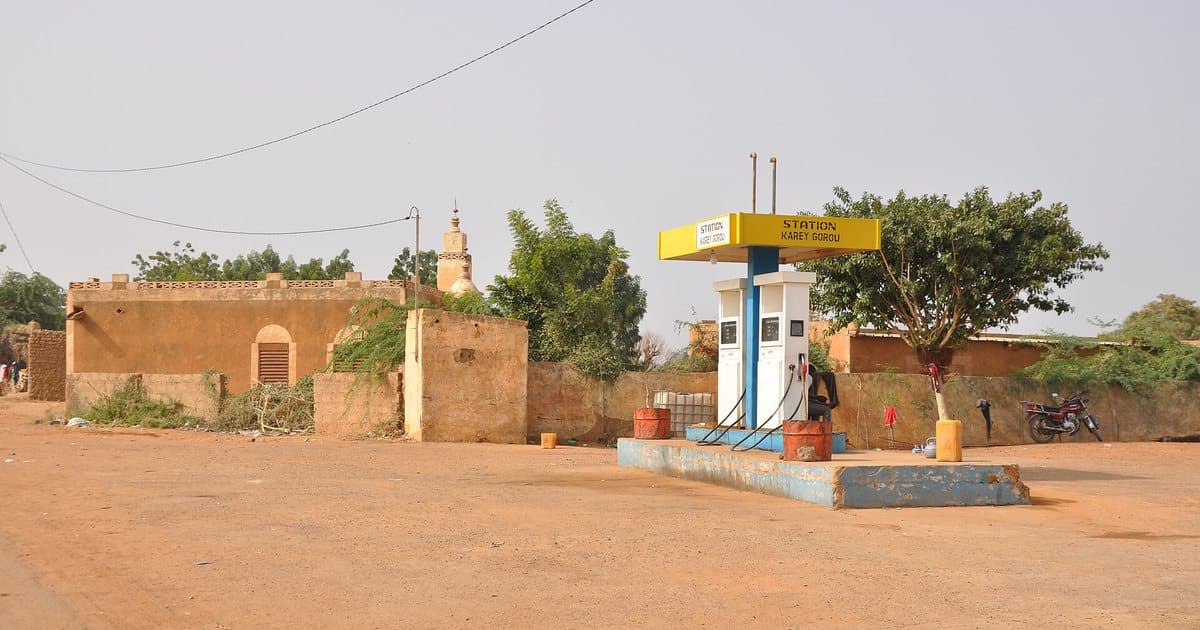
In every West African country a public institution controls the fuel tap. Sometimes it imports everything itself. Sometimes it only sets prices and lets private companies import. Sometimes the state simply regulates a free market. For a supplier or a large consumer, knowing who decides in which country saves months of wasted effort.
Here are the main ones, and what they actually do.
SONABHY, Burkina Faso: the monopoly
Burkina Faso's national hydrocarbons company is a state company with a share capital of 20 billion CFA francs. The law gives it the monopoly on importing and storing hydrocarbons throughout the country. Distributors are private: they buy from SONABHY and sell through their stations.
Its supply chain has five steps, as it describes them: international purchasing through competitive tenders, transport by private hauliers, transit storage in coastal depots, storage in inland depots, and delivery to distribution companies. It operates, among others, the 104,000 cubic metre Péni depot, opened in January 2025 near Bobo-Dioulasso, and also relies on Ghana's depots through a renewed partnership with BOST.
SONABHY also carries the cost of subsidies. In August 2026 the government said diesel would cost about 1,050 CFA francs a litre without public support, against 750 at the pump, and that subsidies on that product alone reached nearly 60 billion CFA francs in the first half of the year.
For a supplier: in Burkina Faso you do not sell fuel "to the market". You answer SONABHY's international tenders, or you work for those who win them, as a haulier or a transit depot.
SONIDEP, Niger: from imports to the whole chain
Created in 1977 as the Niger petroleum products company, SONIDEP was renamed the Niger petroleum company in 2020 with a mandate covering the whole oil chain. For decades it was limited to importing, storing and marketing products. In June 2024 it launched its first exploration and production operations.
Niger has a special feature: it refines its own crude at Zinder and exports the surplus. SONIDEP long held the exclusive right to those exports; according to Niger's energy regulator, the state has now allocated half of them to the SORAZ refinery itself.
SONAP, Guinea: prices and supply
Guinea's national petroleum company, SONAP, created in 2021, controls the price structure. The structure of 1 April 2026 kept the public price at 12,000 Guinean francs a litre but set different prices by use: 15,500 francs for the mining sector, 14,100 for the national power utility, 16,400 for exempt operations. It is a way of charging more to those who can afford it and targeting the subsidy.
SONAP is also the voice when supply tightens. On 3 March 2026, as queues grew in Conakry, it said stocks and cargoes on the way covered the country's needs and urged people not to panic.
OMAP, Mali: prices, and now the security stock
The Malian Petroleum Products Office (OMAP) was created by the law of 22 December 2022. It announces official prices, such as the increase of 28 March 2026 that took diesel to 940 CFA francs in Bamako. In Mali imports are carried out by licensed private companies; the Office supervises.
Since April 2026 it has an extra mission: building the national security stock, 45 days of consumption of petrol, diesel, jet fuel and butane, up to half of which it may delegate to private operators. We describe the scheme in our article on fuel storage.
Senegal and Côte d'Ivoire: administered prices, private operators
In Senegal, imports and distribution are handled by licensed private companies, and storage mainly by SENSTOCK. The energy sector regulator (CRSE) publishes the price structure, and ceiling prices are set by order of the ministers of energy and trade. Subsidies have become a major budget issue: in August 2026 the forecast for energy subsidies rose from 250 to 729 billion CFA francs.
In Côte d'Ivoire, the Ministry of Mines, Petroleum and Energy publishes maximum prices every month, SIR refines and GESTOCI stores.
Ghana and Nigeria: free markets, regulators
In Ghana, the National Petroleum Authority (NPA) regulates the sector and publishes price floors twice a month; marketers set their prices above them. State owned BOST runs depots and pipelines.
In Nigeria the downstream market is deregulated and supervised by the NMDPRA. NNPC, a state company turned commercial, has shut its three refineries, and its retail arm is one of the twelve marketers buying petrol from the Dangote refinery.
Our reading
West Africa has three models: the state monopoly (Burkina Faso), the state that sets prices and lets private companies import (Mali, Guinea, Senegal, Côte d'Ivoire), and the free market under a regulator (Ghana, Nigeria). None escapes the same constraint: when crude rises, someone pays the difference, either the state through subsidies or the consumer at the pump.
For a foreign supplier, the most common mistake is to canvass distributors in a country where only the national company imports. For a large consumer, it is to assume the official price is the one it will pay: in Guinea, a mine pays almost 30 percent more than a motorist.
Frequently asked questions
What is SONABHY?
Burkina Faso's national hydrocarbons company, a state company with 20 billion CFA francs of share capital, which holds the monopoly on importing and storing hydrocarbons in the country.
How do you sell fuel to SONABHY?
By answering its international tenders: SONABHY buys its products through competitive bidding and then contracts private operators for transport.
Who sets fuel prices in Mali?
The Malian Petroleum Products Office, created by the law of 22 December 2022. Since 28 March 2026 diesel costs 940 CFA francs and petrol 875 CFA francs in Bamako.
What is SONAP in Guinea?
Guinea's national petroleum company, created in 2021. It sets the price structure for petroleum products and oversees the country's supply.
What we do
GraceRoad buys and delivers certified fuel through Côte d'Ivoire, Benin, Togo and Senegal, and hauls for those who supply the inland countries. Our tender watch follows consultations by the region's national companies. If you are a supplier or a large consumer, tell us which country you are looking at: we will tell you who decides and how to get in.
Read next: fuel storage in West Africa and diesel prices in West Africa, country by country.
Sources: SONABHY, official website (status, capital, monopoly, supply chain); LSI Africa, 10 August 2026 (real cost of diesel and subsidies in Burkina Faso); Burkina 24, 24 January 2025 (Péni depot); Energy Chamber, 14 April 2025 (BOST and SONABHY partnership); AFP via Connaissance des énergies, 23 June 2024 (SONIDEP upstream operations); Niger Energy Sector Regulatory Authority (SONIDEP and SORAZ exports); Soleil FM Guinée, April 2026 (SONAP price structure); allAfrica, 3 March 2026 (SONAP statement); Official Journal of Mali (law 2022-053 of 22 December 2022; ordinance 2026-014 and decree 2026-0184 of 10 April 2026); Bamada.net (prices of 28 March 2026); Vie publique Sénégal (price structure published by the energy regulator); Le Soleil, August 2026 (energy subsidy forecasts); KOACI, 31 August 2026 (maximum prices in Côte d'Ivoire); Citi Newsroom, September 2026 (NPA price floors); Nairametrics, 25 February 2026, and Freedom Online, 5 February 2026 (NNPC and Dangote).