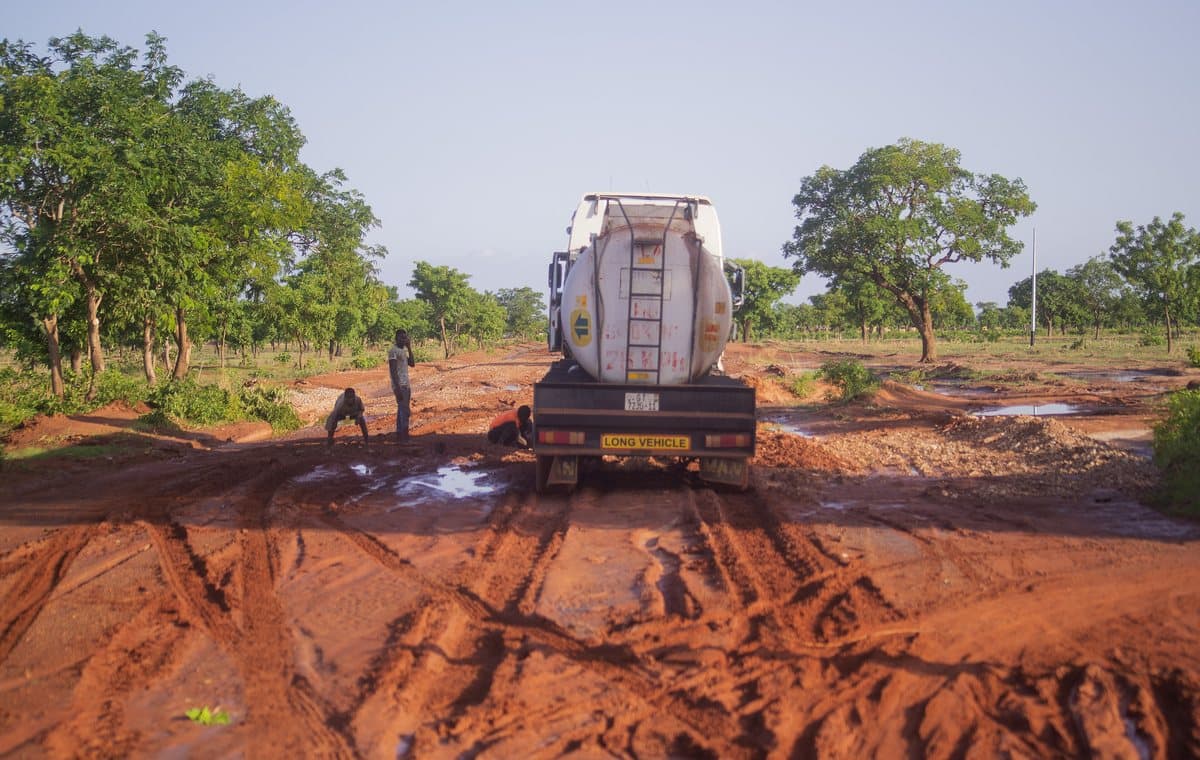
On 8 October 2026, a tanker discharged 8,000 tonnes of petrol at Owendo; the first 4,000 tonnes were expected to cover six days of Gabon's consumption. On 19 October, Sierra Leone's petroleum regulator reported 6.4 weeks of diesel in stock nationwide, and 2.9 weeks of petrol. In Mali, fuel has been arriving in army-escorted convoys for more than a year.
In these countries, the question is no longer just the price per litre. It is how many days a site can hold when the truck does not come. A mine, power plant or construction site that stops for lack of diesel loses in a single day far more than its stock would have cost.
Take action
- Size your stock and plan your deliveries: send your consumption and tank capacity on WhatsApp.
- See how we deliver fuel, from tanker truck to full cargo.
A national stock does not protect you
When a country runs short of fuel, what remains is shared, and businesses are rarely served first. On 2 October 2026 in Libreville, some stations capped sales at 5,000 CFA francs per customer, taxis, buses and trucks included, and businesses relying on generators were warned of slowdowns.
Governments learnt the lesson before many companies did. In Mali, after the blockade announced on 3 September 2025, eased in late October through convoys and reimposed in late April 2026, the authorities created by ordinance on 10 April 2026 a national security stock of 45 days of consumption for each product. In International Energy Agency countries the rule is stricter still: every importing member must hold at least 90 days of its net imports.
These stocks serve the country. They do not guarantee that your site will be supplied on the day the road closes.
The calculation
A site's minimum stock fits on one line:
minimum stock = daily consumption × (normal resupply lead time + safety days)
Daily consumption comes from your meters. For a power plant or generators, manufacturers' data sheets give between 0.25 and 0.31 litres of diesel per kWh produced, between 50% and 100% load. The full calculation is in our article on generator fuel consumption.
The normal lead time is the time between your order and delivery on an ordinary day: distance from the depot, loading queue, border, road conditions.
Safety days cover what is not ordinary. This is where the corridor decides everything.
| Site situation | Safety days we recommend |
|---|---|
| Near a coastal depot, safe road | 7 to 10 days |
| Inland, a single corridor or a border to cross | 20 to 30 days |
| Area where fuel moves in convoys, or under threat of blockade | 45 days, the threshold chosen by the Malian state |
| Country importing all its fuel by sea | at least the national autonomy, and more if cargoes are irregular |
This grid is ours: it should be discussed site by site.
A worked example
A 5 MW power plant runs on average at 70% of its capacity. It produces 3,500 kW for 24 hours, or 84,000 kWh a day. At 0.28 litres per kWh, it burns about 23,500 litres of diesel a day, one 45,000 litre tanker truck every two days.
If it is resupplied in 5 days and sits on an inland corridor, with 25 safety days, its minimum stock is 23,500 × 30 = 705,000 litres, about sixteen tanker loads.
At the import parity price of diesel in Senegal's price structure of 10 October 2026, 888 CFA francs a litre before taxes and margins, this stock ties up about 626 million CFA francs. That is the price of insurance. Compare it with the cost of a single day of shutdown on your site: you know that figure better than we do.
The reorder point: never wait for an empty gauge
A stock is useless if it is ordered too late. The reorder point is the tank level at which the order goes out:
reorder point = daily consumption × normal lead time + safety stock
In the example, 23,500 × 5 + 23,500 × 25: the order goes out as soon as the tanks fall below 705,000 litres. Your tanks must therefore hold this stock plus a full delivery. Read the level every day and send it to your supplier every week. A supplier who sees your levels delivers before the alarm, not after.
Keeping diesel usable
Oversized stock ages. According to ExxonMobil estimates reported by the trade press, diesel stays usable for six months to a year if kept cool and dry; according to BP, twelve months or more below about 21°C, but six to twelve months at higher temperatures. In the West African climate, plan a full turnover in under six months: first litre in, first litre out.
Water is the main enemy. Microorganisms grow at the boundary between water and diesel and form sludge that clogs filters and fouls injectors. Three rules:
- Drain tank bottoms regularly to remove settled water.
- Keep tanks full as far as possible: less air means less condensation.
- Check every delivery: certificate of analysis, density, appearance. A doubtful batch must never enter the stock. We cover the signs of adulterated diesel.
What comes next
The shortages of 2025 and 2026 are not isolated accidents. On 8 October 2026, Gabon's Council of Ministers cited both the disruption in the Strait of Hormuz and "structural weaknesses" in the national supply system. Congo's refinery had been shut since 8 September. Gabon's refining output fell 15.2% in the first quarter.
States are building reserves: 45 days in Mali, 170,000 more cubic metres financed in Lomé by the West African Development Bank in September 2026, a new 20,000 cubic metre tank at Yamoussoukro in July. The companies that come through the next crises will be those that do the same at their own scale: a properly sized stock, two possible origins, and a supplier who delivers before the gauge drops.
Frequently asked questions
How many days of diesel should a site hold?
It depends on the lead time and the corridor risk. Count 7 to 10 safety days near a coastal depot, 20 to 30 days inland, and up to 45 days where fuel moves in convoys, the threshold the Malian state chose for its national stock.
How do you calculate a fuel safety stock?
Multiply daily consumption by the sum of the normal resupply lead time and the safety days. For generators, count 0.25 to 0.31 litres per kWh produced.
How long can diesel be stored?
Six months to a year if cool and dry according to ExxonMobil, less at high temperatures according to BP. In West Africa, plan to turn the stock over in under six months.
What is a reorder point?
The tank level at which the order must go out: daily consumption multiplied by the normal lead time, plus the safety stock.
What we do
GraceRoad supplies diesel from our own depots or those of our partners in Dakar, Abidjan, Lomé or Cotonou, depending on availability, by tanker truck to your site, with a certificate of analysis for every batch. For remote sites and large volumes, we deliver by ship to your port, from 2,000 tonnes. We help you size your stock, set your reorder point and plan a fallback origin if a corridor closes.
Send your consumption on WhatsApp or see how we deliver fuel.
Read next: tank farms and fuel terminals in West Africa, port by port and Gabon fuel shortage 2026.
Sources: Gabon Media Time, October 2026 (8,000 tonnes of petrol, six days of autonomy); Sierra Leone National Petroleum Regulatory Authority, stock table for the week of 19 October 2026; African Press Agency, 10 October 2026 (tanker convoys to Bamako); Gabonreview, 2 October 2026 (sales capped at 5,000 CFA francs, businesses relying on generators); Institute for Security Studies, 4 June 2026 (Mali blockade); Official Journal of Mali, 2026, no. 7 (ordinance 2026-014 and decree 2026-0184 of 10 April 2026, 45-day national security stock); International Energy Agency, "Oil stocks of IEA countries" (90 days of net imports); generator manufacturers' data sheets, as compiled in our generator consumption article; Senegal Energy Sector Regulatory Commission, price structure of 10 October 2026 (diesel import parity price); Fleet Equipment Magazine, citing ExxonMobil and BP (diesel shelf life, water and microorganisms); final communiqué of Gabon's Council of Ministers, 8 October 2026; Les Dépêches de Brazzaville, 5 October 2026 (CORAF shutdown); Ecomatin, 4 August 2026 (Sogara refining); Ecofin Agency, 28 September 2026 (BOAD financing for COMPEL); Ivorian Press Agency, 24 July 2026 (Yamoussoukro depot).