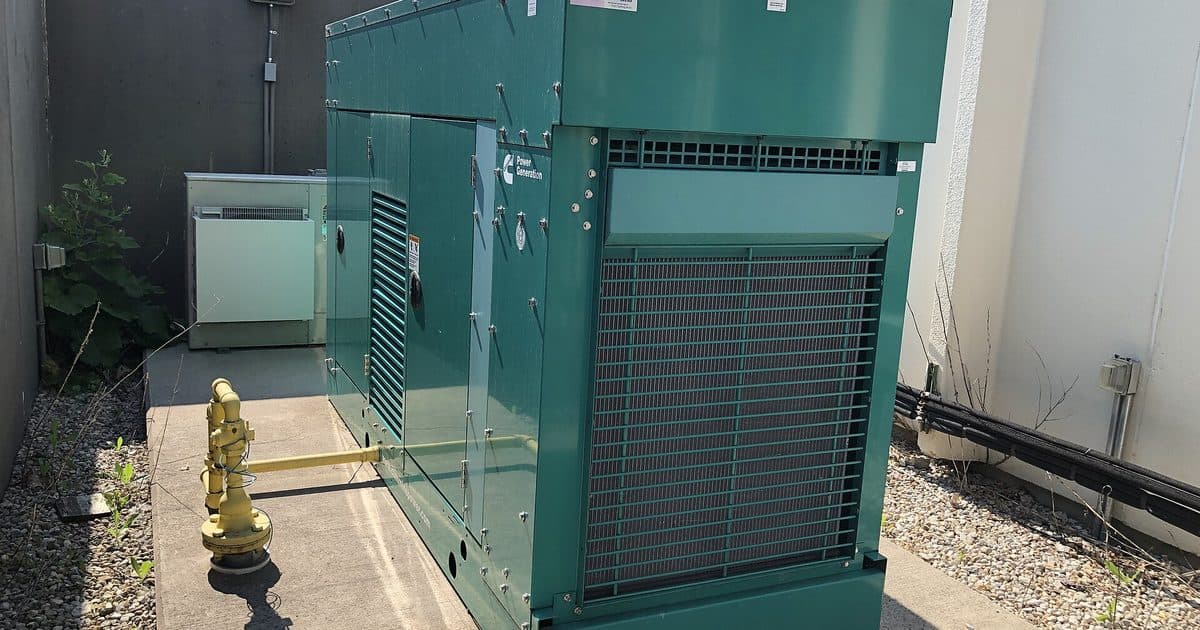
A 1,000 kVA generator running at 75% of its power burns 148 litres of diesel an hour, according to the manufacturer's data sheet. Over a full day, that is 3,554 litres. Over a month, more than 106,000 litres: two and a half 45,000 litre road tankers.
For a mine, a construction site, a hospital or a factory that makes its own electricity, diesel quickly becomes the largest cost. Here is how to calculate a generator's consumption from verifiable figures, and how to turn it into a supply requirement.
What the data sheets say
Manufacturers publish the consumption of each generator set at several load levels. Here are four examples, at 50 Hz and 1,500 rpm, from their data sheets.
| Generator set and engine | Prime power | 100% load | 75% | 50% |
|---|---|---|---|---|
| Kohler SDMO J250K, John Deere 6068HFS55 engine | 227 kVA, 182 kW | 47.1 L/h | 35.9 L/h | 24.4 L/h |
| Caterpillar, 3406C TA engine | 320 kVA, 256 kW | 73.0 L/h | 56.0 L/h | 39.6 L/h |
| Kohler SDMO KD1100-F | 1,000 kVA, 800 kW | 202.4 L/h | 148.1 L/h | 101.3 L/h |
| Kohler SDMO X2200C, MTU 16V4000G23E engine | 2,000 kVA, 1,600 kW | 458 L/h | 336 L/h | 227 L/h |
For the KD1100-F, the sheet also gives consumption at 25% load: 55 litres an hour.
The rule of thumb: litres per kWh
Divide consumption by the energy produced, and the four sets look very similar. Between 50% and 100% load, they burn 0.25 to 0.31 litres of diesel per kWh produced.
| Generator set | At 100% | At 75% | At 50% |
|---|---|---|---|
| J250K | 0.26 L/kWh | 0.26 L/kWh | 0.27 L/kWh |
| Caterpillar 320 kVA | 0.29 L/kWh | 0.29 L/kWh | 0.31 L/kWh |
| KD1100-F | 0.25 L/kWh | 0.25 L/kWh | 0.25 L/kWh |
| X2200C | 0.29 L/kWh | 0.28 L/kWh | 0.28 L/kWh |
Hence a simple method for a first estimate:
litres per hour = power actually drawn in kW × 0.25 to 0.31
What counts is the power your equipment actually draws, not the size of the generator. A 1,000 kVA set supplying 300 kW burns according to those 300 kW.
kVA, kW, prime, standby: the traps
kVA and kW. A generator's power is shown in kVA, but consumption depends on kW. Data sheets are based on a power factor of 0.8: 1,000 kVA means 800 kW.
Prime and standby power. Under ISO 8528-1, as used by manufacturers, prime power (PRP) is available for an unlimited number of hours a year with a variable load. Standby power (ESP) is for emergency supply only, with no overload allowed. For a site that generates its own electricity around the clock, prime power is the figure to use.
Heat. Ratings are given for 25°C intake air. Where it is 40°C, the manufacturer applies a derating: the set delivers less. This must be planned for when choosing the size.
From litres per hour to road tankers
Take the KD1100-F at 75% load, or 600 kW:
| Period | Consumption |
|---|---|
| One hour | 148 litres |
| One 24 hour day | 3,554 litres |
| One 30 day month | 106,632 litres |
| In 45,000 litre road tankers | 2.4 tankers a month |
At the Ivorian pump price of diesel, 725 CFA francs a litre since August 2026, a day costs about 2.6 million CFA francs. A site running continuously therefore needs regular supply, buffer storage for several days, and compliant diesel: contaminated or adulterated fuel damages injectors and drives consumption up.
Our view
Many sites estimate their diesel from the size of the generator at full power, and buy too much; others underestimate actual running hours and run dry. Manufacturers' figures allow a better approach: start from the power actually drawn, apply 0.25 to 0.31 litres per kWh, then check against the site's meters after a few weeks.
Once the requirement is known, it can be planned like any other supply: monthly volume, delivery frequency, storage capacity, controlled quality.
Frequently asked questions
How much diesel does a 100 kVA generator use?
At a prime rating of 80 kW, about 20 to 25 litres an hour at full load, using the 0.25 to 0.31 litres per kWh rule. The model's data sheet gives the exact figure.
How much diesel does a 500 kVA generator use?
For 400 kW at full load, about 100 to 124 litres an hour under the same rule. At 75% load, about 75 to 93 litres an hour.
How do you convert kVA to kW?
Multiply by 0.8, the power factor used by manufacturers: 500 kVA means 400 kW.
Does a generator use less fuel at low load?
It uses fewer litres per hour, but not necessarily fewer per kWh produced. The KD1100-F burns 55 litres an hour at 25% load, or 0.275 litres per kWh, against 0.253 at full load.
What is the difference between prime and standby power?
Prime power is available continuously, with no limit on hours. Standby power is only for outages, with no overload.
What we do
GraceRoad supplies diesel to mines, construction sites and industrial sites in West Africa, from our own depots or those of our partners in Dakar, Abidjan, Lomé or Cotonou, depending on availability. Tell us the power of your generators and their running hours: we calculate your monthly requirement and propose a delivery schedule.
Read next: fuel tanker truck: 45,000 litres and adulterated diesel: how to spot it.
Sources: Kohler SDMO, J250K, KD1100-F and X2200C data sheets; Caterpillar, data sheet for the 320 kVA prime generator set with 3406C TA engine, published by the UK Environment Agency; ISO 8528-1, power definitions as used by manufacturers; diesel price in Côte d'Ivoire since August 2026, see our article on diesel prices in West Africa.