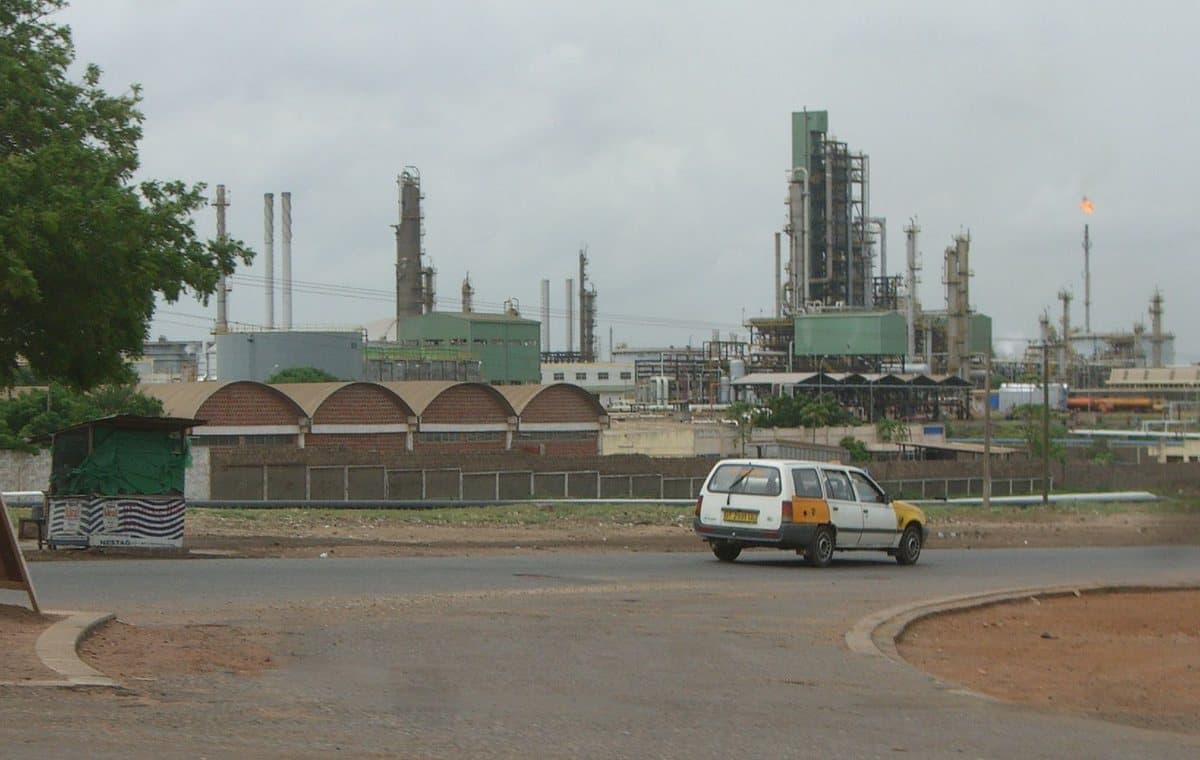
In 2024, Senelec's power plants burned 344,243 tonnes of heavy fuel oil, and the utility bought 397 billion CFA francs worth of it, according to its annual report. The same year in Mali, EDM could not buy enough fuel for its plants for lack of money, and its output fell back to 2015 levels.
Heavy fuel oil is the least visible fuel in West Africa. It may be the most strategic: when it runs out, there is no queue at the pump, the lights simply go off, and with them factories, hospitals and water pumps.
Take action
- Ask for a heavy fuel oil offer: grade, quantity, delivery point and date.
- Understand the "Platts plus premium" formula that sets a cargo price.
What heavy fuel oil is
Heavy fuel oil, or HFO, is what remains at the bottom of the distillation column once petrol, kerosene and diesel have been drawn off. It is thick, heavy, often high in sulphur, and much cheaper than diesel. The slow and medium-speed engines of thermal power plants, like those of ships, are designed to burn it.
It is graded by viscosity, under the international marine fuel standard ISO 8217:
- HFO 180: maximum viscosity of 180 mm²/s (centistokes) at 50°C;
- HFO 380: maximum viscosity of 380 mm²/s at 50°C, the most common grade in power plants.
The more viscous it is, the more it must be heated: to store it, to pump it, then to inject it. ExxonMobil recommends keeping it about 10°C above its pour point, and the engine maker's instructions set the injection temperature. Badly heated HFO does not flow, and a badly fed engine wears out.
For ships, sulphur content has been capped at 0.50% worldwide since 1 January 2020 by the International Maritime Organization. Power plants on land follow each country's own rules.
Who burns it in West Africa
In Senegal, Senelec's diesel units consumed 344,218 tonnes of heavy fuel oil in 2024; diesel accounted for only 1,128 tonnes across the whole grid. Independent producers come on top: the Tobène Power plant, 118 MW on HFO, generated 387 GWh in 2024; Kounoune Power, 68 MW, saw its contract end on 31 January 2024 after fifteen years, with a one-year extension.
In Mali, Albatros Energy's 90 MW HFO plant at Kayes produced nothing in 2024. Its contract, terminated in October 2024, was reinstated in April 2025, with the operator committing to secure a stable fuel supply.
In Liberia, the government is preparing a 100 MW HFO plant with private partners including MNG Mining, presented as the emergency answer to the power crisis. The energy minister put the cost of production at 33 cents per kWh, against 14 cents in 2022.
In Sierra Leone, the petroleum regulator reported 8.1 weeks of national marine fuel oil stock in the week of 19 October 2026, and the regulated fuel oil price was 32.24 new leones a litre from 24 September.
What heavy fuel oil costs
A cargo price is built like a diesel price: an international quotation, a premium, freight, then heated storage and transport to the plant.
The reference. On 23 October 2026, HFO 380 traded around 697 dollars a tonne in Rotterdam according to Ship & Bunker, and 884 dollars in Singapore according to Bunker Index. The gap between the two markets hit a record 95 dollars a tonne on 7 October, as product from the Middle East went missing.
In CFA francs. At the ECB rate of 21 October, 697 dollars a tonne is about 407 CFA francs per kilo in Rotterdam, before freight, storage, transport, taxes and margin. For comparison, the official price of fuel oil 180 in Côte d'Ivoire was set at 546 CFA francs per kilo for October 2026, against 508 in September.
The formula. A sound contract indexes the price to a published quotation, averaged over set days, plus a premium fixed at signature, and writes the loading port and grade into the contract. We explain the mechanism in Platts plus premium.
Supplying a power plant: what makes the difference
- Quality, checked on every batch. Viscosity, density, sulphur, water, sediment, flash point, ash: ISO 8217 sets the limits. An off-spec batch fouls engines and costs more in maintenance than it saved.
- Heat, end to end. Heated tanks at the port, insulated tankers on the road, reheating and purification on site before injection.
- Stock. A plant serving a grid cannot wait for the next ship. The days-of-autonomy calculation is the same as for diesel: we set it out in diesel buffer stock on site.
- Payment. The region's utilities often carry arrears, and EDM's case in 2024 shows that unpaid fuel is undelivered fuel. The payment method, documentary credit or guarantee, is settled before the first ship.
What comes next: gas, but not tomorrow morning
The region is preparing to move off heavy fuel oil. In Senegal, the 366 MW Cap des Biches plant is due to switch to gas; according to EmediaSN, Senelec's managing director confirmed on 21 September 2026 that it was still running on diesel. In Liberia, a 300 MW combined-cycle gas plant is planned at Buchanan for about 500 million dollars, but an HFO plant is due to come first.
So heavy fuel oil is not the fuel of the past: it is the fuel of the transition. For several more years it will run much of the region's grids, with tight prices and contested cargoes. Producers who secure their supply now, with an indexed price, a properly sized stock and two possible origins, will get through the transition without blackouts. The others will suffer it.
Frequently asked questions
What is HFO 380?
A heavy fuel oil whose viscosity does not exceed 380 mm²/s at 50°C, under ISO 8217. It is the most common grade in thermal power plants and on ships.
What is the difference between HFO 180 and HFO 380?
Viscosity: at most 180 mm²/s for the first, 380 for the second. 380 is thicker, cheaper and needs more heating.
What is the price of heavy fuel oil?
On 23 October 2026, about 697 dollars a tonne in Rotterdam and 884 dollars in Singapore for 380. Add the premium, freight, heated storage and transport. In Côte d'Ivoire, fuel oil 180 was set at 546 CFA francs per kilo in October 2026.
How is heavy fuel oil delivered to a power plant?
By ship to the port, into heated tanks, then by insulated tankers to the site, where it is reheated and purified before injection.
What we do
GraceRoad supplies heavy fuel oil by ship to your port, from 2,000 tonnes, with independent inspection at loading and a certificate of analysis for every batch. The price follows the international quotation for the product plus an announced premium, and the loading port is written into the contract. For the last mile, we arrange transport in suitable tankers from our own depots or those of our partners in Dakar, Abidjan, Lomé or Cotonou, depending on availability.
Ask for an offer on WhatsApp or see how we deliver fuel.
Read next: West African refineries in 2026 and fuel shortages in Africa: causes, costs and costed solutions.
Sources: Senelec, 2024 annual report (heavy fuel oil consumption in 2023 and 2024, fuel purchases, Tobène Power output, end of the Kounoune Power contract); Senelec, presentation to FISUEL, performance to end June 2025 (capacities of Kounoune Power and Tobène Power, both on HFO); EDM-SA, 2024 annual activity report, published January 2026; Africa Energy, "Kayes Albatros Energy HFO" record (90 MW); Maliweb and Bamada, 2025 (termination of 17 October 2024 and its annulment of 18 April 2025); African Press Agency, 2025 (Albatros fuel commitment); FrontPage Africa, 2026 (100 MW HFO plant, partners including MNG Mining, 33 cents per kWh, 300 MW gas plant at Buchanan); Sierra Leone National Petroleum Regulatory Authority, prices of 24 September 2026 and stocks for the week of 19 October 2026; ISO 8217 standard (residual fuel grades); ExxonMobil, "Low viscosity fuel oil" technical topic (margin above pour point); International Maritime Organization, 0.50% sulphur limit since 1 January 2020; Ship & Bunker, Rotterdam 380 price, 23 October 2026; Bunker Index, Singapore 380 price, 23 October 2026; OilPrice via Yahoo Finance, October 2026 (record Singapore Rotterdam spread); European Central Bank, rate of 21 October 2026; Fraternité Matin, 30 September 2026 (fuel oil 180 price in Côte d'Ivoire); EmediaSN, 2026 (Cap des Biches plant).