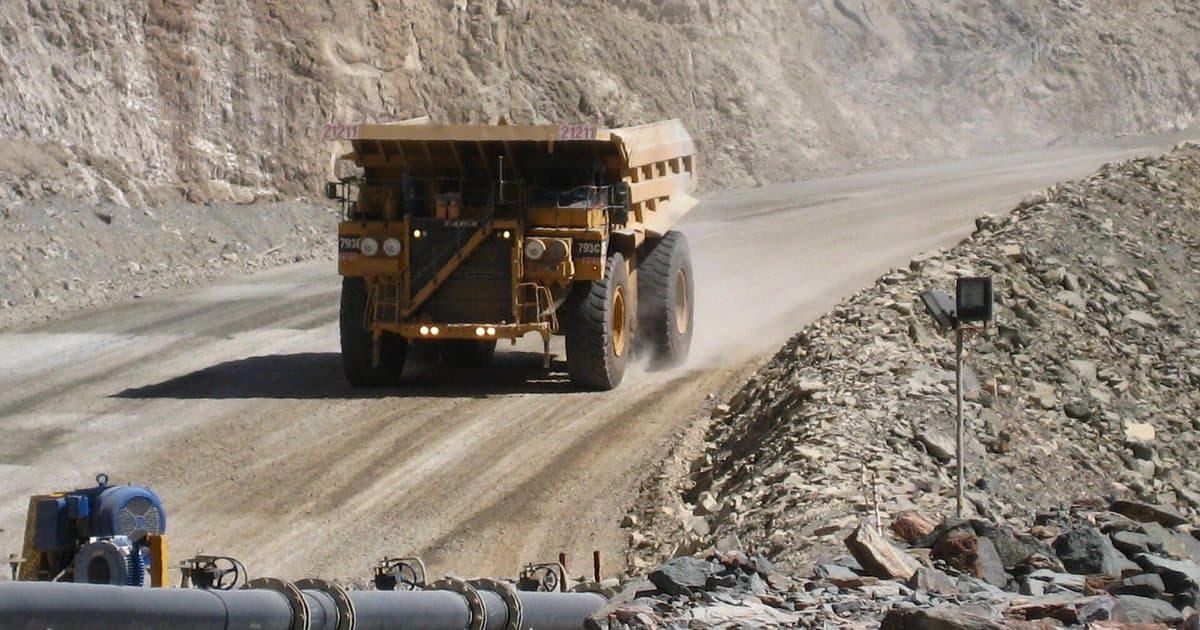
In 2023, the Fort Knox gold mine in Alaska used the equivalent of 2.6 million gigajoules of diesel, according to figures from its operator Kinross compiled by Lawrence Berkeley National Laboratory in a study published in 2026. Converted at the study's heating value, that is about 73 million litres in a year, 200,000 litres a day.
Not every mine is Fort Knox. But every mine has to answer the same question before buying its fuel: how many litres a month? Here is how to work it out, machine by machine.
Take action
- Have your monthly requirement costed: send your fleet on WhatsApp.
- See our fuel offer: road tanker in West Africa, ship elsewhere in Africa.
Where a mine's diesel goes
The Lawrence Berkeley study recalls two orders of magnitude from the US Department of Energy: diesel is the largest energy source in US mining, about 34 % of consumption, and it supplies 87 % of the energy used in materials handling, that is loading and hauling. A 2026 study of open-pit haul trucks notes that truck haulage alone accounts for one third or more of a site's diesel.
A mine's diesel therefore falls into four items:
- Haulage: the trucks that carry ore and waste out of the pit.
- Loading and earthmoving: excavators, loaders, dozers, graders.
- Electricity, when the mine is off-grid: generators or a fuel oil power plant.
- The rest: light vehicles, pumps, compressors, and the explosive itself, since ANFO, an explosive widely used in mining, is a blend of about 94 % ammonium nitrate and 6 % fuel oil.
What the machines burn
Caterpillar's Performance Handbook publishes hourly fuel rates drawn from the telematics of its machines, at low, medium and high load. Converted to litres, here are some of them:
| Caterpillar machine | Low load | Medium load | High load |
|---|---|---|---|
| 773G haul truck | 29 l/h | 38 l/h | 46 l/h |
| 775G haul truck | 31 l/h | 41 l/h | 50 l/h |
| 777G haul truck | 45 l/h | 59 l/h | 73 l/h |
| 793F haul truck | 121 l/h | 159 l/h | 196 l/h |
| 6015 hydraulic excavator | 70 l/h | 90 l/h | 109 l/h |
| 992 wheel loader | 50 l/h | 65 l/h | 80 l/h |
| D9 dozer | 30 l/h | 39 l/h | 49 l/h |
| D10 dozer | 43 l/h | 57 l/h | 71 l/h |
These values assume an idle share of 50 % at low load, 30 % at medium load and 10 % at high load. Steep ramps, a deep pit or machines queuing at the loader push consumption up. For your own fleet, the best source remains your telematics or your fuel tickets.
Electricity. For generators, manufacturers' data sheets give 0.25 to 0.31 litre of diesel per kWh produced, between 50 % and 100 % load.
The calculation
diesel per day = sum, for each machine, of (hourly rate × working hours per day) + kWh produced × litres per kWh + other uses
Then multiply by the number of operating days in the month, and add your safety stock, as we explain in diesel buffer stock on site.
A worked example
Take a mid-sized open-pit gold mine, off-grid. The fleet figures are a working assumption; the fuel rates are those in the table.
| Item | Assumption | Diesel per day |
|---|---|---|
| Haulage | 8 × 777G trucks, medium load, 20 h a day | 9,467 litres |
| Loading | 2 × 6015 excavators, medium load, 20 h a day | 3,581 litres |
| Earthmoving | 3 × D9 dozers, medium load, 16 h a day | 1,886 litres |
| Electricity | 3 MW average, round the clock, 0.28 l/kWh | 20,160 litres |
| Total | excluding light vehicles, pumps and explosives | 35,094 litres |
Over 30 days, that is about 1.05 million litres, close to 885 tonnes of diesel a month. A 2,000 tonne cargo therefore covers a little over two months of consumption.
In this example, electricity weighs more than haulage. That is why so many mines are adding solar: according to the trade press, the expansion of the Fekola solar plant in Mali to 52 MW lets B2Gold save about 20 million litres of heavy fuel oil a year.
What real mines report
The Lawrence Berkeley study compiles the consumption reported by operators for 2023. Converted to litres:
| Mine (operator) | Diesel in 2023 |
|---|---|
| Morenci, copper (Freeport-McMoRan) | about 198 million litres |
| Fort Knox, gold (Kinross) | about 73 million litres |
| Marigold, gold (SSR Mining) | about 50 million litres |
| Round Mountain, gold (Kinross) | about 46 million litres |
| Bald Mountain, gold (Kinross) | about 39 million litres |
| Tyrone, copper (Freeport-McMoRan) | about 16 million litres |
At the other end of the scale, the grid-connected Blanket underground mine in Zimbabwe uses about two million litres of diesel a year according to Caledonia Mining. And a mine construction site can run on a much smaller contract: in Malawi, Lindian Resources signed a twelve-month contract with Petroda for 500,000 litres of diesel delivered to the Kangankunde site, at 2.83 dollars a litre, according to its July 2026 quarterly report.
Why there is no universal ratio per tonne
People often look for a "litres per tonne of ore" figure. There is no universal one: consumption depends above all on the strip ratio between waste and ore and on the haul distance. IEEFA showed it for Australian coal mines: as the pit deepens, more waste must be moved further, and diesel per tonne rises. The right ratio is the one in your own mine plan, updated every year.
Frequently asked questions
How much diesel does a mine use?
From a few hundred thousand litres a year for a construction site or a small grid-connected underground mine, to tens of millions of litres for a large open-pit mine: 73 million litres in 2023 at Fort Knox, according to Kinross figures.
How much fuel does a Caterpillar 777 use?
About 45 litres per hour at low load, 59 at medium load and 73 at high load for the 777G, according to Caterpillar's Performance Handbook.
How do I calculate a mine's fuel requirement?
Add, for each machine, the hourly rate times working hours, then electricity production times consumption per kWh, and other uses. Multiply by operating days and add the safety stock.
How many litres of diesel per tonne of ore?
There is no universal ratio: it depends on the strip ratio and haul distances, which are specific to each mine.
What we do
GRACECORP AMD GROUP supplies diesel and CST 180 fuel oil to mine sites. In West Africa we deliver by road tanker from our own depots or those of our partners in Dakar, Abidjan, Lomé or Cotonou, depending on availability; elsewhere in Africa, by ship to your port, from 2,000 tonnes. Send us your fleet and working hours: we help you cost your monthly requirement and your safety stock, then make you an offer.
Send your fleet on WhatsApp or see our fuel offer.
Read next: fuel delivery to a mine in Guinea and diesel for Zambia, Malawi, Botswana and Zimbabwe: which port.
Sources: Lawrence Berkeley National Laboratory, "Diesel Fuel Consumption in Prominent U.S. Open-Pit Mines: Site-Level Estimates", February 2026 (reported 2023 consumption in GJ; conversion at 0.0358 GJ per litre; diesel shares from the US Department of Energy, 2007); Caterpillar, Performance Handbook, Fuel consumption section (VisionLink data, idle assumptions), copy published by Wheeler Cat, December 2022; Nobahar, Xu, Dowd and Sattarvand, multi-factor analysis of haul truck fuel consumption in open-pit mining, 2026; generator manufacturers' data sheets, as used in our generator consumption article; Mugglehead, on the Fekola solar expansion (B2Gold); Mining Zimbabwe, on the Blanket mine (Caledonia Mining); Lindian Resources, ASX quarterly report of 30 July 2026; IEEFA, "Fuel efficiency alone won't dig coalminers out of a deepening diesel hole"; composition of ANFO (94 % ammonium nitrate, 6 % fuel oil).