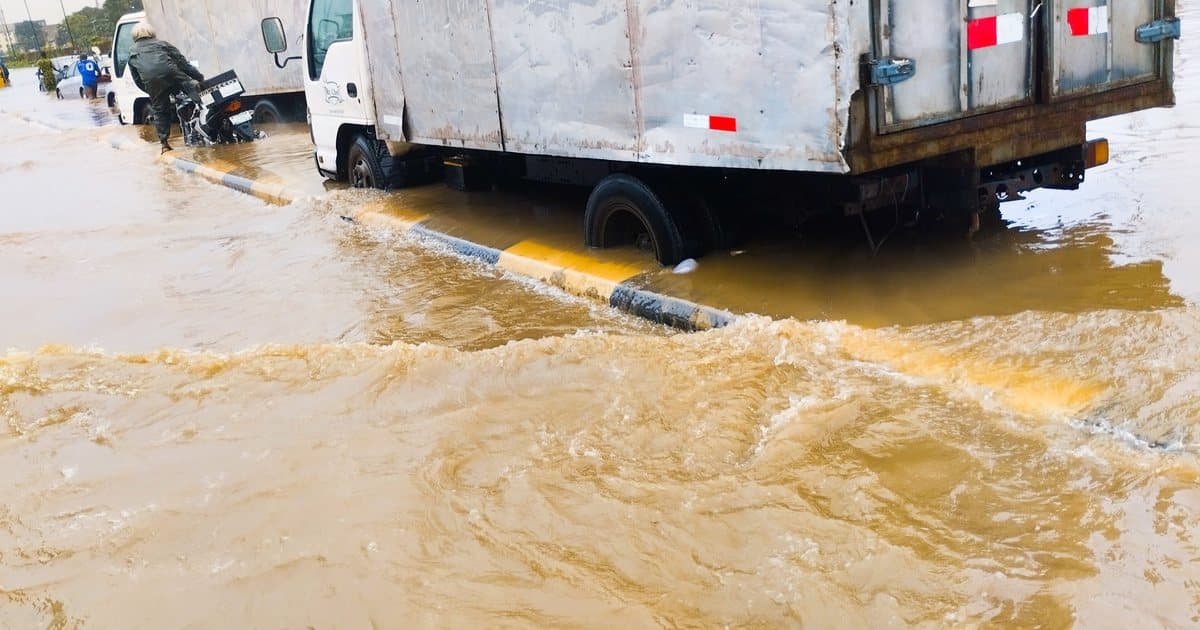
In Senegal and Mali, the rainy season runs broadly from June to October, with the heaviest rain in August and September. For transport, it is the season when a road that worked in May can close overnight.
None of this is a surprise; it happens every year. Yet it is the season with the most late cargo and the most quotes that no longer hold.
What rain does to the roads
Known weak points give way. On the Bamako to Kayes road, close to 600 kilometres, users warned in May 2025 of a critical point at the village of Tassara that could cut the road completely during the rains, trapping hundreds of trucks, buses and cars.
Tracks become mud. In 2026, much of the freight to Mali moved to the southern branch via Tambacounda, Kédougou, Saraya and the Moussala border post. According to the joint inspection of 13 August 2026, about ten kilometres there are unpaved, and the post has almost no parking. A laterite track carrying heavy trucks turns into ruts in the rain.
Low lying areas get cut off. In the Saraya district, the rising Gambia River cuts some sections, and a 21 kilometre stretch between Missirah Sirimana and Kondokho has already been made impassable, two broken down heavy trucks being enough to block all traffic.
What it changes for a shipment
Transit times lengthen. Average speed falls, trucks wait for a passage to clear, a temporary bridge can no longer take heavy loads. A ten day trip takes fifteen.
Rates rise. A carrier that knows its truck will do fewer trips in the month builds that into the price. Breakdowns and tyres cost more on a broken road. And fewer trucks are willing to go.
Cargo suffers. Water gets under a loose tarpaulin, comes up through a trailer floor, soaks a carton left on the deck. Rice, flour, cement, fertiliser, finished goods in cartons: wet cargo is often lost cargo.
Trucks can stand still for days. And someone pays for every one of them.
How to plan around it
Build stock before July. For goods whose demand you know, the safest move is to get them inland before the heavy rains. Stock at destination costs less than a stock out in September. See forward stock in a bonded warehouse.
Protect the cargo against water. Pallets for anything that fears damp, a double tarpaulin properly strapped, stretch wrap on cartons. It is the cheapest line in the budget and the one that prevents the most claims.
Choose the route on this week's information. North or south, longer tarmac or shorter track: the decision is made with the carriers driving the road, not on a map.
Build slack into the contract. A contract with a fixed September delivery date that ignores the season becomes a dispute. Better a realistic date and a clause saying what happens if the road is cut.
Check the insurance. Is water damage covered? Does the policy cover a truck stuck for several days? Ask before the season, not after the loss.
Track the truck. Knowing where a truck is stopped, and for how long, lets you act: unload into a nearby warehouse, send a second vehicle, warn the consignee.
And after the rains
At the end of the year the roads dry out, but demand for trucks climbs again with harvests and agricultural marketing campaigns. Trucks become scarce for a different reason. The best time to negotiate volume is therefore not necessarily October. It is often May, before both tight seasons.
What we do
During the rainy season we check the route with our partner carriers before every departure, ask for palletised and tarpaulined loads for water sensitive cargo, and give you a transit time that reflects the season rather than one that sounds good. Every truck is tracked.
Read next: the West Africa logistics calendar and 4 to 7 million CFA francs for a truck to Bamako.
Sources: Le Soir de Bamako, 22 May 2025 (Bamako to Kayes road, Tassara weak point); Senegal Press Agency, 13 August 2026 (joint inspection at Moussala, unpaved section, lack of parking); Senegal Press Agency (Saraya district, section cut between Missirah Sirimana and Kondokho, Gambia River flooding); Pressafrik (rainy season isolation of Saraya district); Senegalese Shippers' Council (shift of freight to the southern branch).