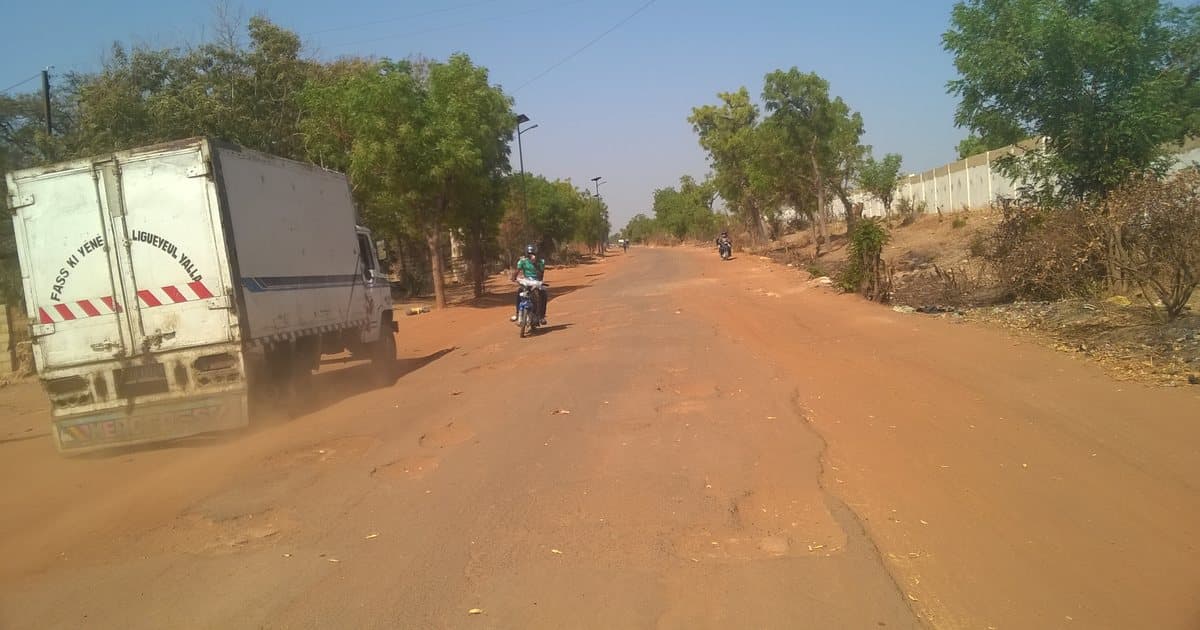
In September 2026, on the requests we handle, a full truck from Dakar to Bamako goes for between 4 and 7 million CFA francs, roughly 6,000 to 11,000 euros, depending on tonnage. Before the blockade of September 2025, the same trip cost around 1.4 million. In July, Senegalese truckers quoted in the press were talking about 3.6 million, sometimes 4.
Mali publishes an official rate grid for the Dakar corridor. It puts the distance at 1,353 kilometres and the rate between 56,152 and 63,334 CFA francs per tonne. For 40 tonnes, that is 2.25 to 2.53 million. The market is paying two to three times the grid.
So where does the money go? We did the calculation, with our assumptions written down so that anyone can redo it.
What a round trip costs
Diesel. A round trip is about 2,700 kilometres. A tractor in reasonable condition burns around 45 litres per 100 km loaded and 32 empty, a little over 1,000 litres for the whole trip. At the Senegalese pump price set on 15 August 2026, 755 CFA francs a litre, that is 790,000 CFA francs. Fill up partly in Mali, where diesel sold at around 940 in July, and it approaches a million. Older trucks burn far more: the World Bank measured 65 litres per 100 km in Central Africa, against 34 in France.
The other distance costs. On the Bamako route, the World Bank found fuel to be 80 percent of variable costs. The rest splits between tyres (9 percent), maintenance (5 percent) and informal payments (6 percent, up to 10 on some routes). If diesel costs a million, those add about 250,000.
The costs that run every day. Crew, depreciation, insurance, overheads. By our own estimate, for a used tractor and trailer, 40,000 to 60,000 CFA francs a day, whether the truck moves or waits. A trip that used to take ten days now often takes twenty.
Road charges. Escorts, crossings, parking: a few hundred thousand CFA francs depending on the route.
| Item | Assumption | Amount (CFA francs) |
|---|---|---|
| Diesel | about 1,050 litres at 755 to 940 | 0.8 to 1 million |
| Tyres, maintenance, informal payments | 20% of variable costs | 0.2 to 0.25 million |
| Crew, depreciation, insurance | 40,000 to 60,000 a day, 10 to 20 days | 0.4 to 1.2 million |
| Road charges | depending on route and escort | 0.2 to 0.3 million |
| Total | 1.6 to 2.75 million |
At 4 to 7 million a trip, the owner keeps 1.25 to 5.4 million. The margin is real, and it is comfortable. But it is not free money, and it evaporates when a trip goes wrong.
Why the rate is so high
The road. The Bamako to Kayes section, close to 600 kilometres, has been described by its users as almost impassable for years, with a weak point at Tassara that threatens to cut the road every rainy season. On the southern branch, now the busiest, about ten kilometres before the Moussala border post are unpaved. Bad roads eat tyres, break suspensions and cut average speed. Back in 2009 the World Bank rated only 61 percent of the Tema to Bamako route in good or fair condition.
Too few trucks willing to go. Since the blockade began in September 2025, many owners refuse to send trucks into Mali. In July the Senegalese truckers' union counted at least 15 Senegalese trucks burned and several hundred stuck or abandoned. In February about 4,000 empty containers sat in Bamako. When willing capacity shrinks, the price rises.
Lost time. A truck that does two trips a month instead of four must earn on each what it used to earn on two. The 15 kilometre queue recorded at Moussala on 13 August 2026 ends up in the rate. The World Bank measured 65,000 km per truck per year in Central Africa, against 121,000 in France: half the time, the truck is not moving.
Empty returns. Between 30 and 40 percent of trucks return empty on the region's corridors, so the outbound shipper pays for the way back too. Where return loads exist, the World Bank found prices about 14 percent lower.
Market structure. The least visible cause, and according to the World Bank the heaviest. In West and Central Africa, queuing systems, bilateral freight quotas and carrier cartels keep a lasting gap between cost and price. The study put margins at 60 to 160 percent, with direct contracts between shippers and carriers still marginal.
Risk. A lost truck is tens of millions. And on land, war risk is normally not covered by standard cargo policies. Carriers price that in, and they are right to.
What it means for a shipper
Today's rate is not a cost price. It is a scarcity and risk price, sitting on a market structure that was already expensive before the crisis. It will come down when security, road condition and the way freight is allocated change.
Meanwhile, shippers have levers. Offer a return load: a carrier who knows the truck comes back full lowers the price. Consolidate volumes rather than sending half empty trucks. Plan ahead to avoid peaks and long waits. Pay for legal payloads: a cheap quote built on overloading costs more at the first weighbridge, as we showed in half of Senegal's trucks run overloaded. Accept a route clause rather than an unrealistic fixed price that ends in a dispute at the first detour.
What we do
Our quotations state the planned route, the expected duration and what makes the price move. We do not hide the carrier's margin; we show you what it pays for. Every assigned truck is tracked, so lost time is visible and can be discussed.
If you have regular volumes to Bamako, or better, a return load to offer, talk to us. That is where the real savings are.
Read next: shipping to Mali under blockade and the empty truck going home.
Sources: official rate grid for solid goods on the Dakar corridor, published on Mali's trade portal (distance, floor and ceiling rate per tonne); Mondafrique, 20 July 2026 (rates up from 1.4 to 3.6 and 4 million CFA francs, diesel price in Mali, burned and abandoned trucks); Government of Senegal, fuel prices from 15 August 2026 (diesel at 755 CFA francs a litre); World Bank, Teravaninthorn and Raballand, Transport Prices and Costs in Africa, 2009 (variable cost structure on the Bamako corridor, fuel consumption, annual mileage, road condition, margins and market organisation); Le Soir de Bamako, 22 May 2025 (Bamako to Kayes road); Senegal Press Agency, 13 August 2026 (15 km queue at Moussala); Institute for Security Studies, 4 June 2026 (empty containers in Bamako). Daily costs and road charges are our own estimates.