In Senegal's official petroleum price structure, published by the energy regulator CRSE on 6 December 2025, one tonne of diesel counts as 1,152 litres at 15 °C and 1,160 litres at 25 °C. Eight litres of difference for the same tonne, without a single drop going missing.
Fuel is bought in tonnes on international markets and burned in litres on site. Between the two sit two numbers every buyer should master: the density of the product and the temperature at which it is measured.
Take action
- [Get an offer in tonnes or in litres at 15 °C](https://wa.me/221778779913?text=Hello%20GRACECORP%2C%20I%20would%20like%20a%20fuel%20offer.%20Product%3A%20...%20Quantity%20%28tonnes%20or%20litres%29%3A%20...%20Delivery%20point%3A%20...: send your requirement on WhatsApp.
- See our fuel offer: products, delivery, price and payment.
The conversion rule
A tonne measures mass, a litre measures volume. To move from one to the other you need the density at 15 °C, stated on the certificate of analysis of every lot:
litres at 15 °C = kilograms ÷ density at 15 °C (in kg per litre)
A diesel of 845 kg/m³, or 0.845 kg per litre, gives 1,000 ÷ 0.845 = 1,183 litres per tonne. A diesel of 820 kg/m³ gives 1,220. Two lots meeting the same standard can therefore differ by almost 40 litres per tonne: on a 2,000 tonne cargo, that is more than 70,000 litres.
Litres per tonne, product by product
The standards set a density range. Here are its limits, and what they give in litres:
| Product | Standard | Density at 15 °C | Litres per tonne at 15 °C |
|---|---|---|---|
| Diesel | EN 590 | 820 to 845 kg/m³ | 1,183 to 1,220 litres |
| Unleaded gasoline | EN 228 | 720 to 775 kg/m³ | 1,290 to 1,389 litres |
| Jet A-1 | DEF STAN 91-091 (AFQRJOS) | 775 to 840 kg/m³ | 1,190 to 1,290 litres |
| CST 180 fuel oil | ISO 8217, RME 180 or RMG 180 | 991 kg/m³ maximum | at least 1,009 litres |
Senegal's figure of 1,152 litres per tonne implies a density of 868 kg/m³, above the European range. It is the factor used to compute the official price, not a measurement of your lot: for a purchase, only the density on the certificate of analysis counts.
To compare an offer in dollars per tonne with a consumption in litres, divide the price by the number of litres per tonne. For example, at 900 dollars per tonne for a diesel of 845 kg/m³: 900 ÷ 1,183 = 0.76 dollar per litre at 15 °C, before transport and taxes.
Temperature changes the volume, not the mass
Fuel expands as it warms. The mass stays the same, the volume does not. This is why the oil trade brings volumes back to a reference temperature of 15 °C (or 60 °F in the United States), using correction factors from the API and ASTM tables (standard ASTM D1250).
For a diesel of 840 kg/m³, the official table published by Measurement Canada gives these factors:
| Product temperature | Correction factor | 1,000 measured litres are worth, at 15 °C |
|---|---|---|
| 20 °C | 0.9958 | 995.8 litres |
| 25 °C | 0.9915 | 991.5 litres |
| 30 °C | 0.9873 | 987.3 litres |
| 35 °C | 0.9830 | 983.0 litres |
| 40 °C | 0.9788 | 978.8 litres |
In other words, diesel loses about 0.85 % of its volume for every 10 °C it cools. Gasoline and kerosene expand more: the volumetric expansion coefficient published by the Engineering ToolBox is 0.00095 per degree for gasoline and 0.00099 for kerosene and jet fuel.
Why your tank shows less than the delivery note
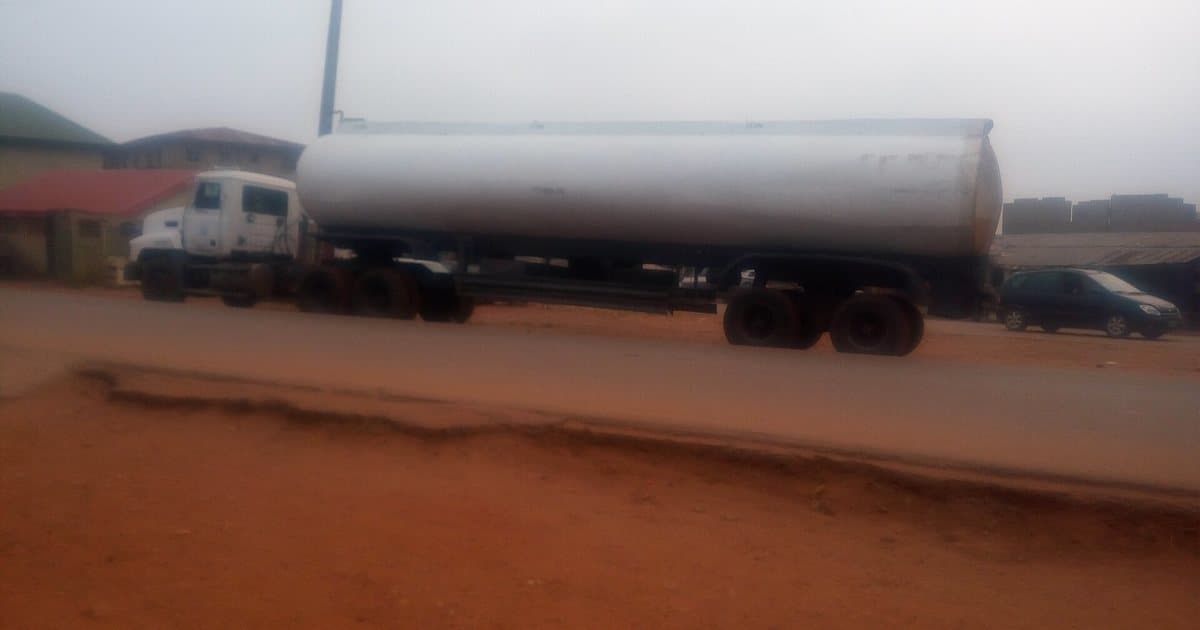
Take a road tanker loaded with 40,000 litres measured at 35 °C, at the depot, in the middle of the day. At 15 °C, those 40,000 litres are worth 40,000 × 0.9830 = 39,320 litres.
The truck reaches your site the next morning and the product is at 25 °C. The same 39,320 litres at 15 °C now occupy 39,320 ÷ 0.9915 = 39,657 litres. Your gauge will read 343 litres less than the depot's note. Nobody stole anything: the diesel contracted.
The reverse also happens: product loaded cold and delivered warm will seem to "gain" volume. Either way, the rule is the same:
- Invoice in litres at 15 °C or in tonnes, never in "observed" litres without a temperature.
- Record the temperature and the density at loading and at delivery, on both documents.
- Use temperature compensated meters where they exist: they display the volume at 15 °C directly.
Beyond what temperature explains, a gap becomes a quantity question that the contract must settle. BP's general terms, widely used in the trade, admit no quantity claim when the difference between loaded and discharged quantity is 0.5 % or less; we cover these clauses in fuel supply contract: the clauses to read before signing.
Ships: tonnes in vacuum, tonnes in air, barrels
On a cargo, the certificate of quantity issued by the independent inspector usually states the quantity in metric tonnes, in cubic metres at 15 °C and in barrels at 60 °F. Two points avoid many misunderstandings:
- A barrel is 42 US gallons, or 158.987 litres, and a US gallon is 3.78541 litres. Useful for reading prices per gallon, as in Liberia.
- Mass "in vacuum" and weight "in air" are not quite equal, because of air buoyancy. The gap is in the order of one part per thousand and is computed with Table 56 of ASTM D1250. Check which one the invoice uses.
What to require from your supplier
- The density at 15 °C of each lot on the certificate of analysis, with the test method.
- The temperature and the correction factor on the loading note.
- An offer that states clearly whether the price is per tonne or per litre at 15 °C.
- The same units from end to end: offer, contract, invoice, delivery note.
Frequently asked questions
How many litres of diesel are there in a tonne?
Between 1,183 and 1,220 litres at 15 °C for diesel meeting EN 590, whose density ranges from 820 to 845 kg/m³. The exact figure is computed from the density on the certificate of analysis: 1,000 divided by the density in kg per litre.
What is the density of diesel at 15 °C?
From 820 to 845 kg/m³ under the European EN 590 standard, a relative density of 0.820 to 0.845.
How many litres are there in a tonne of gasoline or Jet A-1?
From 1,290 to 1,389 litres for gasoline (720 to 775 kg/m³, EN 228) and from 1,190 to 1,290 litres for Jet A-1 (775 to 840 kg/m³).
Why is fuel measured at 15 °C?
Because its volume changes with temperature while its mass does not. Bringing every volume back to 15 °C makes a loading and a delivery done at different temperatures comparable.
How many tonnes are there in a 40,000 litre diesel tanker?
Between 32.8 and 33.8 tonnes at 15 °C, depending on the density of the diesel. We cover tanker capacities in fuel tanker truck 45,000 litres.
What we do
GRACECORP AMD GROUP supplies diesel, gasoline, Jet A-1, CST 180 fuel oil and bitumen. In West Africa we deliver by road tanker from our own depots or those of our partners in Dakar, Abidjan, Lomé or Cotonou, depending on availability; elsewhere in Africa, by ship to your port, from 2,000 tonnes. Every lot leaves with its certificate of analysis, and our offers state the price unit clearly.
Request an offer on WhatsApp or see our fuel offer.
Read next: diesel certificate of analysis: how to read it, line by line and fuel delivery checklist: receiving diesel on site.
Sources: Senegal energy regulator (CRSE), petroleum price structure of 6 December 2025 (diesel conversion factors at 15 °C and 25 °C); EN 590 requirements table as reproduced by Wikipedia (density 820 to 845 kg/m³); CEN/TR 18238:2025 and Measurlabs EN 228 test package (gasoline, 720 to 775 kg/m³); AFQRJOS Issue 36 specification published by Attock Refinery and ExxonMobil Jet A-1 data sheet (775 to 840 kg/m³); ISO 8217:2017, Table 2, as reproduced by Chevron Marine Products (RME 180 and RMG 180, 991 kg/m³ maximum); Measurement Canada, volume correction factors for diesel fuel, Table 54B, density 840 kg/m³ (July 2018) and bulletin V-18; Engineering ToolBox, volumetric expansion coefficients of liquids; ASTM International, D1250 (petroleum measurement tables); BP Oil International, 2015 general terms and conditions, section 59.2.1; Lawrence Berkeley National Laboratory, 2026 (US gallon conversion).