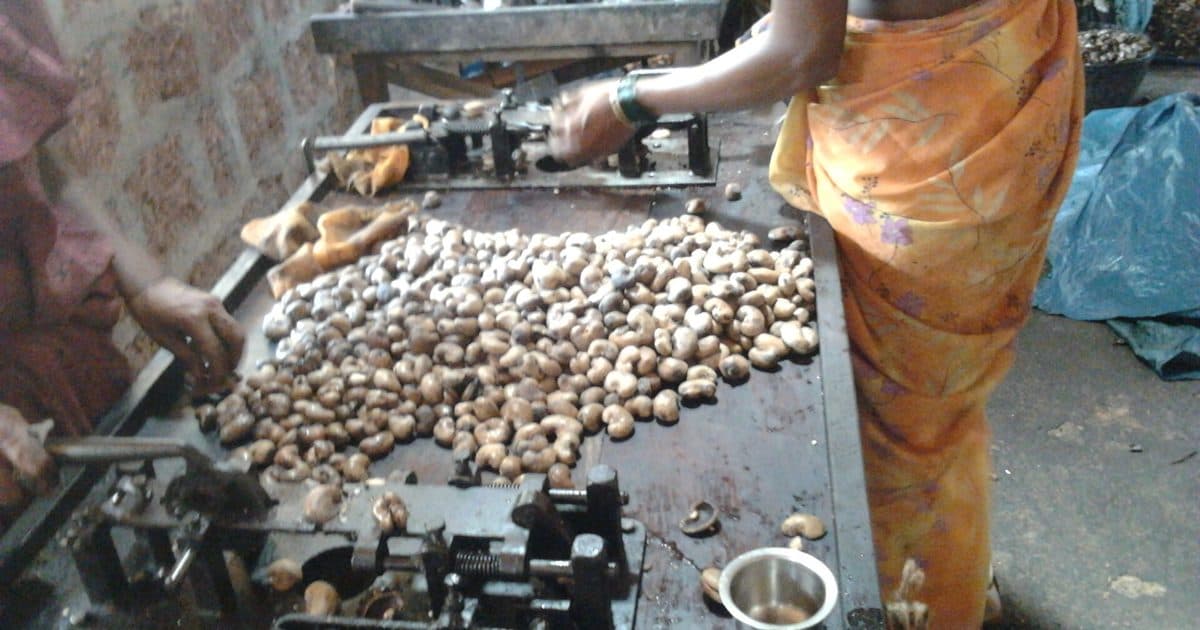
In mid September 2026, Vietnamese sellers of W320 cashew kernels were generally refusing to go below US$3.15 a pound, according to the CMB market information service. In July, African origin was quoted at US$3.35 to 3.50 a pound. At the same time, a tonne of Ivorian raw cashew nuts was trading at around US$1,540, delivered to Vietnam.
A tonne of W320 kernels is therefore worth more than US$6,800, while the raw nut that produces it is sold abroad for a fraction of that price. That is what local processing is about. Here is what W320 means, how to read a quality sheet, and how to buy kernels directly from West African processors.
What W320 means
The world cashew kernel trade follows the specification of the Association of Food Industries (AFI), an American food industry association, last updated in September 2023.
- W stands for whole: a kernel with no more than one eighth broken off.
- 320 is the size: 300 to 320 kernels per pound, or 660 to 706 per kilo.
The smaller the number, the bigger the kernel, and the higher the price.
| Size | Kernels per pound | Kernels per kilo |
|---|---|---|
| 180 | 140 to 180 | 266 to 395 |
| 210 | 180 to 210 | 395 to 465 |
| 240 | 220 to 240 | 485 to 530 |
| 320 | 300 to 320 | 660 to 706 |
| 450 | 400 to 450 | 880 to 990 |
W320 is the market's benchmark grade: it is the one whose price everyone follows.
Qualities and broken grades
Colour decides the quality:
- first quality, or fancy, a uniform white, light yellow or pale ivory: the "WW" of Vietnamese offers;
- second quality, or scorched (SW), darker;
- lightly blemished (LBW, LBP) and dessert grades, for processing.
Broken kernels have their own names: butts (broken crosswise), splits (split lengthwise), then pieces graded by size (LWP, SWP, BB). They sell for much less than wholes: in July 2026, US$1.40 to 2.80 a pound depending on quality.
The quality sheet
The AFI specification sets, among other things:
- moisture between 3% and 5%;
- no more than 10% by weight of kernels of the next lower size;
- no more than 10% by weight of broken kernels in wholes;
- free fatty acids of no more than 1.5% and a peroxide value of no more than 5 meq/kg, signs of freshness;
- no salmonella and no E. coli;
- for aflatoxins, the limits of the country where the goods are sold: in the European Union, those of Regulation (EU) 2023/915.
The specification also provides that every shipment be inspected before loading.
The W320 price in 2026
| Origin | Indicative price | Date |
|---|---|---|
| Vietnam, FOB | US$3.10 to 3.30 a pound | mid September 2026 |
| Vietnam, FOB Ho Chi Minh City | US$7.00 to 7.50 a kilo | first half of 2026 |
| Africa, FOB | US$3.35 to 3.50 a pound | July 2026 |
| India, FOB | about US$3.75 a pound | July 2026 |
These prices are benchmarks published by market information services and exporters. The real price depends on quality, certification, packing and loading date.
Loading a container
Kernels travel vacuum packed, in bags or tins, to prevent oxidation. Commercial offers usually state 50 pound cartons, holding two 25 pound bags or tins, and 700 cartons per 20 foot container: 35,000 pounds, about 15.9 tonnes.
At US$3.10 a pound, such a container is worth about US$108,500; at US$3.50, about US$122,500. For a 40 foot container, the net weight depends on the packing and the maximum permitted weight: always get it confirmed in writing.
Buying in West Africa
Côte d'Ivoire is West Africa's largest cashew producer, and it processes a growing share of its crop: about 600,000 tonnes of raw nuts in 2025, according to the African Cashew Alliance, or 81% of the volumes processed in the region. Benin has banned raw nut exports since April 2024 and is pushing its own plants. Burkina Faso, Ghana and Togo also have processors.
To buy kernels:
- Write your specification: size, quality, crop year, moisture, packing, required certifications (HACCP, ISO 22000, BRC, halal), quantity, port of destination.
- Ask several approved processors for offers, with their technical sheet and certificates.
- Have the goods inspected before loading by an independent body, against your specification.
- Pay by documentary credit, against the shipping documents and the inspection certificate.
Our view
Cashew is the perfect example of what West Africa loses by selling raw. Côte d'Ivoire has shown this can change: it now processes hundreds of thousands of tonnes. What remains is to sell those kernels directly to end buyers, with the same quality standards as Vietnam or India, instead of going through intermediaries who keep the margin.
Frequently asked questions
What does W320 mean for cashews?
A whole kernel, 300 to 320 kernels per pound, or 660 to 706 per kilo, under the AFI specification.
What is the price of W320 cashew?
In mid September 2026, around US$3.10 to 3.30 a pound FOB Vietnam. African origin was quoted at US$3.35 to 3.50 a pound in July.
What is the difference between W240 and W320?
W240 is bigger: 220 to 240 kernels per pound. It sells for more, around US$3.45 to 3.55 a pound in Vietnam in mid September 2026.
What does WW320 mean?
White Whole 320: a whole, white, first quality kernel, size 320.
How many cashew kernels fit in a 20 foot container?
Commercial offers usually state 700 cartons of 50 pounds, or about 15.9 tonnes.
What we do
GraceRoad sources cashew kernels from West African processors, on mandate, for a fixed sourcing fee agreed upfront. We vet the processor, have every lot inspected against your specification and arrange transport to your port.
Read next: raw cashew nuts price in 2026 and sourcing agent in Africa: what it does, what it costs.
Sources: Association of Food Industries, "Specifications for cashew kernels", updated September 2023; CMB News, 10 July and 18 September 2026, on kernel and raw nut prices; SVC Group, "Vietnam Cashew Market: H1 2026 Review and H2 Outlook", 1 July 2026; African Cashew Alliance, on processing in Côte d'Ivoire in 2025; our article on cashew prices in 2026, for Benin; published commercial offers, for container loading.