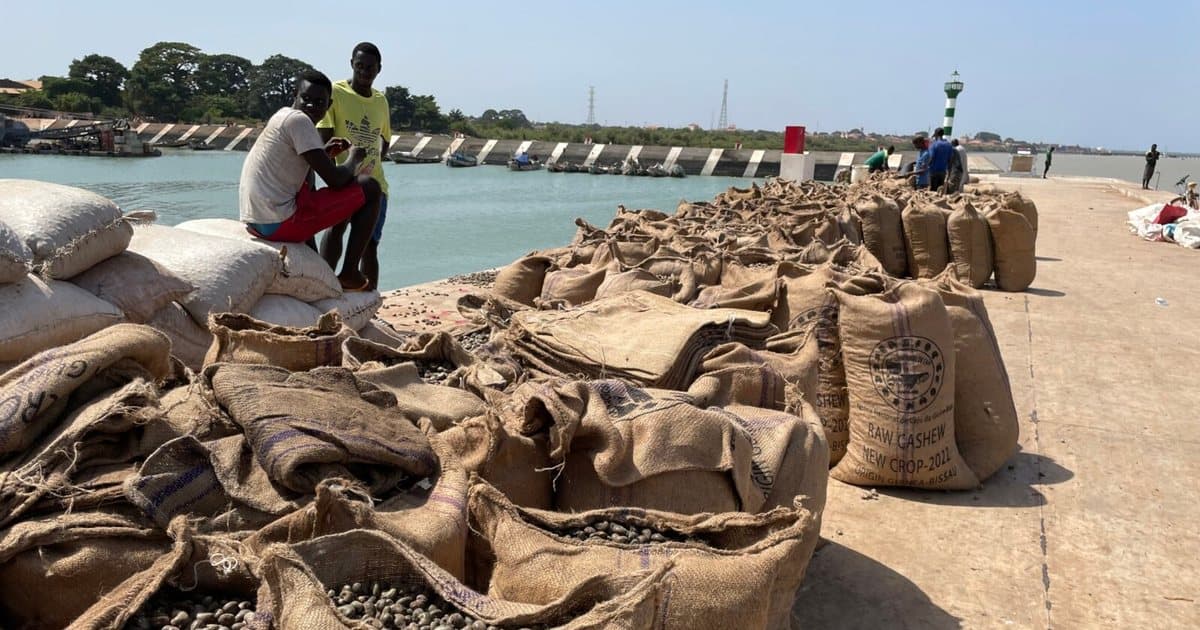
West Africa is one of the world's leading regions for raw cashew nuts, and Côte d'Ivoire is the top producer. Yet most of the crop is still shelled in India and Vietnam. For a buyer, understanding the cashew price in 2026 means understanding three things: the minimum prices set by governments, the price actually paid at export, and quality, which decides everything.
Côte d'Ivoire: 400 CFA francs a kilo at farmgate
On 6 February 2026, Ivorian agriculture minister Bruno Nabagné Koné set the minimum farmgate price for raw cashew nuts at 400 CFA francs per kilogram for the 2026 season, against 425 the previous season, a 6 percent cut.
The reasons given: weaker international prices, and the additional duties imposed by the United States between August and November 2025, which disrupted the market. The fall of the dollar, from about 620 CFA francs in 2025 to 565 at the time of the announcement, also reduced room for manoeuvre. The cotton and cashew council specified that these prices apply only to well dried, properly sorted nuts.
Côte d'Ivoire does not only export raw nuts. According to the African Cashew Alliance, it processed about 600,000 tonnes in 2025, roughly 81 percent of the volumes processed in West Africa. According to 2024 customs data cited by the Alliance, its top three markets were Vietnam, the Netherlands and the United States.
Benin: raw nuts no longer leave
Since 1 April 2024 Benin has banned exports of raw cashew nuts, under a March 2022 decree. The goal is to process the crop at home, notably in the Glo-Djigbé special economic zone, with a target capacity of 110,000 tonnes.
The bet is not yet won. According to the Beninese press, part of the crop still leaves through neighbouring countries, and the factories still lack financing against competition from foreign buyers. For a foreign buyer the conclusion is simple: in Benin you buy processed kernels, not raw nuts.
Guinea-Bissau: a cashew economy
Guinea-Bissau lives on cashew: it is by far the country's largest export. In March 2026 the state and the West African Development Bank (BOAD) launched a company, SOCA-GB, to process more locally. The country nonetheless remains first and foremost a raw nut exporter.
What buyers pay for
Indian and Vietnamese processors do not buy weight, they buy yield. The price of raw nuts depends above all on the KOR (kernel outturn ratio): the number of pounds of white whole kernels obtained from an 80 kg bag of raw nuts. A 50 lb nut is not worth the same as a 47 lb nut.
Next come moisture content, nut count per kilogram and defect rate. That is why the Ivorian council insists on nuts that are "well dried and properly sorted": a damp nut weighs more at purchase and is worth less on arrival.
Buying cashew in West Africa without surprises
Know the country. Raw nuts in Côte d'Ivoire or Guinea-Bissau, kernels in Benin.
Buy on analysis. A cutting test by an independent inspector, on a sample drawn from the actual lot, fixes KOR, moisture and defects before the balance is paid.
Mind the calendar. The season opens in February. The best nuts leave early; the last ones, at the end of the rainy season, are often damper.
Control the road. Between growing areas and the port, nuts travel by truck. A delay in the rain degrades a dry lot.
Pay securely. A deposit against a sample, the balance against documents and the inspection report, ideally by documentary credit.
Our reading
West African cashew is at a turning point. Côte d'Ivoire already processes a large share of its crop, Benin has shut raw nut exports, Guinea-Bissau is building capacity. For Indian and Vietnamese buyers, access to raw nuts will become more contested. For kernel buyers, an African supply is taking shape. Either way, those who control quality at origin, inspection and transport to port will buy better than those who buy at the price of the day.
Frequently asked questions
What is the raw cashew nut price in Côte d'Ivoire in 2026?
400 CFA francs per kilogram, the minimum farmgate price set on 6 February 2026 for well dried, sorted nuts, against 425 in the previous season.
Can you import raw cashew nuts from Benin?
No. Since 1 April 2024 Benin has banned raw cashew nut exports to promote local processing.
What is KOR in cashew trading?
The kernel outturn ratio: the number of pounds of white whole kernels obtained from an 80 kg bag of raw nuts. It is the first price criterion for Indian and Vietnamese buyers.
Where is African cashew processed?
Mainly in India and Vietnam. But Côte d'Ivoire processed about 600,000 tonnes in 2025, and Benin and Guinea-Bissau are developing their own plants.
What we do
GraceRoad buys raw cashew nuts or kernels on your behalf in Côte d'Ivoire and the region, with independent inspection of the lot, transport to port and DDP delivery if you wish. Tell us the product, quantity, target quality (KOR, moisture) and destination port.
Read next: sourcing commodities from Africa and due diligence on an African supplier.
Sources: Agence Ecofin, 9 February 2026, and Abidjan.net (400 CFA franc minimum farmgate price, 6 percent cut, reasons, dollar rate); African Cashew Alliance (US duties from August to November 2025, 600,000 tonnes processed in Côte d'Ivoire in 2025, 81 percent of West African processed volumes, export markets); Bénin Web TV and La Nouvelle Tribune (raw nut export ban since 1 April 2024, decree 2022-214 of 30 March 2022, 110,000 tonne target at Glo-Djigbé, leakage); Financial Afrik, 13 March 2026 (SOCA-GB in Guinea-Bissau with BOAD).