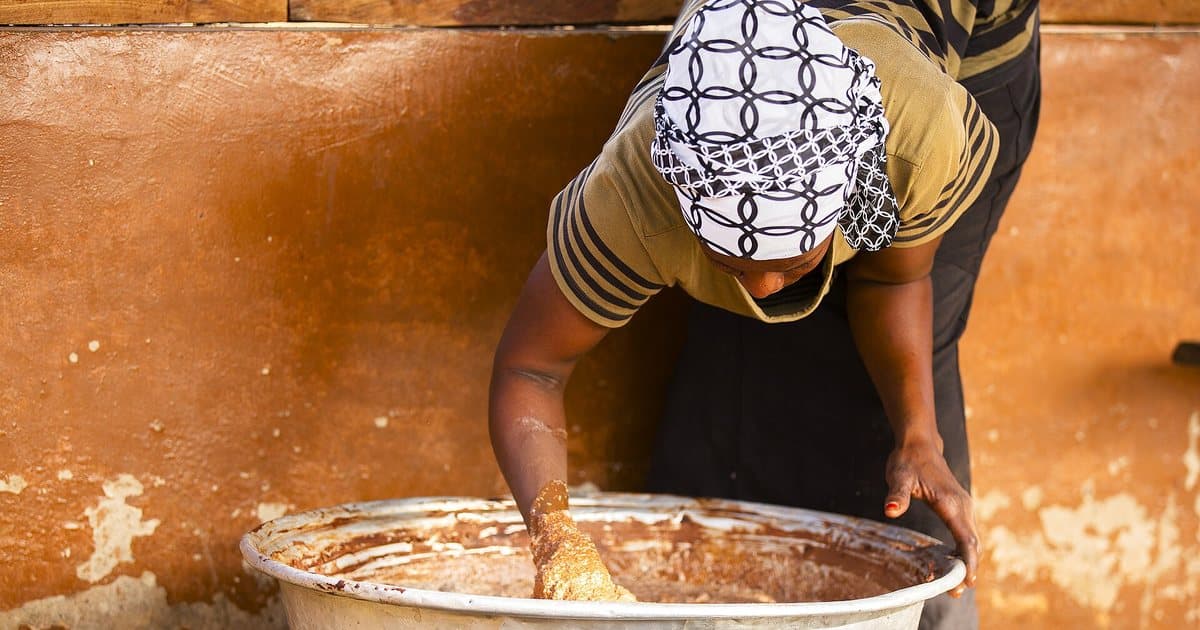
The shea tree grows wild across the West African savanna. Its kernels, gathered and processed mostly by women, yield a butter sought by the cosmetics and food industries worldwide. In two years the rules of the trade have changed: almost every producing country has restricted raw kernel exports to have them processed at home. For a buyer, that changes where to buy and what to buy.
Countries are closing raw kernel exports
According to Agence Ecofin, several countries have suspended or limited shea kernel exports since 2024:
| Country | Measure |
|---|---|
| Mali | Exports suspended since October 2024 |
| Côte d'Ivoire | Suspended since January 2025; for 2026-2027, ban on exporting nuts and kernels across land borders |
| Togo | Suspended since April 2025 |
| Nigeria | Restrictions since August 2025 |
| Ghana | Ban under consideration by end 2026 |
| Burkina Faso | Suspended in September 2024, lifted on 22 May 2026 with conditions |
In Burkina Faso exports have resumed under control: every exporter needs a special export authorisation, must reserve at least 25 percent of volumes for local processors and pays a levy of 200 CFA francs per kilogram exported. Between 2020 and 2024 the country exported an average of 124,287 tonnes of kernels a year.
Butter is replacing kernels
The trade figures show it. According to the N'kalô market service, cited by Agence Ecofin, shea butter imports reached 27,951 tonnes in the first quarter of 2026, against 22,046 tonnes a year earlier, a 27 percent increase and the highest first quarter level in five years. Over the same period, shea kernel imports fell 25 percent to 84,705 tonnes.
In other words, West Africa is exporting more and more of a processed product, and less and less of the raw material.
Official kernel prices
Mali. The 2026-2027 season was launched on 24 September 2026 in Bamako. Conventional kernels are priced at 175 CFA francs a kilo at farmgate and 200 at cooperatives; improved kernels at 225 to 250 CFA francs a kilo, provided they are sorted, free of foreign matter, below 8 percent moisture and very low in acidity.
Côte d'Ivoire. For 2026-2027 the cotton, cashew and shea council set the minimum price at 250 CFA francs a kilo at farmgate, 275 in inland stores and 305 delivered to factory. The season opened on 14 August 2026, with priority for local processing plants.
Burkina Faso. For 2025-2026, the maximum price for selling kernels to Burkinabè processors was set between 300 and 310 CFA francs a kilo depending on the region.
These prices are for kernels. Butter is negotiated case by case, depending on quality (unrefined, refined, organic), volume and packaging.
What makes quality
Moisture. A damp kernel moulds and gives lower grade butter; Mali requires less than 8 percent for improved grade.
Acidity. Measured as free fatty acids, it signals a badly dried or badly stored kernel.
Sorting. No foreign matter, no blackened kernels.
For butter: extraction method, refining if any, organic certification where required, and traceability back to the women's collection groups.
Where to buy in bulk
From licensed processors in each country, who now have priority on kernels and produce unrefined or refined butter.
From women's cooperatives, often grouped into unions, for artisanal butter and fair trade or organic supply chains.
Through tenders or season contracts, to secure a volume ahead of the harvest.
In every case: a sample tested before the contract, an inspection of the lot before the balance, and a contract stating quality, packaging and Incoterm.
Our reading
Shea is doing what cashew is only starting to do: moving from raw material to processed product, at the initiative of governments. For a European or American butter buyer that is good news: the supply of West African butter is growing. For a kernel buyer, the door is closing or comes at a price, through levies and quotas. Quality, meanwhile, still has to be checked lot by lot.
Frequently asked questions
What is the price of shea kernels in 2026?
In Mali, for 2026-2027, 175 CFA francs a kilo at farmgate for conventional kernels and 225 to 250 for improved kernels. In Côte d'Ivoire, 250 at farmgate, 275 in store and 305 delivered to factory.
Can you export shea kernels from Burkina Faso?
Yes, since 22 May 2026, with a special export authorisation, at least 25 percent of volumes reserved for local processors and a levy of 200 CFA francs per kilo.
Where can I buy shea butter in bulk in Africa?
From licensed processors and women's cooperatives in Burkina Faso, Mali, Ghana, Côte d'Ivoire and Togo, on a tested sample and a quality contract.
Why are countries banning shea kernel exports?
To have shea processed locally and keep the value of the butter at home: Mali, Côte d'Ivoire, Togo and Nigeria have restricted exports since 2024 and 2025.
What we do
GraceRoad buys shea butter or kernels on your behalf where it is allowed, with a tested sample, lot inspection and transport to port, or DDP delivery. Tell us the product, quality, volume and destination port.
Read next: raw cashew nuts price in 2026 and due diligence on an African supplier.
Sources: Agence Ecofin, 25 May 2026 (lifting of Burkina Faso's suspension, conditions, special export authorisation, 2020-2024 average, neighbouring countries' measures); Agence Ecofin, 8 June 2026, citing N'kalô (first quarter 2026 butter and kernel imports); Bamada.net, September 2026 (Mali 2026-2027 season, prices and quality criteria); Abidjan.net, 14 August 2026 (Côte d'Ivoire 2026-2027 season, prices, land border ban); Wakat Séra (kernel prices to Burkinabè processors for 2025-2026).