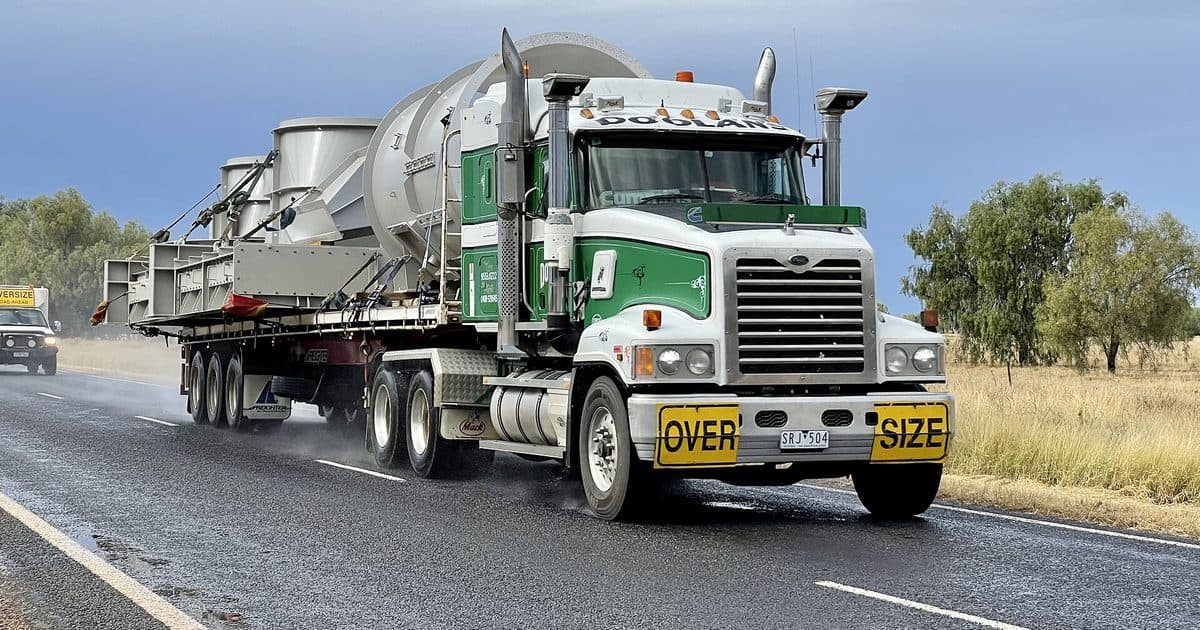
Since 1 April 2025, Mali has strictly enforced UEMOA Regulation 14 against non-compliant heavy trucks. It took an intervention by the Senegalese authorities to obtain a temporary derogation, until 13 May 2025, for Senegalese trucks exceeding the weight and size limits. The message is clear: on West African corridors, anything outside the norms must now travel with a permit.
A transformer, a crusher, a wind turbine blade, a tank or a mining machine does not fit on an ordinary truck. Here is when a load becomes an exceptional transport, which permits are needed, and how the convoy is prepared.
When a load becomes oversized
Regulation No. 14/2005/CM/UEMOA, adopted on 16 December 2005, sets the maximum dimensions and weights of heavy goods vehicles in the eight member countries of the West African Economic and Monetary Union.
| Limit | Maximum value |
|---|---|
| Overall width | 2.55 metres (2.60 metres for a refrigerated vehicle) |
| Overall height | 4.00 metres |
| Length of an articulated vehicle | 16.50 metres |
| Length of a road train, rigid truck and trailer | 18.75 metres |
| Axle load | 11.5 tonnes |
| Gross combination weight | 51 tonnes |
Width, height and length are measured load included. A 2.40 metre machine on its cradle, with its lifting points, can exceed 2.55 metres. And height is measured from the road: a 3 metre machine on a 1.20 metre trailer exceeds 4 metres.
The exceptional transport permit
Article 7 of the Regulation is precise. Transports above 51 tonnes gross combination weight, and "non-standard" transports, require in each member state an exceptional transport permit:
- granted by the minister in charge of transport;
- after the binding opinion of the minister in charge of roads;
- under the national rules in force.
The same article requires safety devices, and additional measures such as an escort and a rotating beacon, even when the permit has been granted.
In practice: a convoy from Dakar to Bamako needs two permits, one Senegalese and one Malian. A convoy from Abidjan to Ouagadougou likewise. Each country has its own lead times and documents. Outside the UEMOA, in Ghana, Guinea or Nigeria, national rules apply.
Preparing the convoy, step by step
- Measure the real package: dimensions and weight with cradle, packing and accessories, centre of gravity, lifting and lashing points specified by the manufacturer.
- Choose the equipment: low-bed semi-trailer, machinery carrier, multi-axle trailer to spread the load below 11.5 tonnes per axle where possible.
- Survey the route: clearance under power lines and bridges, load capacity of structures, turning radii, village crossings, damaged sections.
- Apply for permits in each country crossed, with the loading plan and route.
- Arrange the escort and accompanying vehicles.
- Prepare the arrival: stabilised unloading area, crane of sufficient capacity, qualified crew.
What costs money
The transport itself is often not the biggest cost. What blows a budget is waiting: a mobilised low-loader waiting for a permit, a convoy stuck in front of a bridge that is too low, a crane missing on arrival day. Those days are invoiced.
The question of dismantling also arises from the start. Equipment that can travel in several parts within the size limits often costs less to transport, but reassembly on site must be planned.
Our view
Non-compliant trucks were long tolerated in West Africa, at the cost of ruined roads. Tighter enforcement, in Mali since April 2025 and in Senegal, where new measures were announced in July 2026, is good news for honest carriers. It also forces shippers to plan: a heavy package that used to arrive by "making do" must now be prepared as a real project.
For a mine, a power plant or a factory under construction, the arrival date of a machine often decides the commissioning date. That is where preparation pays most.
Frequently asked questions
What is the maximum truck width in the UEMOA?
2.55 metres overall, 2.60 metres for a temperature-controlled vehicle, under Regulation No. 14/2005/CM/UEMOA.
What is the maximum truck height in West Africa?
4 metres overall in UEMOA countries, load included.
Who issues the exceptional transport permit?
In each UEMOA country, the minister in charge of transport, after the binding opinion of the minister in charge of roads.
Does an oversized convoy need an escort?
Regulation 14 requires additional safety measures, such as an escort and a rotating beacon, on top of the permit.
What is the maximum truck weight in the UEMOA?
51 tonnes gross combination weight and 11.5 tonnes per axle. Above that, an exceptional transport permit is required.
What we do
GraceRoad prepares oversized road transport in West Africa end to end: measuring the package, choosing equipment, route survey, permits in every country crossed, escort, real-time tracking and unloading on site.
Read next: heavy equipment from port to mine site and half of Senegal's trucks run overloaded.
Sources: UEMOA Regulation No. 14/2005/CM/UEMOA of 16 December 2005 on the harmonisation of standards and procedures for controlling the dimensions, weight and axle load of heavy goods vehicles, articles 5 and 7 and annex; Le Soleil, 3 May 2025, on Mali's derogation for non-compliant Senegalese trucks; Le Soleil, 2 July 2026, on the measures announced in Senegal.