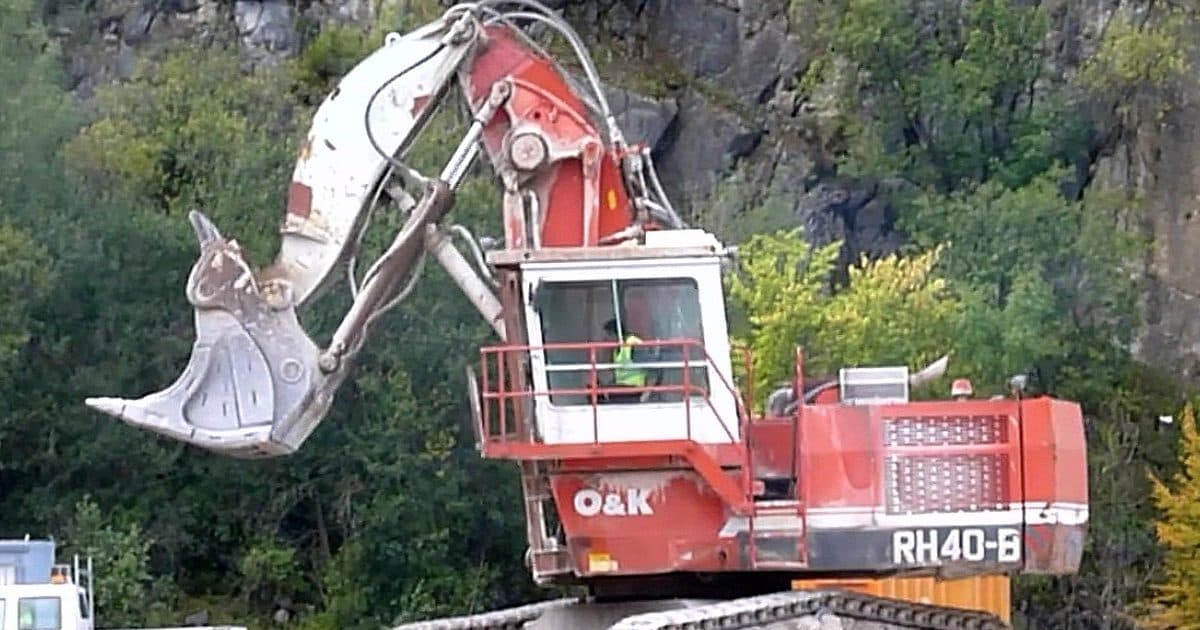
A forty-tonne crusher discharged at Dakar for a gold site in eastern Senegal is not a transport problem. It is about ten separate problems, only one of which involves a truck.
This is what catches out procurement teams handling their first move of this kind. They negotiated the machine, secured a CIF port price, and assumed the rest would be a formality. The rest is often a third of the total cost, and all of the schedule risk.
Here is how the operation is actually built.
What starts before the machine leaves the factory
Real dimensions and weight, not catalogue figures. A manufacturer quotes the machine. What travels is the machine plus its cradle, plus packing, plus lifting points. Three centimetres of additional height can turn an ordinary road move into an abnormal load, with all the permits that implies.
The lifting and lashing plan. It must come from the manufacturer, in writing. A machine slung from the wrong point deforms, and the damage appears at commissioning — by which time the transit insurance no longer responds.
Whether to dismantle. Much plant can travel in separate elements. It is almost always cheaper and less risky than a single out-of-gauge piece, but it means reassembly on site, with the skills and tooling that requires. That decision belongs at the start of the file, not on the day of loading.
The port
This is where most of the delay is lost, and most of the money.
Discharging a heavy lift requires a crane of adequate capacity and a booked window. On a congested terminal, that window is reserved in advance; improvised, it waits.
Customs clearance of industrial equipment deserves particular attention. The tariff classification determines the duty, and a misclassification is paid for twice — in duty not owed, and in the days the goods sit while it is contested. Equipment destined for a mining operation frequently qualifies for a privileged regime under the mining code or an establishment convention, but only if the supporting documents are presented when the declaration is lodged, not afterwards.
And the clock runs. Free days consumed, demurrage and storage accrue regardless of why the file is held.
The road to site
Mining and industrial sites are rarely at the end of a well-maintained trunk road.
The route survey is the step nobody wants to pay for and everybody regrets skipping. It means driving the route ahead of the convoy and recording what obstructs it: clearance under power lines and bridges, the load rating of structures, turning radii at village junctions, and the stretches of laterite that will not carry a loaded low-loader through the wet season.
Abnormal load permits depend on dimensions and weight, are issued by the authorities of each country crossed, and take time. An international move can require three separate sets.
The equipment is not an ordinary truck: low-loader, extendable trailer, and for the heaviest pieces a hydraulic modular trailer. These are scarce in the region. Their availability, more often than price, sets the schedule.
Escort is mandatory for an abnormal load, with pilot vehicles. It becomes a separate security escort when the value of the equipment or the sensitivity of the route justifies it.
Offloading on site
The last step, and the last trap. A forty-tonne machine cannot be offloaded with whatever is to hand.
You need a stabilised offloading area, a crane of sufficient capacity either mobilised to site or already there, and qualified personnel for the lift. On a site under construction, none of those three is a given. A convoy that arrives when nothing is ready waits, and a mobilised low-loader standing idle is charged by the day.
The check is made when the file is built, by asking the site one plain question: what will you actually have available on the day of discharge?
What we handle
We run these files end to end: receipt at the port, customs clearance, route survey, abnormal load permits, chartering the right equipment, escort, real-time tracking and site offloading.
Tracking deserves a word, because it is what foreign principals ask for most. A project manager in Toronto, Perth or Shanghai does not need to be told the convoy is on its way. They need to know where it is, whether it is moving, and when it will arrive — so they can schedule the crane and the erection crew. We provide that, not a reassuring phrase.
What we will ask you for
To study a file of this kind we need the dimensions and weight of the packed piece, the manufacturer's lifting and lashing plan, the port of arrival and estimated date, the exact site location, and the offloading means available on site.
With that, we build the operation. Without it, nobody can give you anything better than an approximation — and on this kind of move, an approximation always ends up costing more than the study it was meant to avoid.
Read next
Quoting DDP into West Africa for the customs regimes that apply, and choosing a freight agent in West Africa.