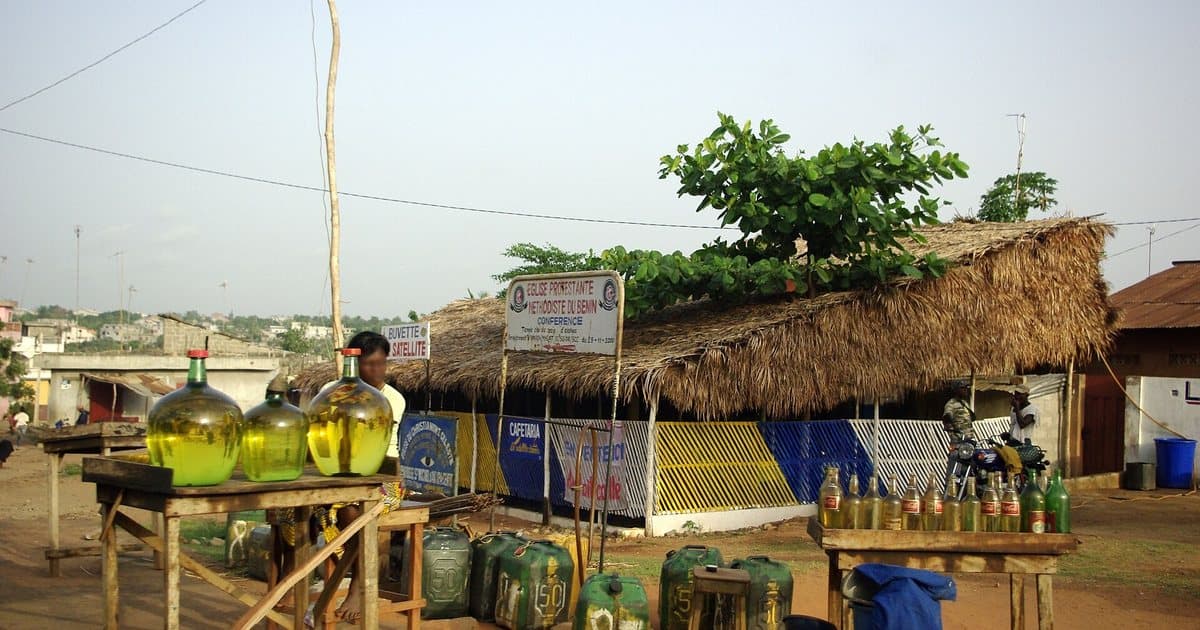
Along Benin's roads, bottles and demijohns of yellow petrol stand in rows on wooden tables. This is kpayo: smuggled petrol from Nigeria. The word means "not original" in Goun, a language of southern Benin. For decades kpayo, not filling stations, kept much of the country moving.
Where kpayo comes from
Nigeria is one of Africa's largest oil producers and long subsidised its fuel heavily. Petrol there was at times three times cheaper than in Benin. Smuggling answered the price gap: motorcycles loaded with three to five 50 litre cans cross the border, and the petrol is resold by the litre or by the bottle.
The scale has been known for a long time. In 2007 the authorities estimated that 551 million litres of smuggled petrol entered Benin, against 81 million litres sold through official stations. The trade was said to support around 100,000 families.
What kpayo costs in 2026
On 29 May 2023 Nigeria ended fifty years of petrol subsidy. Within weeks, a litre of kpayo in Benin went from 350 to 700 CFA francs.
In 2026, according to the Beninese outlet La Météo, traditional kpayo sells for around 700 CFA francs a litre and petrol from licensed mini-stations for around 800. The official pump price, set by the Ministry of Industry and Trade, has been 725 CFA francs since 1 May 2026.
The gap has not closed. In late September 2026, petrol sold for 1,400 to 1,500 naira a litre at Nigerian stations, about 600 to 640 CFA francs at the exchange rate of 30 September. The margin is thinner than before 2023, but it is still there, helped by a weak naira that makes Nigerian fuel cheap when seen from Benin.
The risks
Fire. Petrol stored in houses, makeshift warehouses and cans not designed for it burns. On 23 September 2023, a fire at a kpayo warehouse in Sèmè-Kraké, on the Nigerian border, killed 34 people.
Quality. Kpayo goes through no checks. Nobody can say what it contains, or whether it has been diluted or badly stored. For an engine it is a lottery; we describe the signs of adulterated fuel in a dedicated article.
Money going elsewhere. The trade escapes taxation, and some smuggling networks in northern Benin are monitored by analysts for their links with armed groups.
The mini-station reform
Benin has tried several times to regulate the trade. A June 2018 law penalised illicit fuel trading while providing support for those who lived from it. After the Sèmè-Kraké fire, the government sped up the rollout of mini-stations: small licensed pumps handed out free to registered vendors, to replace bottles with safer distribution.
The census carried out after the fire counted around 54,000 informal sales points. The stated target is 10,000 mini-stations. Three years on, La Météo's assessment is mixed: mini-stations sell about 100 CFA francs dearer than roadside tables, and price-sensitive customers have not given up kpayo. The market has moved more than it has disappeared.
What Dangote changes
The Dangote refinery now produces in Nigeria the petrol the country used to import. For kpayo the logic is unchanged: as long as petrol is cheaper on one side of the border, it crosses. What changes is the potential quality of the product at source, and the fact that the Nigerian price now follows the market without subsidy: smuggling now lives on differences in tax and exchange rates rather than on a subsidy.
Our reading
Kpayo is not a policing problem. It is a price and distribution problem. It thrives where the licensed station is far away, expensive or dry, and fades when the price gap closes. Mini-stations are a step in the right direction, provided they are supplied at a price that lets them compete with the roadside table.
For a company the conclusion is simpler: a truck or generator engine should never receive fuel without a certificate of analysis.
Frequently asked questions
What does kpayo mean?
"Not original", in Goun, a language of southern Benin. The word refers to petrol smuggled from Nigeria and resold at the roadside.
How much does kpayo cost in Benin?
About 700 CFA francs a litre in 2026 according to La Météo, against 725 CFA francs at official pumps since 1 May 2026. Before Nigeria ended its subsidy in May 2023, it sold for around 350 CFA francs.
Is kpayo dangerous?
Yes, in two ways: makeshift storage causes fires, such as the one in Sèmè-Kraké that killed 34 people in September 2023, and nobody checks the quality of the product.
What is a mini-station in Benin?
A small licensed pump given by the state to registered kpayo vendors, to replace bottle sales with safer distribution.
What we do
GraceRoad buys certified fuel from partners with depots in Benin, Togo, Côte d'Ivoire and Senegal and delivers it to site with a certificate of analysis for every batch. For a fleet or a construction site in Benin, it is the reliable alternative to the roadside market.
Read next: diesel prices in West Africa, country by country and Dangote refinery sales: who can buy.
Sources: Wikipedia (French), Kpayo (etymology, 2007 estimate, transport method, June 2018 law); Africanews, 16 June 2023 (end of the Nigerian subsidy, kpayo price from 350 to 700 CFA francs); La Météo, 2026 (mini-station assessment, Sèmè-Kraké fire of 23 September 2023, census, prices); Benin Ministry of Industry and Trade, reported by Bénin Web TV (prices of 1 May 2026); Brand Communicator, 21 September 2026 (petrol price in Nigeria); Global Initiative against Transnational Organized Crime, West Africa risk bulletin (mini-stations and smuggling networks in northern Benin); exchange rates of 30 September 2026.