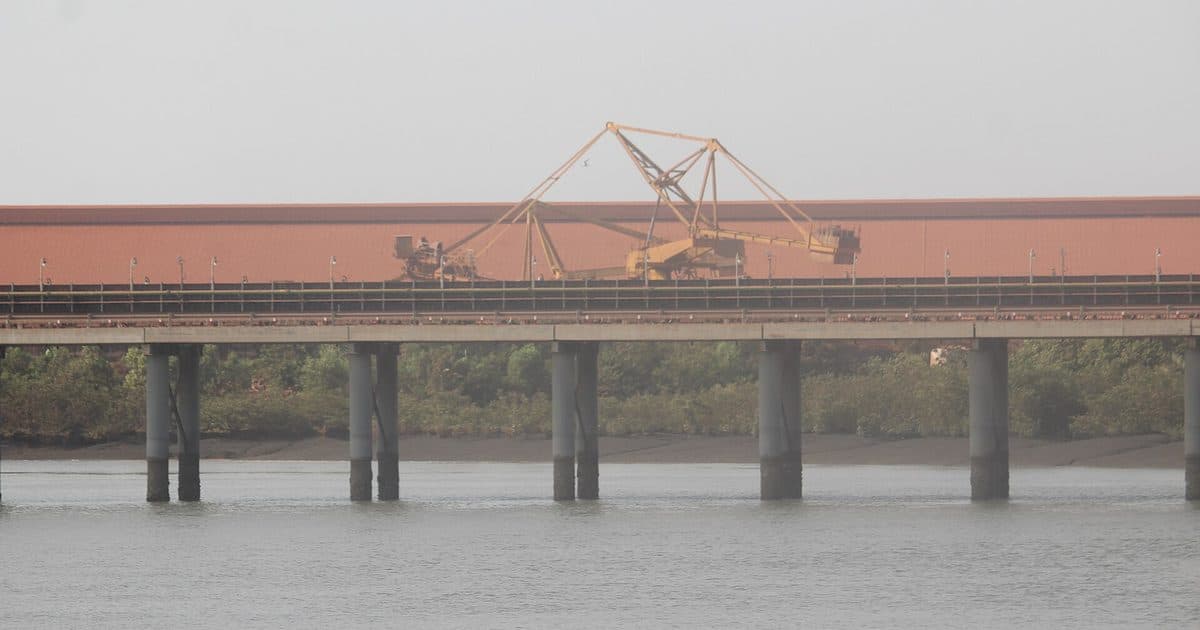
On 30 November 2025, a bulk carrier sailed from San Pedro in Côte d'Ivoire with 28,950 tonnes of spodumene concentrate for Hainan, China. It was the first cargo from Bougouni, the lithium mine Kodal Minerals operates 180 km south of Bamako.
The mine had been producing since February. Its concentrate only went on the road at the end of October, after an export permit was granted in September. It then took about five weeks to truck more than 30,000 tonnes some 880 km to a dedicated stockpile in the Ivorian port, before the vessel berthed on 29 November.
Between the ore pile and the hold sits the work the industry calls load-out: loading, weighing, sampling, hauling, stockpiling at the port, then filling the ship. That is where the weeks are lost, and sometimes the tonnes.
One vessel is eight hundred trucks
A 51-tonne combination, the gross weight ceiling set by WAEMU Regulation 14, legally carries about 35 tonnes. Bougouni's first cargo therefore represents roughly 830 truckloads over a road of almost 900 km. The mine now targets regular parcels of 15,000 to 20,000 tonnes.
At scale, the arithmetic changes character. Goulamina, Mali's other lithium mine, operated by Ganfeng, has a first-phase capacity of 506,000 tonnes of concentrate a year, and its product travels about 1,000 km by road to the port of Abidjan. At 35 tonnes a truck, that is close to 14,500 loads a year, some forty a day, every day. Allow six days for a round trip including loading, the border and discharge, a cautious assumption over that distance, and you need around 240 trucks in permanent rotation.
Nobody in the region keeps a fleet like that in reserve. A mine's load-out is therefore built from several hauliers, and that is what makes it fragile: each one weighs, covers and documents its loads in its own way.
The temptation to overload is real too. In April 2026, 47.71 % of trucks weighed in Senegal were over the legal limit. A mine that pays for haulage by the tonne without checking weights at its own gate is paying, without knowing it, for offloading at weighbridges and trucks held at the roadside.
Water, the risk nobody sees
Some concentrates behave like damp sand on land and like a liquid in the hold of a rolling ship. The International Maritime Solid Bulk Cargoes Code, the IMSBC Code, classes them as Group A: they may liquefy if shipped above their transportable moisture limit. Upgraded spodumene is one of them.
Bauxite joined the list after a disaster. In January 2015 the Bulk Jupiter sank off Vietnam with a cargo of bauxite, and 18 seafarers died. Bauxite was then classed among cargoes that carry no such risk. The work that followed produced a Group A schedule for bauxite fines, mandatory since 1 January 2021.
For the road leg, the consequence is practical. Moisture must be tested on samples taken no more than seven days before the ship starts loading, and significant rain between the test and the end of loading calls for check tests. Concentrate hauled in open tippers through the rainy season, then left uncovered on the quay, arrives with a moisture content nobody has tracked. In 2022, Leo Lithium, then the operator of Goulamina, secured 9,000 m² of warehousing directly on the Abidjan wharf for ten years, about 60,000 tonnes of storage.
Water also shows up on the invoice. Concentrate is sold in dry tonnes: for its first cargo, Kodal was paid on 28,735 dry metric tonnes, US$27.25 million in all. Nobody buys the water you hauled 880 km.
Three weights that never agree
A tonne of concentrate is weighed at least three times: on the mine weighbridge, at the gate of the port stockpile, and at the ship, by reading the vessel's draught before and after loading, the draft survey. That last figure is usually the one on the bill of lading.
Between the three there is dust, spillage at transfer points, water that evaporates or soaks in, and sometimes a load that never arrived. A gap nobody follows truck by truck becomes, by the time the ship sails, a hole of several hundred tonnes that no one can explain.
The remedy is well known and rarely applied: one consignment note per truck with the departure weight and seal number, an arrival weight checked against it the same day, and a daily reconciliation between mine and port.
The port is not a waiting room
A ship is not loaded as trucks happen to arrive. The port stockpile has to reach the size of the parcel: almost 29,000 tonnes for Bougouni's first cargo, up to 55,000 tonnes for a handymax at berth 14 in Abidjan. At Goulamina, seven weeks separated the first trucks reaching the port, on 7 May 2025, from the first vessel's departure on 24 June. At San Pedro, Bougouni's second parcel of 20,000 tonnes was being loaded in early February 2026, after two months of rotations.
If the trucks are late, the ship waits and demurrage runs. If they are early, with no room on the quay, the trucks wait, and a truck that waits is not hauling the next parcel. Leo Lithium planned from 2022 to keep two export channels so as not to depend on a single port.
Paper before the road
At Bougouni, seven months passed between first production and the export permit. A load-out starts with the documents that allow it: export permit, the customs regime set out in the mining convention, certificate of origin, assay certificate, moisture certificate, and the road transit documents between Mali and the port, under the ECOWAS inter-state road transit regime.
Security belongs in the plan as well. On the Abidjan to Bamako road, tankers have been attacked around Sikasso since October 2025. The state of these roads is published every Monday in the corridor weather.
What we do
We organise road haulage between mine and port with hauliers whose documents and vehicles we have checked: trucks loaded to the legal weight and covered, one consignment note per load with its weight and seal number, and tracking on every truck. We reconcile tonnages leaving the mine against tonnages received at the port every day, so that a gap is explained on the day it appears, not when the ship sails.
If you are preparing a tender or a contract for concentrate haulage, describe the mine, the target port and the monthly volume in the form below. Our team studies the file and comes back to you with a proposal.
Read next: the first years of a mining project's supply chain and half of Senegal's trucks run overloaded.
Sources: Agence Ecofin, 1 December 2025 (Bougouni's first cargo, 28,950 tonnes, September export permit, capacity of 125,000 tonnes a year); Global Mining Review, 2 December 2025 (more than 30,000 tonnes hauled about 880 km to the San Pedro stockpile, vessel arrival on 29 November); Kodal Minerals, operations update of 5 February 2026 (payment on 28,735 dry metric tonnes, US$27.25 million, second 20,000-tonne parcel loading, regular parcels of 15,000 to 20,000 tonnes); Mining.com, 26 December 2024 (Goulamina first-phase capacity); Gasgoo, 29 June 2025 (first trucks at the port on 7 May, first departure on 24 June 2025); Mining.com.au, 14 November 2022 (Leo Lithium's agreement with Terminal Vraquier Abidjan: ten years, 9,000 m², about 60,000 tonnes, berth 14, vessels up to 55,000 tonnes, about 1,000 km, two export channels); International Maritime Organization, IMSBC Code, section 4.5 and the "Spodumene (upgraded)" and "Bauxite fines" schedules; Gard, 13 January 2021 (Bulk Jupiter, amendment 05-19); WAEMU Regulation No. 14/2005/CM/UEMOA; Agence de presse sénégalaise, 1 July 2026 (47.71 % of trucks overloaded in April 2026); ISS Africa, 4 June 2026 (tanker attacks around Sikasso). The number of truckloads and trucks in rotation is our calculation, based on a 35-tonne payload and an assumed six-day round trip.