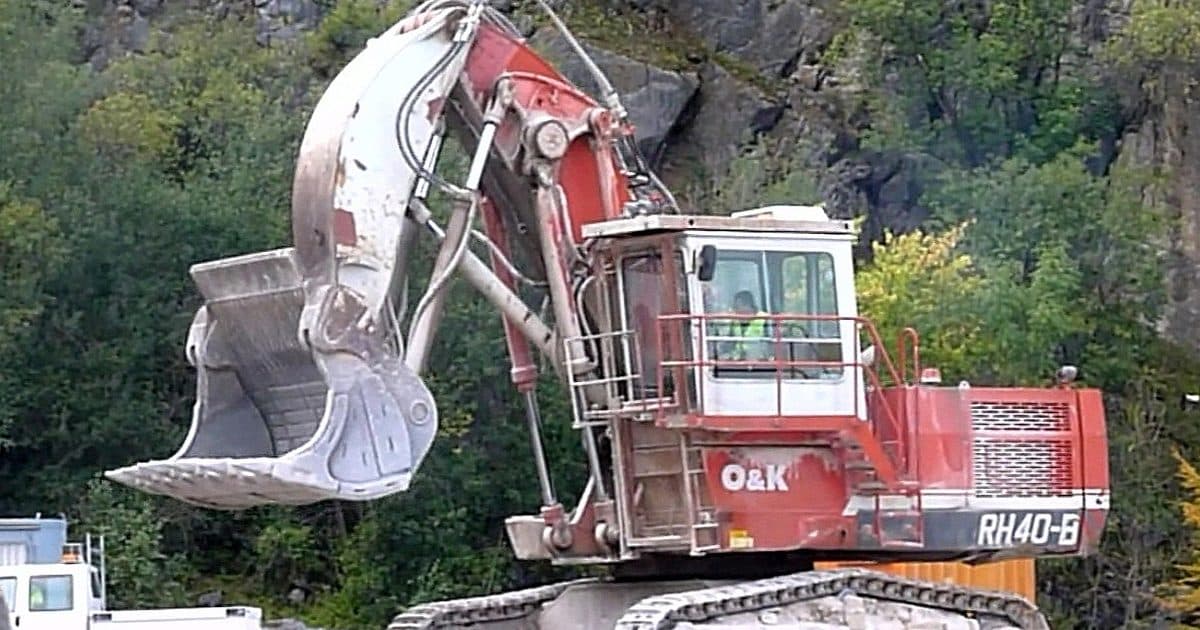
Every mining project in this region eventually discovers the same thing. Getting the plant in was the visible challenge, and it was the easy one. Keeping the site supplied afterwards — every week, for years — is where the money and the schedule actually go.
The construction phase has a project manager, a budget line and everyone's attention. The operating phase has a purchasing officer, a spreadsheet, and a truck that did not arrive.
This is a view of the whole sequence, for companies evaluating or starting an operation in Senegal, Mali, Burkina Faso, Guinea or Côte d'Ivoire.
Phase one: construction
Eighteen to thirty months of heavy, irregular, high-value inbound movement. Crushers, mills, generators, conveyor structures, tanks, prefabricated buildings, camp equipment, earthmoving fleet.
Three things decide whether this phase runs to schedule.
Sequencing. Equipment must arrive in the order it will be installed, not in the order it was ordered. A mill shell that arrives before the foundations are poured occupies a laydown area and a crane for months. One that arrives after the erection crew has demobilised costs far more than storage.
Port capacity. Heavy lift discharge needs a crane and a booked window. A project moving forty out-of-gauge pieces in a year does not improvise them one at a time.
Route capacity. The bridges and the road between the port and the site have a limit, and it is fixed. If your heaviest piece exceeds it, that is discovered during the route survey, not on the day. Some projects have had to dismantle and reassemble on site because nobody checked in time.
Phase two: the permanent flow
This is the phase nobody plans for with the same care, and it lasts as long as the mine.
Fuel. A working site consumes considerable volumes of diesel, delivered by road tanker on a schedule that cannot slip. A tanker carries thirty tonnes of payload, and forty thousand litres of gas oil weighs more than that — which is why a full tanker of diesel is not a legal load, and why fuel supply is planned in tonnes rather than in litres by anyone who has done it before.
Reagents and chemicals. Many are classified dangerous goods under ADR, requiring compliant vehicles, trained drivers and specific documentation. Sodium cyanide, sulphuric acid, caustic soda: each has its own handling and vehicle requirements, and none tolerates an improvised carrier.
Explosives, under a separate authorisation regime, with dedicated transport and storage.
Spares. Low volume, high urgency, high value. A part that stops a plant is worth flying, and the difference between a working supply chain and a poor one is whether that decision can be made and executed in twenty-four hours.
Consumables and camp supplies. Unglamorous, constant, and the first thing to be forgotten in a logistics plan.
The customs regimes that decide your cost base
This is where a well-advised project separates from a poorly advised one, and the difference is measured in percentage points of operating cost.
Mining conventions and establishment agreements commonly provide duty relief or suspension on equipment and inputs during defined phases. The relief exists, but it is not automatic: it must be claimed with the right supporting documents at the moment the declaration is lodged. Claimed afterwards, it becomes a refund request, and refund requests take a long time.
Temporary admission suits equipment entering for a defined period and leaving afterwards — drilling rigs, contractor plant, testing equipment. Duty is suspended against a guarantee. It requires discipline: the re-export must be documented, or the guarantee is called.
Bonded warehousing allows goods to be stored under customs control with duty deferred until they are released for consumption. For a project importing in bulk and consuming over time, this is a working-capital instrument, not an administrative detail.
Inter-state transit under the ECOWAS TRIE regime applies to everything crossing a border to reach a landlocked site. The file has to be opened correctly at the port, or the truck is stopped at the first serious checkpoint.
Where projects usually lose time
Treating logistics as procurement's afterthought. The supplier is chosen, the incoterm is agreed, and the logistics question is asked afterwards. By then the packing, the dimensions and the delivery terms are fixed, and each of them constrains what is now possible.
A single point of failure in the haulage. One contractor with a small fleet is efficient until a truck fails on a Friday night eight hundred kilometres from anywhere. A supply chain that cannot substitute a vehicle within a day is not a supply chain.
No visibility. A purchasing officer who cannot say where a load is cannot plan the crane, the crew, or the plant shutdown that depends on it. "In transit" is not information.
Rainy season, discovered in July. From July to October, secondary tracks degrade and some become impassable. Projects that plan their heavy movements for the dry season and stock consumables ahead of the rains do not stop. Those that do not, stop.
What we do
We handle port operations, customs, inland haulage and site delivery for industrial and mining operations, on both the construction phase and the permanent flow.
Concretely: heavy lift discharge and clearance under the applicable regime, route survey and abnormal load permits, road tankers for fuel with the payload calculated on the actual density of the product, ADR-compliant vehicles for reagents, escort where value or route requires it, and position reporting your purchasing team can read from any time zone.
Every carrier we use has had its transport licence, vehicle registrations, roadworthiness certificates and cargo insurance verified before it moves anything, with expiry dates tracked. On a site where a delivery failure stops production, that check is not administrative box-ticking.
What we will ask you for
The site location, the phase you are in, the equipment list with dimensions and weights for the heavy pieces, the expected consumption profile for fuel and reagents, the customs regime under your convention if one applies, and the offloading means available on site.
From that we build the plan — including what is not feasible as specified, which is worth knowing before it is contracted rather than after.
Read next
Getting heavy equipment from the port to a mine site for a single out-of-gauge move, and quoting DDP into West Africa.