The test takes ten minutes at any junction in Dakar. Count the cars going past: Toyotas, Chinese brands, a few Americans, a German now and then. Ten years ago the street was European. The only European cars still common are the old taxis, twenty or thirty years on the road.
Europe did not lose the African car market overnight. It lost it by selling as if it were still 1960, while others arrived with new vehicles, clear prices and payment terms. Trucks are now following exactly the same path, only faster.
What China sends
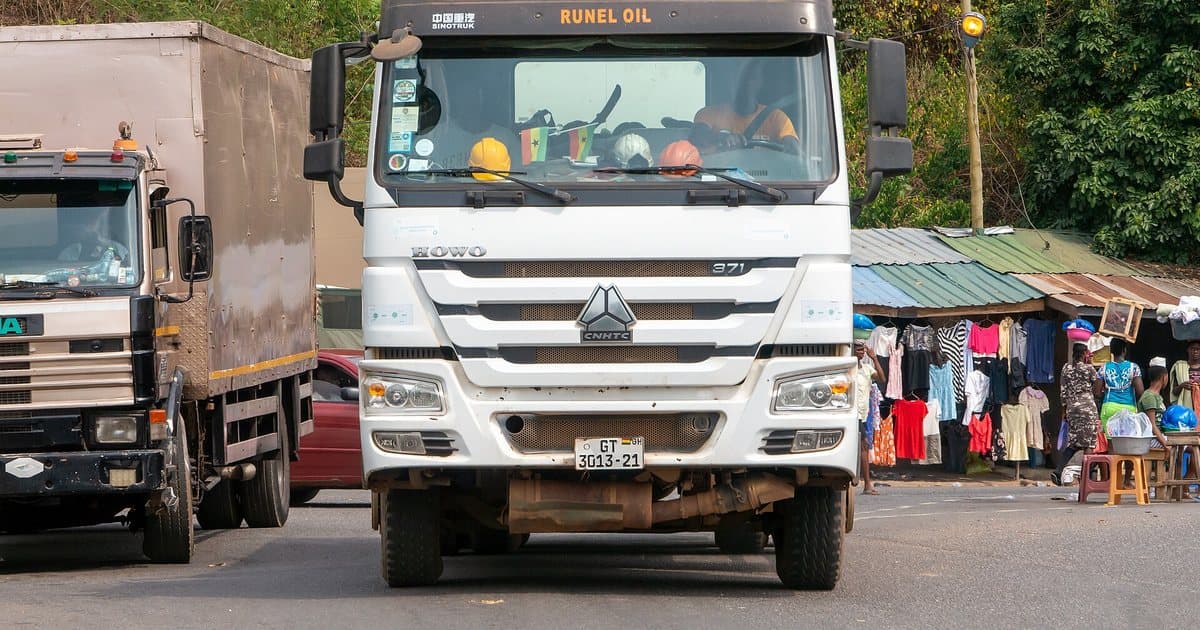
Chinese industry figures leave little room for doubt. Between January and October 2025, China exported 289,000 heavy trucks, of which 118,000 went to Africa, a market up 54 % year on year. Sinotruk, China's leading truck exporter for the twenty-first year running, alone shipped more than 150,000 heavy trucks abroad in 2025. It is established in Nigeria's Lekki Free Zone and has brought an assembly plant into service in Algeria.
These trucks arrive new. In Ouagadougou on 30 May 2025, the local distributor launched Sinotruk's new HOWO-MAX, a 430 horsepower 6x4 tractor, at 35 million FCFA before tax with a two-year warranty. And China has a state export credit insurer, Sinosure, set up in 2001 to cover exactly what banks will not carry alone: the risk of non-payment on capital goods sold abroad.
China has not discovered a less risky continent than everyone else. It decided to insure the risk and sell.
What Europe sends
Europe sends its used trucks. According to the UN Environment Programme, the European Union accounted in 2020 for about 46 % of global exports of used heavy-duty vehicles, while producing only around 6 % of the world's new ones. For West Africa, the typical European truck is not a new truck. It is an end-of-lease truck.
The arithmetic is quick. A 2019 Volvo FH 460 tractor, seven years old, is listed from 29,000 euros on the main European used truck marketplaces, roughly 19 million FCFA before shipping, customs clearance and refurbishment. Landed in Dakar, it is not far from the price of a new Chinese tractor with a two-year warranty. And by decree of 24 October 2025, Senegal raised the maximum age of imported used heavy vehicles from 10 to 15 years: the flow of old European trucks is set to grow.
European manufacturers are not absent, and precision matters here. Daimler sells in Côte d'Ivoire and Ghana, notably trucks built in India by its subsidiary DICV. Scania runs a network from Accra covering Ghana, Côte d'Ivoire, Benin, Burkina Faso, Togo and Nigeria. Volvo works through a Belgian distributor serving mainly mining and industry. What is missing is not presence. It is an offer for the carrier who owns two or three trucks, has more freight than he can handle, and cannot pay cash.
"Africa equals risk": a bias, not a calculation
The answer heard everywhere fits in three words: too much risk. Look at the numbers rather than the reputation.
The GEMs consortium, which pools data from the multilateral development banks and development finance institutions, published in October 2025 its statistics on three decades of private sector lending in emerging markets. Sub-Saharan Africa has the highest default rate of any region, at 6.05 %. It also has the highest recovery rate, at over 78 %. On what these institutions lent, the actual loss comes to about 1.3 % of the amounts. That is not the profile of a continent to avoid.
And the risk pays. The World Bank found that on West and Central African corridors, transport rates carry margins of 60 to 160 % over operating costs, precisely because trucks are scarce. High risk with a high return has a name in finance: an opportunity, provided the risk is covered.
Risk can be insured, and the tools are European
This is the point that ought to trouble European manufacturers most. The instruments needed to sell trucks into Africa on credit exist, and many of them are European.
Sweden's export credit agency, EKN, typically guarantees 95 % of a buyer credit extended by a bank to a foreign customer. It already does so for Volvo trucks in West, Central and North Africa through the Belgian distributor SMT, which said in 2019 that roughly 10 % of its sales would not exist without that guarantee, and that "very few" were willing to take on the risk for its region. Every major truck-making country has an equivalent agency. On the continent, the pan-African insurer ATIDI covers political and commercial risk, and its members include Senegal, Côte d'Ivoire, Benin, Togo, Niger, Nigeria and Ghana. Behind all of these insurers sits the reinsurance market.
Add what makes a truck a particular kind of collateral: it can be tracked by GPS, immobilised remotely, insured against all risks, and resold on an active second-hand market. Europe knows that better than anyone, since it is where Europe sells its own used trucks.
What a European manufacturer could do tomorrow
None of this requires inventing a financial product.
- Offer leasing in CFA francs through a local partner, covered by its home export credit agency and, for the African share, by ATIDI.
- Guarantee a buy-back value after five years, which lowers the lender's risk and reassures the carrier.
- Make GPS and comprehensive insurance mandatory, as a condition of the financing rather than an option.
- Target the carrier, not only the mine: he is the one short of trucks, and he is the one who moves the economy.
- Hold spare parts stock in Dakar, Abidjan or Lomé, because a truck idle for want of a part is a credit risk the manufacturer created itself.
What is at stake now
European manufacturers may one day wake up to find that the African heavy truck market has been lost to them, as the car market was. On that day, a good product will not be enough to return. The networks, the workshops, the habits and the trust of carriers will have been built by others.
There is still a window. It is closing at a rate of more than 10,000 Chinese trucks a month.
What we do
We have put a simple model to manufacturers and dealers in China and in Europe: a down payment, payment spread over five years, insurance, GPS, and freight brought by our platform so the trucks earn from the day they arrive. Our door is open to the European manufacturer willing to take it seriously.
If you are a manufacturer, distributor, lender or insurer and want to test this model on a handful of trucks, write to us. We already have the freight.
Read next: our field report on the truck shortage and what a truck costs when money costs 25 percent.
Sources: chinatrucks.org, 29 December 2025 (Chinese heavy truck exports January to October 2025, Sinotruk exports in 2025); Lekki Free Zone Development Company (Sinotruk International Nigeria); Eratruck Burkina Faso, launch of the HOWO-MAX on 30 May 2025 (price, power, warranty); Sinosure (mandate and products); UN Environment Programme, Used Heavy-Duty Vehicles and the Environment, 2024; Autoline, listings for 2019 Volvo FH 460 tractors, viewed September 2026; Le Soleil, decree of 24 October 2025 on the age limit for used vehicles imported into Senegal; Daimler Truck (DICV exports); Scania West Africa; EKN, buyer credit guarantees and "Into Africa with Volvo vehicles", 21 October 2019; GEMs Consortium, default and recovery statistics published 7 October 2025; ATIDI, member countries; World Bank, Transport Prices and Costs in Africa. The loss rate of about 1.3 % is our calculation from the default and recovery rates published by GEMs.