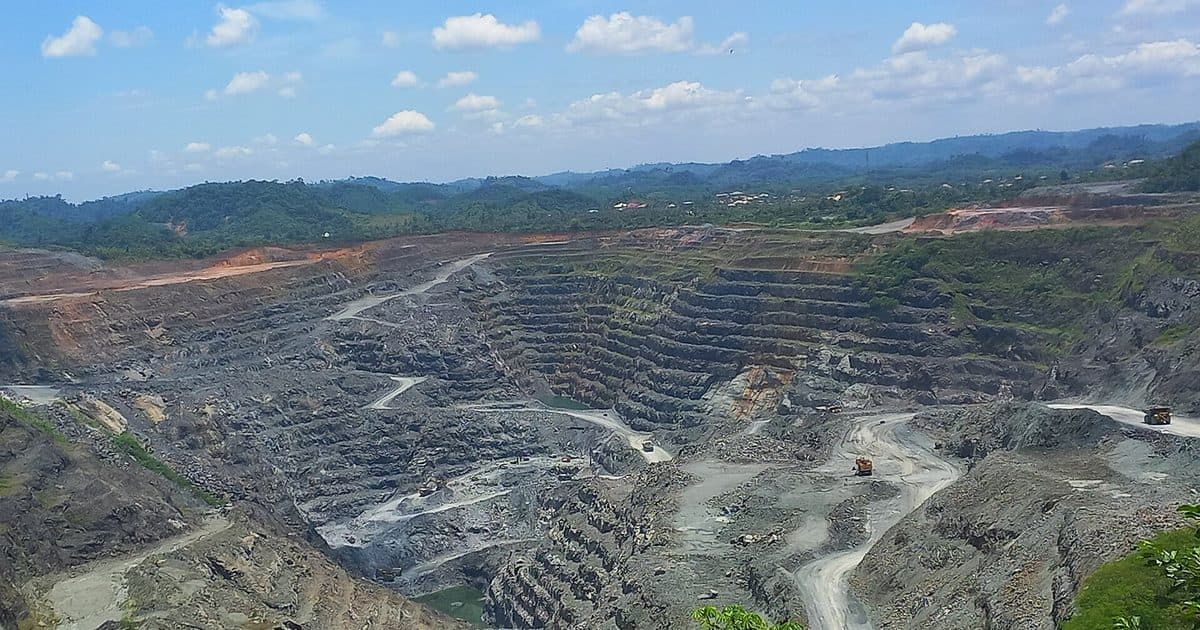
On 26 May 2025, Guinea's government withdrew the exploration permits of 129 mining companies in a single order, covering gold, diamonds and bauxite. The reasons given: work never started on time, idle sites, unpaid fees, and permits transferred without authorisation. The areas went back to the State at no cost.
That decision sums up what a mining licence is in West Africa. It is not an asset you buy and keep. It is a right granted against obligations, and whoever fails to meet them loses it. Here is how a licence is obtained, what the mining codes of seven countries say, and what to check before you take over an existing one.
Mining titles, from the lightest to the heaviest
The names change from one country to the next. The logic does not.
- A reconnaissance or prospecting authorisation lets you look at an area without exclusive rights.
- An exploration licence, called a permis de recherche in French speaking countries, gives the exclusive right to search for a deposit on a defined block, with a work programme and a budget to meet.
- A mining lease, or permis d'exploitation, allows extraction and sale. It requires a feasibility study, an environmental and social impact assessment, and usually a mining agreement signed with the State.
- Small scale and semi mechanised permits cover modest deposits, for shorter terms.
- Artisanal mining is reserved for nationals in Burkina Faso and Côte d'Ivoire.
Moving from exploration to mining is never automatic. You have to prove a deposit exists and can be mined at a profit. That is where reporting codes such as JORC come in, which we explain in our guide to mining terms.
What the mining codes say
| Country | Law | Exploration | Mining lease (large mine) | State share |
|---|---|---|---|---|
| Ghana | Minerals and Mining Act 2006 (Act 703) | 3 years, renewable for 3 | up to 30 years | 10% free carried interest |
| Nigeria | Nigerian Minerals and Mining Act 2007 | 3 years, plus 2 renewals of 2 years, 200 km² maximum | 25 years, 50 km² maximum | no fixed share found in the Act |
| Senegal | Law 2016-32 of 8 November 2016 | 4 years, plus 2 renewals of 3 years, area cut by a quarter each time | 5 to 20 years, renewable | 10% free, plus up to 25% negotiated |
| Côte d'Ivoire | Law 2014-138 of 24 March 2014 | 4 years, plus 2 renewals of 3 years | up to 20 years, then 10 year periods | 10% free, the rest negotiated |
| Burkina Faso | Law 016-2024/ALT of 18 July 2024 | 3 years, plus 2 renewals of 3 years | 10 years, then 5 year periods | 15% free, plus a right to subscribe at least 30% |
| Mali | Law 2023-040 of 29 August 2023 | 9 years in total at most | 12 years, then 10 year periods | 10% free, 20% paid, and 5% sold to Malian investors |
| Guinea | 2011 code as amended in 2013 | depends on the title | depends on the title | 15% free, plus up to 20% paid |
Two numbers weigh heavily on any project. The first is the royalty paid on production: Ghana's Act sets a range of 3 to 6% of revenue, and Senegal charges 5% on unrefined gold, 3.5% if it is refined in the country. The second is the State's share: in Mali, between the free share, the paid option and the obligation to sell 5% to Malian investors, up to 35% of the capital can end up with the State and nationals.
How to apply for an exploration licence
You apply to the Ministry of Mines or its mining cadastre, the office that keeps the register and the map of every title. Nigeria gave that role to a single agency, the Mining Cadastre Office, which processes applications online through its eMC+ portal. In Ghana, the Minerals Commission handles applications and collects the annual mineral right fees. Guinea has also put its cadastre online.
A standard application includes:
- a locally incorporated company, with its articles and registration;
- proof of technical and financial capacity;
- a costed work programme, with the budget committed over the licence term;
- the coordinates of a free area: in Côte d'Ivoire, between 1 and 400 km²;
- the application fee, then an annual rent per square kilometre.
When two applicants want the same area, Senegal's code gives priority to the one offering the best terms and guarantees to the State.
Taking over an existing licence: what to check
Many investors never apply for a licence. They buy one, or buy into the company that holds it. That is where most bad surprises happen.
- Does the title exist, and in whose name? The mining cadastre will tell you. A photocopied order proves nothing.
- Is it still valid? An exploration permit in Senegal lasts ten years in total, and its area shrinks by a quarter at each renewal.
- Are the fees paid and the work done? In Côte d'Ivoire, exploration suspended for more than six months without good reason is a ground for withdrawal.
- Is the transfer authorised? An unauthorised transfer costs the title in Côte d'Ivoire, and it was one of the grounds for Guinea's 129 withdrawals in May 2025.
- What does the sale cost in tax? In Côte d'Ivoire, the capital gain on the transfer of a mining title is taxed.
- What is the data worth? A licence is worth the drilling results and reports that come with it, provided they follow a recognised standard.
- Who must come into the capital? In Mali and Burkina Faso, the share for the State and nationals is negotiated at the mining stage, and it changes the financing plan.
Our view
A mining licence is not a commodity you hold until a buyer shows up. In every code we read, an idle licence is a licence you lose, and a transfer without the State's approval is a ground for withdrawal.
The real value lies elsewhere: in the geological data, in the mining agreement, and in the ability to fund the work. The investors who understand this buy studies before they buy titles. And when a State rewrites the rules midway, as Mali did in 2023 and Burkina Faso in 2024, the one who read the code before signing at least knows what they are exposed to.
Frequently asked questions
How long does an exploration licence last?
Three or four years to start with, depending on the country, then renewable: up to ten years in total in Senegal, ten in Côte d'Ivoire plus an exceptional two years to finish a feasibility study, nine in Burkina Faso and Mali, seven in Nigeria, six in Ghana.
Can a foreigner get a mining license in Africa?
Yes, through a locally incorporated company. Artisanal mining is reserved for nationals in Burkina Faso and Côte d'Ivoire, and some codes require a share of the capital to go to national investors, such as Mali's 5%.
What share does the State take in a mine?
Between 10 and 15% free of charge depending on the country, plus a paid option: up to 25% in Senegal, 20% in Guinea and Mali, at least 30% in Burkina Faso.
Can you buy a mining license?
You can take over a licence, or the company that holds it, but the transfer must be authorised by the administration. Without that approval, the title can be withdrawn.
Where can I check that a mining license is valid?
At the country's mining cadastre, which keeps the official register of titles, their holders and their expiry dates. In Nigeria, the Mining Cadastre Office runs this register.
What we do
GraceRoad works on mandate. Before any search, we charge a fixed sourcing fee and agree a precise specification with you: the mineral, the target countries, the grade you are after, the size of the project and your budget. We then identify available licences or the companies that hold them, check their status at the cadastre and the documents behind them, and introduce you to geologists and mining lawyers with a track record in the country. We do not sell licences.
Read next: what is JORC, and mineral resources versus reserves and sourcing from Africa: three worked cases.
Sources: Ghana, Minerals and Mining Act 2006 (Act 703); Nigeria, Nigerian Minerals and Mining Act 2007 and Mining Cadastre Office; Senegal, Law 2016-32 of 8 November 2016 on the Mining Code, articles 17, 18, 24, 31, 38 and 77 (published by SenLII); Côte d'Ivoire, Law 2014-138 of 24 March 2014 on the Mining Code, articles 22, 32 and 158, and grounds for withdrawal; Burkina Faso, Law 016-2024/ALT of 18 July 2024 on the Mining Code, article 66 and licence terms (published by the Ministry of Energy, Mines and Quarries); Mali, Law 2023-040 of 29 August 2023 on the Mining Code, summarised by Sancy Lenoble Matschinga, Village de la Justice, 20 October 2023; Guinea, 2011 Mining Code as amended by Law L-2013-053-CNT of 8 April 2013, presentation note by the investment promotion agency; Guinea, government statement of 26 May 2025 and Agence Ecofin, 28 May 2025, on the withdrawal of 129 exploration permits.