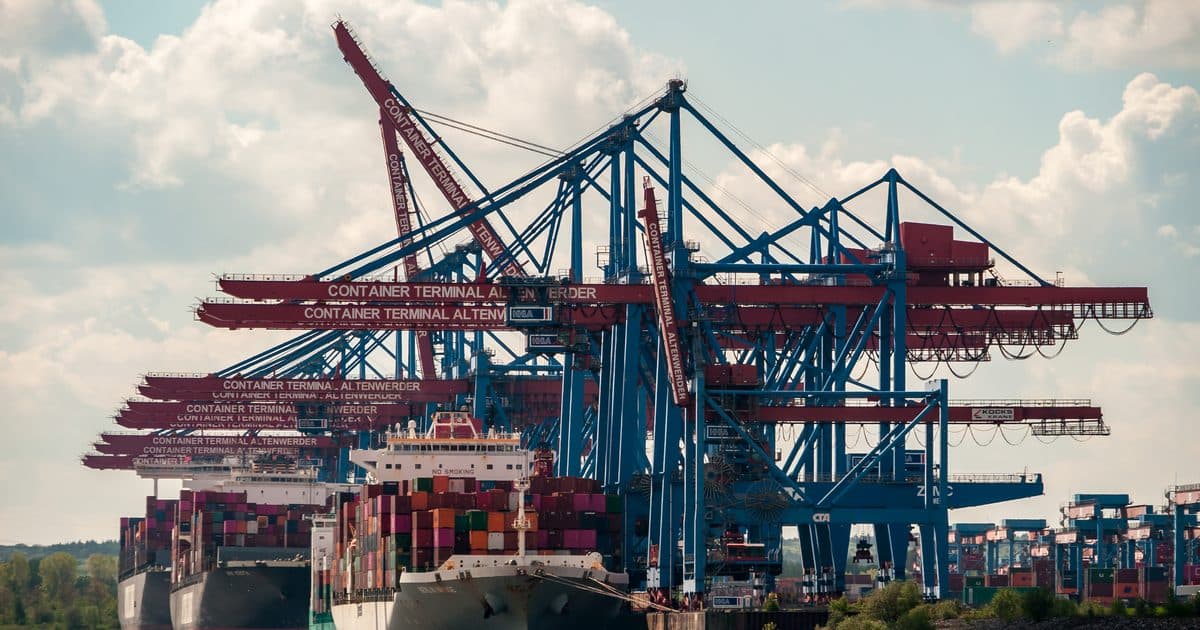
Every trade lane that works on this planet has nodes. A place where a ship hands cargo to a train, where a train hands it to trucks, where customs clears once and where goods wait in a warehouse that was built to hold them. Rotterdam has them. Jebel Ali has them. Shanghai has them.
West Africa has ports, and then it has 1,200 kilometres of road. Between the quay and the market there is no node, so the cargo waits in the places least suited to holding it: the port yard, the barrier, the truck.
That is the whole story of our logistics costs, and it is not a story about poverty. It is a story about nobody deciding to build the meeting points.
What a hub is, and what it is not
A hub is not a warehouse and it is not a parking area. It is a place where three things happen together.
Modes change. Rail to road, sea to rail, long haul truck to distribution van.
Customs clears. On site, with the authority to release, so the cargo is not cleared twice in two cities.
Goods wait on purpose. Bonded storage, cold storage, grain silos, a container yard with a weighbridge and a scanner. Stock held where land is cheap rather than where land is most expensive.
Add a bank branch and an insurance desk and you have described every functioning inland terminal in the world.
Two African examples, and what they teach
Kenya built an inland container depot at Naivasha on its northern corridor, with capacity for 4,000 containers, aimed at long haul cargo to Uganda, Rwanda, the DRC and South Sudan. Mombasa handled 45.45 million tonnes of cargo in 2025, up from 40.99 million the year before. The depot is running at about 19 percent occupancy.
Ethiopia routes about 80 percent of its import and export trade through the Modjo dry port, 75 kilometres from Addis Ababa on the Djibouti corridor. Performance studies of the site record delivery delays reported by two thirds of users, alongside real gains from expanded storage and consolidation.
The lesson is not that dry ports do not work. It is that concrete is the easy part. What decides whether a node works is governance: who operates it, whether customs really releases there, whether the rail actually serves it, and whether the tariff makes it cheaper than the habit it replaces.
Build the yard and forget the operating model and you get an expensive empty field. We should learn that from our neighbours rather than repeating it.
Where our nodes belong
For this corner of the continent the map is not mysterious.
A rail and road node at Tambacounda. The point where the Dakar Niger line, the eastern road and the Malian traffic already meet. Customs, storage, a container yard, fuel.
A border node at Kidira and Diboli. One stop, one inspection, one guarantee released, rather than a queue on each side of a line.
A consolidation node at Bamako. Where containers are stripped, empties are collected for the return leg, and regional distribution starts.
An agricultural node in the Niayes and another in the Casamance. Cold storage and pack houses where the produce is grown, so fruit is chilled within hours rather than trucked hot to a port that has no space for it.
A port node that stays empty. Dakar as a transfer machine, not a warehouse.
None of these are megaprojects. Each is a fenced yard, a building, a customs post, a weighbridge and an operator with a tariff.
The exclusion we do to ourselves
The story we tell about world trade is that it was organised without us and against us. There is truth in the history. There is very little truth in the present.
The African Continental Free Trade Area exists. The Pan African Payment and Settlement System is in force and is expected to cut foreign exchange costs on intra-African payments by 20 to 30 percent. Intra-African trade is forecast at about 230 billion dollars in 2026, with manufacturing and agri food close to half of it. Development banks have money committed and undrawn in our own countries.
What is missing is the physical place where a ship, a train and a truck meet, and the company that runs it. As long as there is no node, our goods will keep travelling badly and expensively, and buyers will keep sourcing from suppliers who have one.
Nobody is shutting us out of that market. We are, one unbuilt terminal at a time.
What we do about it
GraceCorp runs freight on these corridors as they are, and costs them honestly: what a tonne really pays between a field, a port and a landlocked market. That operating data is what any hub project needs before it is drawn, because a terminal is only worth building where the flows and the losses already are.
If you are working on a terminal, a cold chain or a corridor service, tell us the flow you intend to serve. We will give you the real transit times, the cost per tonne and the loss points, measured rather than assumed.
Read next
The rail problem that roads are paying for, and what a bankable corridor file looks like.