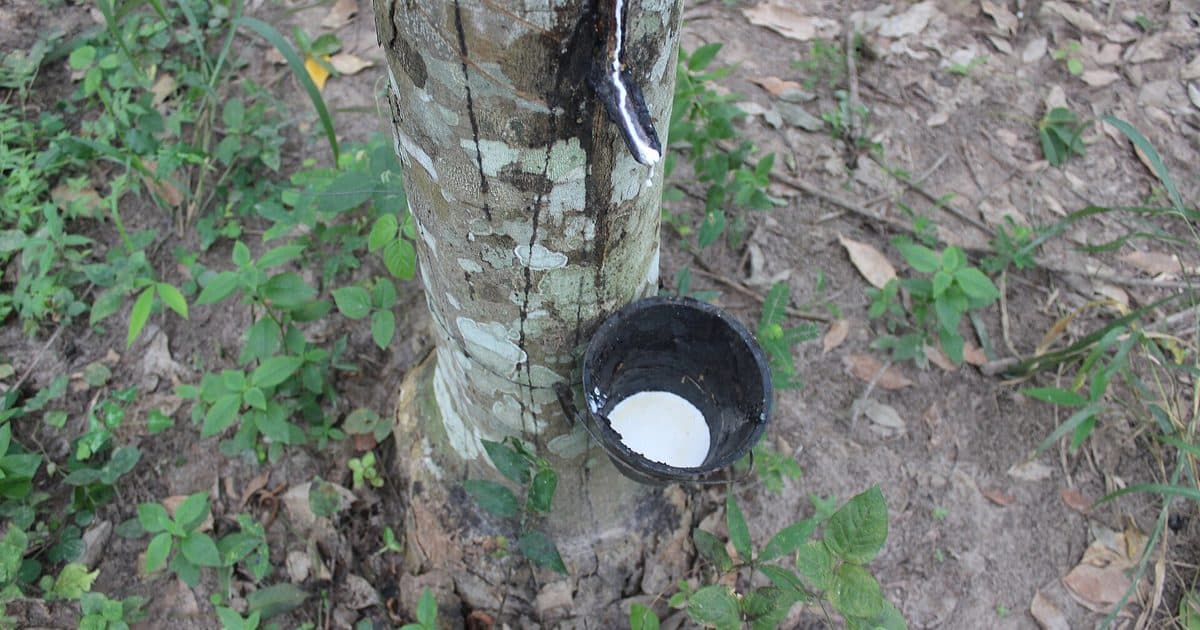
In October 2026, Ivorian farmers are paid 526 CFA francs per kilo of rubber, the highest level of the year. In April, it was worth 401 francs. In October 2023, the official price was 307 francs, and some farmers complained that buyers did not respect it.
Côte d'Ivoire has become the world's third largest producer of natural rubber, behind Thailand and Indonesia. But from the tapped tree to the tyre on a car, value is shared very unevenly. Here is how the price is set, what changed in 2026, and who earns what.
The farmgate price in 2026
The association of natural rubber professionals of Côte d'Ivoire, APROMAC, publishes every month the official price of a kilo of wet rubber.
| Month 2026 | Official price per kilo |
|---|---|
| April | 401 CFA francs |
| May | 439 CFA francs |
| July | 493 CFA francs |
| August | 474 CFA francs |
| September | 484 CFA francs |
| October | 526 CFA francs |
The price follows the world market with a one month lag: it is calculated from prices recorded each day in Singapore during the previous month. On 28 September 2026, TSR 20 rubber, the benchmark grade, traded at 253.20 US cents per kilo in Singapore for October delivery, or about US$2,530 per tonne.
The 2026 reform
The 2026 season opened on 19 June in Yamoussoukro, with a reform based on an agreement between farmers and factories signed on 16 February 2026, approved by the Rubber, Oil Palm and Coconut Council on 29 April and applied since 1 May.
The calculation has four steps:
- start from the previous month's Singapore prices;
- deduct the sector's taxes and a levy of about 2 francs per kilo for its operation;
- this gives a net reference price;
- the net price is shared between farmers and factories.
Three things changed for farmers:
- their share of the net price rises from 63% to 66%;
- the 2 franc per kilo discount is abolished: it dated from a time when Ivorian rubber was considered of lower quality than Asian rubber;
- middlemen are regulated: the official price is the one paid at the factory gate. A farmer who sells to a cooperative or a buyer cannot have more than 20 francs per kilo withheld for transport and costs. Bonuses paid by factories to attract supply are capped at 10 francs per kilo.
Who earns what, from farmer to tyre
The farmer receives 66% of the net reference price. The sector supports more than 1.2 million people, including about 170,000 producers and more than 140,000 tappers. In 2025, it paid more than 700 billion CFA francs to producers.
The factory keeps the rest of the net price, out of which it must turn wet rubber into dry rubber, transport it and export it. Since 2023, Côte d'Ivoire has banned the export of raw material: all rubber must go through a primary processing plant in the country. On 4 June 2025, the Council stopped issuing permits for new plants, considering that existing capacity can absorb the whole national output.
The State collects the sector's taxes. Rubber brought in 1,489 billion CFA francs in export earnings in 2024, about €2.2 billion. It is the country's second source of agricultural foreign exchange, after cocoa.
The tyre maker is elsewhere. According to a study commissioned by APROMAC and FIRCA, published in November 2025, less than 0.1% of Ivorian output, about 2,000 tonnes, is turned into finished products locally, mostly mattresses. The rest is exported and becomes tyres, gloves or seals abroad.
How to buy Ivorian rubber
A foreign buyer buys rubber that has already been processed, from an approved factory:
- the product: TSR dry rubber, or concentrated latex;
- the price: often indexed to the Singapore price, with a premium or discount depending on quality and timing;
- the quality: dirt, ash, volatile matter, plasticity, according to the grade standard;
- the documents: certificate of origin, quality certificate, pre-shipment inspection report;
- for the European Union: rubber is one of the products covered by the deforestation regulation. From 30 December 2026, large operators will have to link every lot to the plots where it was harvested.
Our view
Côte d'Ivoire has succeeded in the first step: it doubled its production between 2019 and 2023, and all its rubber must now go through a plant in the country before export. The 2026 reform also makes the split fairer for farmers.
But the real value of rubber lies in the tyre, and the country makes none. A country that produces 1.7 million tonnes a year and turns only 2,000 into finished products lets most of its wealth go. The Rubber and Oil Palm Council is calling for a tyre plant. It is the right ambition, provided the plant is guaranteed its supply and stable rules.
Frequently asked questions
What is the rubber price in Ivory Coast in October 2026?
526 CFA francs per kilo of wet rubber, paid at the factory gate. It was 484 francs in September.
How is the rubber price set in Côte d'Ivoire?
Every month, from the previous month's Singapore prices. After deducting taxes and a sector levy, farmers receive 66% of the net price since 1 May 2026.
Is Côte d'Ivoire the largest rubber producer?
It is Africa's largest producer and the world's third, behind Thailand and Indonesia, with about 1.7 million tonnes a year.
Can you export raw rubber from Côte d'Ivoire?
No. Since 2023, exporting raw material has been banned: rubber must be processed in an Ivorian plant before it leaves.
What is TSR 20?
A technically specified dry natural rubber, the benchmark grade traded on the Singapore exchange. Its price is the basis for the Ivorian price.
What we do
GraceRoad finds rubber factories and approved exporters in Côte d'Ivoire for its clients, on mandate, for a fixed sourcing fee agreed upfront. We check the factory, have every lot inspected and arrange transport to the port.
Read next: cocoa price 2026: who can buy the beans and EUDR 2026: what changes for African cocoa, coffee and wood.
Sources: Erooamba and 7info, October 2026, on the October price; Business & Actuality, on the September 2026 price; Agence ivoirienne de presse, 3 July 2026, on the July price; KOACI, 14 October 2023, on the 307 CFA franc price; Sikafinance, June 2026, on the opening of the season on 19 June 2026, the agreement of 16 February 2026, the Council's decision and the new split; Financial Afrik, 15 January 2026, on the world ranking, production, export earnings, the raw export ban, the end of new permits and the APROMAC and FIRCA study; Agence ivoirienne de presse, 2025 international agriculture and animal resources show, on the tyre plant project; Thuong Hieu va Cong Luan, 28 September 2026, on TSR 20 prices in Singapore.