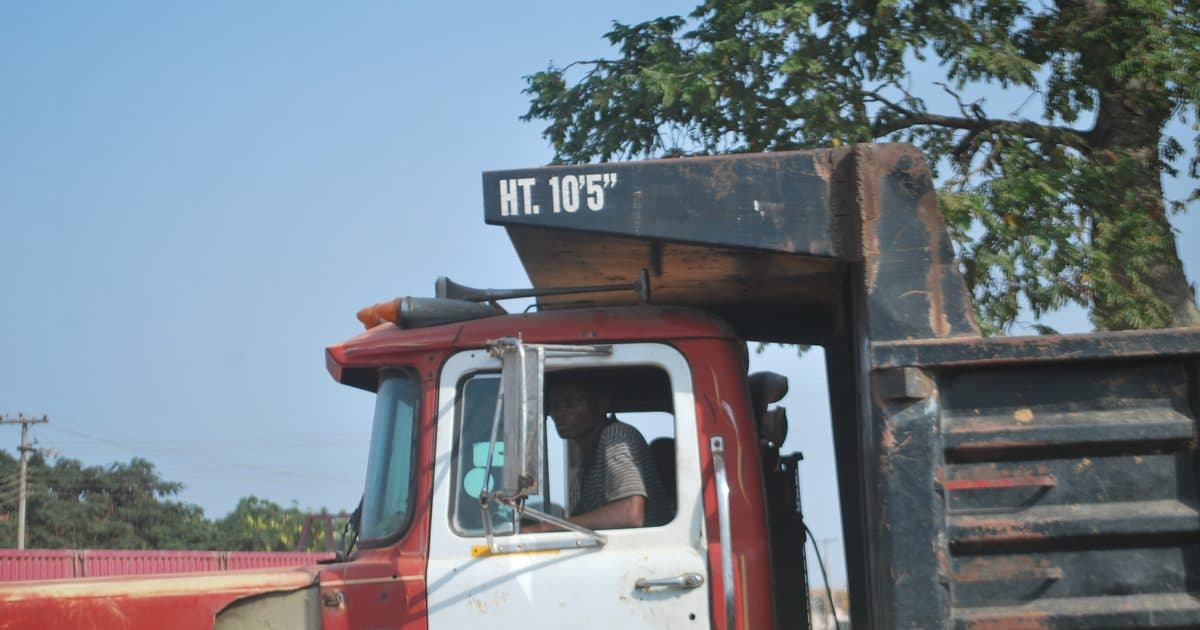
An operator buys a tractor unit. The financing is closed, the insurance is placed, the first job is assigned. Then he spends three weeks looking for someone to drive it, and ends up handing tens of thousands of dollars of equipment and twenty tonnes of cargo to a man he knows almost nothing about.
That scene is more common than a breakdown, and it costs more.
The global number, and the African hole
The International Road Transport Union publishes an annual survey of the driver shortage. The 2024 edition puts the gap at 3.6 million drivers across 36 countries surveyed, that is 7 to 17 percent of the workforce depending on the country. Up to 70 percent of firms surveyed report severe difficulty recruiting.
The age pyramid explains the rest. Drivers under 25 are 6.5 percent of the workforce, while those over 55 are 31.6 percent. A trade that recruits no young people and will lose a third of its workforce within a decade does not have a cyclical problem.
Then the detail that should alarm everyone here: Africa is not in that survey. The continent that has to double its road freight by 2030 is not even counted in the only global census of the profession.
What missing data produces
When a sector is not measured, three things follow.
Governments do not plan training, because they do not know the need. Financiers treat human risk as either nonexistent or infinite, with nothing in between. And firms poach drivers from each other, which raises wages without raising the number of drivers.
That last point is what West African operators feel: the market for an experienced driver is a poaching market, not a training market.
What one resignation really costs
An operator who loses a good driver does not lose a salary. He loses, in order:
Idle days. A stationary unit repays no credit and pays no insurance. Three weeks down is a full rotation on a long corridor.
Corridor knowledge. A driver who knows the posts, the hours, the habits of the checks and the places you do not stop does the run in three days where another takes five.
Fuel. Between a steady driver and a rough one, the consumption gap on the same route runs into double digit percentages, on the heaviest line of the operating account.
Equipment. Clutch, gearbox, tyres, brakes: the maintenance bill of a badly driven vehicle shows up within a quarter.
Risk. A serious accident does not only cost the cargo and the truck. It costs the insurance premium for years afterwards, and sometimes the customer.
What keeps a driver, and what drives him away
We talk to dozens of partner carriers, and the same reasons come back.
What pushes them out: irregular pay, unpaid waiting time, no support on the road, dangerous equipment, and humiliation at checkpoints when the paperwork does not hold.
What keeps them: being paid on a fixed date, knowing how many days the trip will take, carrying a complete file that avoids arguments at the posts, and driving a maintained vehicle.
Those are organisational points, not generosity. An operator who holds them keeps his drivers and pays less than a competitor bidding up salaries.
The job is changing, and that is an opportunity
Three shifts are already visible on our corridors.
The phone has become a work tool. An equipped driver sends his position, photographs a signed delivery note, reports an incident as it happens. That changes his relationship with the operator, and it is worth money: a timestamped proof of delivery settles in an hour a dispute that used to run three weeks.
Women are entering the trade. Slowly, and mostly in structured fleets, the ones that offer predictable runs and decent conditions.
Training is becoming a competitive advantage. Fuel efficient driving, load securing, transport documents, safety basics: a month of training pays for itself in a quarter of fuel.
What we do on our side
On every assigned job we record the driver and his number, and on the morning of loading we send him directly the link that activates tracking on his truck. This is not surveillance: it is what lets the client watch the goods move without calling the driver every two hours, and lets the carrier prove he was on time.
We also ask partner carriers for their drivers' licences at application time, along with the rest of the documents. A complete file clears the posts faster, and the driver is the first to benefit.
The continent will order trucks. It will also need drivers, and those cannot be imported second hand.
Sources: IRU, Global Truck Driver Shortage Report 2024 (3.6 million driver gap across 36 countries, age distribution, recruitment difficulty, survey scope); United Nations Economic Commission for Africa (doubling of road freight by 2030); interviews with our partner carriers on West African corridors.