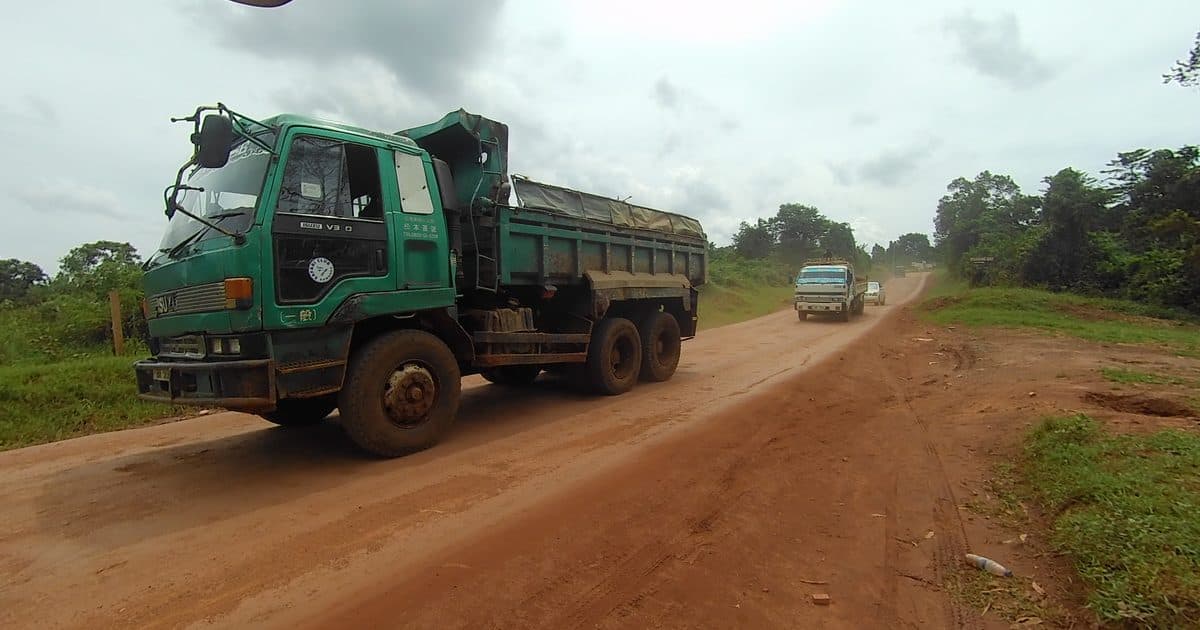
A shipper comparing a Dakar to Bamako quotation with an equivalent run in South East Asia reaches the same conclusion every time: African transport is expensive. He is right about the price. He is wrong about the cause.
The World Bank documented the gap in its reference study on transport prices and costs in Africa. The finding remains counter intuitive fifteen years on: operating costs on the main African corridors are comparable to those of other developing regions, while the prices shippers pay are markedly higher. In West and Central Africa the study puts the margins at 60 to 160 percent.
In other words, the truck is not what costs money. Access to the truck is.
What a transport price actually pays for
Split what a shipper pays into what produces the service and what produces the rent.
Producing the service: fuel, tyres, maintenance, the driver, depreciation, insurance, regular transit charges. Those items are broadly the same everywhere, at local prices, and any operator knows them to the last unit.
Producing the rent: the organisation of access to freight. On much of the corridor network, cargo is not handed directly by the shipper to the carrier. It moves through lorry parks and queue systems, where a truck takes a load when its turn comes, regardless of its cost or its quality. The World Bank study notes that direct contracting between shipper and carrier is non existent in Central Africa and marginal in West Africa.
A queue protects two things: the position of those already in it, and the price. It has no reason to reward the operator who runs better.
A high margin is not a sign of prosperity
This is the most common misreading among investors new to the sector. Margins of 60 to 160 percent suggest a flourishing industry. The reality on the ground is the opposite.
Those margins coexist with poorly utilised fleets, second hand vehicles, chronic overloading and tight cash. The explanation fits in one sentence: when a truck only runs a few days a month because it is waiting its turn, each trip has to carry an enormous margin to cover the year. The price is high because the asset is badly used, not because the operator is getting rich.
Which is why any pitch about lowering prices without improving truck utilisation collapses on contact. You do not durably lower a price by squeezing a margin that funds idleness. You lower it by removing the idleness.
The other half of the problem is on the road
The rest of the price gap happens between checkpoints. As early as 2007, the West African Economic and Monetary Union and ECOWAS set up an Observatory of Abnormal Practices on inter state routes. Nobody creates an observatory of abnormal practices for corridors that run normally.
Those stops cost twice. Once in payments, once in hours. And the hours cost more than the payments: a unit held three days on a five day run is a lost rotation in the month.
There is a direct consequence, verifiable by any operator: the number of stops depends mostly on the quality of the paperwork. A truck whose documents are complete, whose waybill is clean and whose transit is properly opened goes through. One that improvises stops.
What that opens for a serious operator
Turn the reasoning around. On this market, an operator who secures three things holds a very strong position.
Direct access to freight. Bypassing the queue means dealing with the shipper directly. That requires being chosen for something other than your rank: vehicles in order, traceability, clean invoicing.
Utilisation. The main lever is not the price per kilometre, it is the number of loaded kilometres a year. A unit that turns three times more than another can quote below it and still earn more.
Passage. A complete file, an inter state transit properly opened, a driver who knows what he is carrying: that is what turns five days on the road into three.
None of the three requires waiting for a new road. All three are built with organisation and a little administrative discipline.
What we do with that gap
GraceRoad was built on this reading. We do not sell cheaper kilometres by shaving someone's margin. We take the gap where it sits.
We check every partner carrier document by document before the first job, because a compliant vehicle stops less often. We build the file for each operation methodically before departure, because the file decides the time on the road. We track the truck and show the client where it is, because a shipper who knows does not call and does not double his order.
On a market where the price contains 60 to 160 percent of organisational margin, you do not win a place by cutting prices. You win it by removing the reasons the prices are high.
Sources: World Bank, Transport Prices and Costs in Africa (cost and price comparison on corridors, margins in West and Central Africa, direct contracting, effects of freight allocation systems); WAEMU and ECOWAS, Observatory of Abnormal Practices (2007); African Development Bank (road share of inland freight).