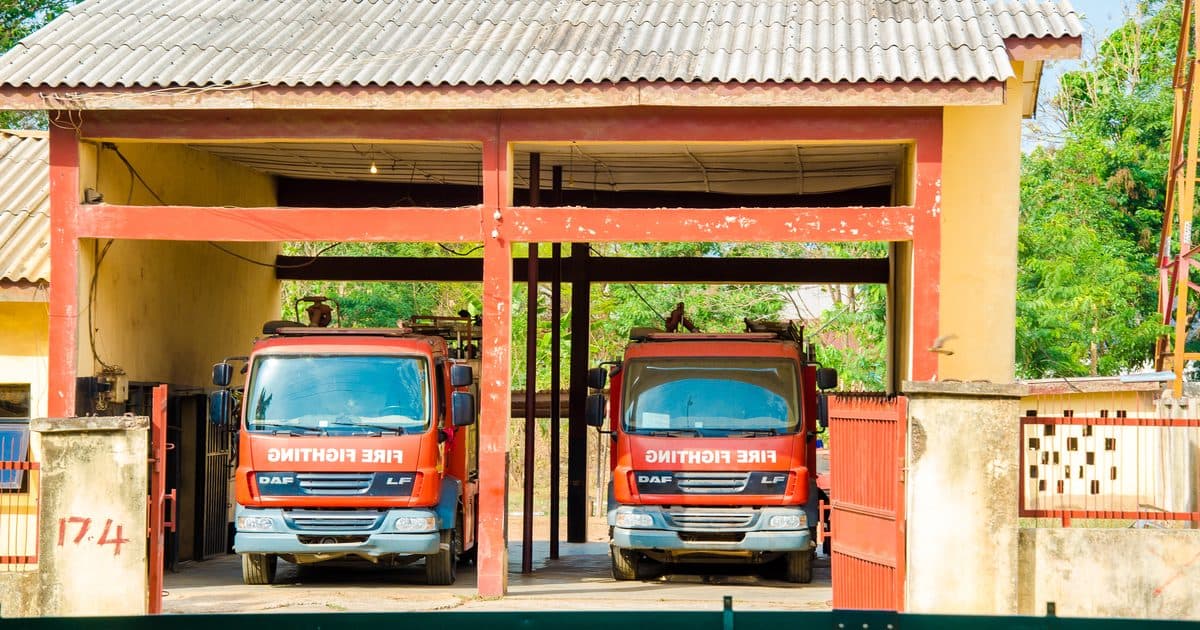
The number sits in a public study by the United Nations Economic Commission for Africa on what the continental free trade area demands of transport. To carry the flows it creates, the continent will need 1,844,000 trucks for bulk cargo and 248,000 trucks for containers by 2030. Intra-African road freight would go from 201 to 403 million tonnes, a doubling, and 39 percent of that additional truck demand sits in West Africa.
Two million trucks is several years of output for a European manufacturer. The figure has been circulating in conference rooms for years. Order books are not moving at anything like that scale.
An announced gap is not a financed gap
The reason is not demand. It is money, and the way the trade is organised.
A West African operator who wants to add a tractor unit hits three walls at once. Bank credit first: in Ghana, commercial banks commonly lend at 25 to 30 percent a year, and non bank lenders well above that. Collateral second: most operators hold no land title and no asset a bank will take as security, which excludes them from formal credit by construction. History third: with no financial statements and no credit record, the lender prices his own ignorance.
You can see the result on the road. Fleets renew through imported second hand units, repair instead of replace, and run far longer than any European depreciation schedule would allow.
Meanwhile, the margin is there
This is the part most investors miss, because it contradicts the picture of a poor sector.
The World Bank established it in its reference study on transport prices and costs in Africa. On the corridors, operating costs are comparable to other developing regions, while the prices shippers pay are far higher. The gap goes into informal payments and margin. In West and Central Africa the study puts those margins at 60 to 160 percent.
A margin like that does not signal a thriving market. It signals a closed one, where queue systems and understandings protect incumbents, and where not enough new capital enters to push the price down. That is precisely the setup an investor looks for: structural demand, a high price, and a barrier that is organisational rather than technical.
What the road carries, and what the road pays
Road is not one mode among several on this continent. According to the African Development Bank, it carries 75 to 90 percent of inland freight in Sub-Saharan Africa. Rail exists in sections, waterways in a few basins, but the tonne that leaves a port for the interior goes on a truck.
That de facto monopoly has a consequence few business plans model: the return on a truck in West Africa barely depends on the price per kilometre. It depends on how many loaded kilometres you manage in a year. Two identical tractors, one badly deployed and one properly allocated, do not differ by fifty percent in revenue. They differ by a factor of three.
Why demand does not summon supply on its own
An economist would say margins of 60 to 160 percent attract capital. On the ground, three frictions stop it.
Freight is not found, it is known. Allocation runs through relationships, lorry parks and queues. An operator who shows up with ten trucks and no network watches them park.
The return leg is empty. Corridor authorities and recent studies put the share of trucks running empty on the return leg at 30 to 40 percent. The empty kilometre is paid for by the loaded one.
Risk is not measured. With no tracking, no documents and no record, a financier cannot tell a serious operator from the rest, so he prices everyone like the worst of them.
These three frictions share a trait: they are information problems, not asphalt problems. They are solved with organisation, not with a ten year infrastructure plan.
The financing gap, in its proper place
People often quote the continent's infrastructure gap, which the African Development Bank puts at 68 to 108 billion dollars a year, against needs of 130 to 170 billion and actual spending of 75 to 80. That is true, and it is enormous.
But a private investor does not have to wait for the road. The truck, the workshop, the warehouse, the system that allocates freight and the tracking that reassures the insurer are private assets, depreciable over five to seven years, against demand that already exists. Heavy infrastructure is the business of states and development banks. Transport capacity is the business of private capital, and it is what runs short first.
What we do with that gap
We build the organisational side, because that is what binds first.
Every partner carrier is checked document by document before receiving a load: registration, current insurance, technical inspection, licence. Every job leaves with a complete file, which cuts the number of stops and the hours lost at checkpoints. Every assigned truck carries a tracking key, and the client watches his goods move. Put end to end, those three things turn an invisible operator into a financeable one.
The same logic holds for an investor: on this market the profitable asset is not the truck, it is the truck employed, with a return load, a file that clears the posts, and a record that proves what happened.
If you look at West African trucking as an asset class, let us talk. We know the part the spreadsheets do not show.
Sources: United Nations Economic Commission for Africa, study on transport requirements under the African Continental Free Trade Area (truck and wagon requirements to 2030, doubling of road freight, regional distribution); World Bank, Transport Prices and Costs in Africa (cost and price comparison on corridors, margins in West and Central Africa); African Development Bank (road share of inland freight, annual infrastructure financing gap); corridor authority data on empty running.