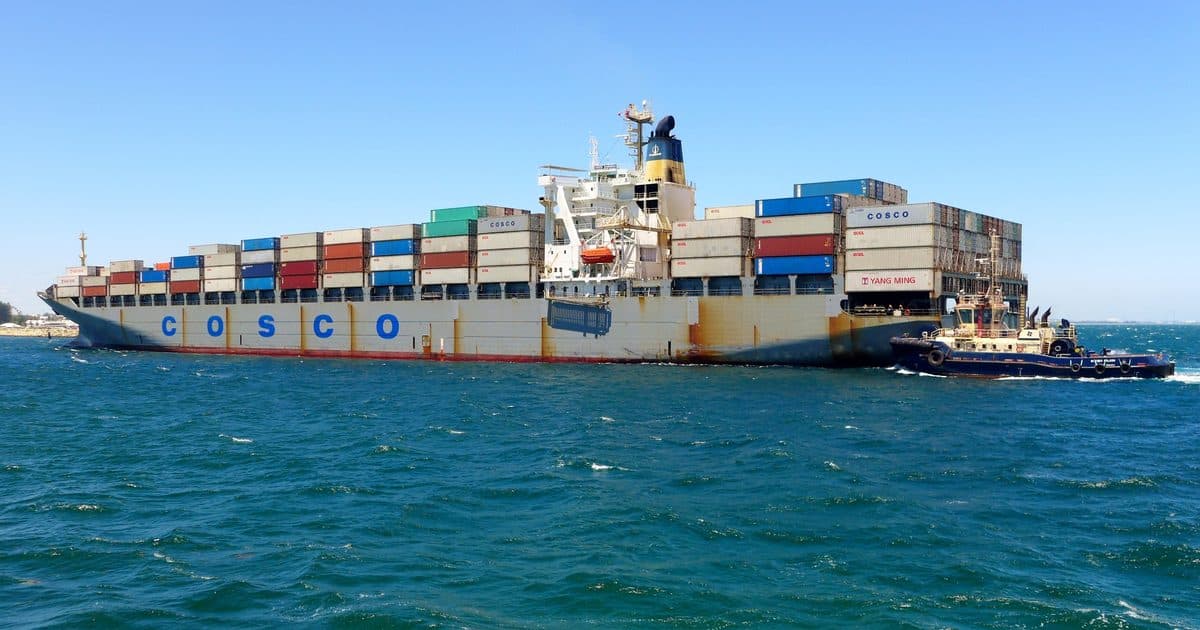
A trader in Guangzhou quotes CIF Dakar. The price is good, the container leaves on time, the vessel arrives when it said it would. Everything the supplier promised is delivered exactly as promised.
Then the container sits in the port for two weeks, and the importer discovers that the goods have already cost thirty percent more than the invoice.
Nothing went wrong at the Chinese end. The problem is that a Chinese forwarder is measured on getting the box onto a ship, and the box arriving is where their knowledge stops. Everything that decides whether the shipment was a good deal happens after that, in a customs office and on a road they have never seen.
Where your supplier's responsibility actually ends
Under CIF, the seller pays freight and insurance to the named port. Risk transfers when the goods are loaded on board at origin.
That means everything on this list is yours, from the moment the vessel sails:
Terminal handling at destination, customs duty and import VAT, the statistical and community levies, port storage once the free period expires, container demurrage, the container deposit, inland haulage, and any transit formalities if the goods continue to a landlocked country.
None of it appears on the CIF quotation. All of it is real.
Tariff classification is decided at destination, not at origin
Your Chinese supplier will put an HS code on the commercial invoice. It is frequently the code used for export from China, and it is frequently not the code the customs administration at destination will accept.
This matters because the ECOWAS common external tariff sets duty by band — 0, 5, 10, 20 or 35 percent — and the code determines the band. A dispute over one heading can double the duty on a container of finished goods.
The dispute also costs time, and time is where the money goes: the free storage period in Dakar is short, and once it expires, storage and demurrage run daily until the file is resolved.
The documents that block containers
Four recurring problems, all of them avoidable, all of them created in China and discovered in Africa.
An undervalued invoice. Some suppliers offer to declare a lower value "to help with the duty". Customs administrations in the region are experienced with this. A challenged value means a valuation dispute, and a valuation dispute means the container stays where it is.
A packing list that does not match the invoice. Different quantities, different weights, different descriptions. Inspection will find it.
A missing certificate of origin, or one that does not support any preference. It changes nothing on Chinese goods for duty purposes, but its absence can still hold a file.
Certificates of conformity. Several countries in the region require pre-shipment verification of conformity for regulated product categories — electrical goods, toys, construction materials, some foodstuffs. The certificate must be obtained before shipment, in China. Obtained after arrival, it costs several times more, and the goods wait.
That last one catches more first-time importers than anything else on this page.
Consolidation: cheaper, and slower than you think
Buying from several suppliers in Yiwu, Guangzhou or Shenzhen and consolidating into one container is the standard practice, and it is the right one.
Two things to know. Your container leaves when it is full, not when your goods reach the warehouse — if you are the first supplier in, you wait for the last. And the consolidator's packing list becomes your customs declaration: if one supplier's description is wrong, the whole container is exposed, not just their pallets.
Have the consolidator send you the final packing list and invoice set before the container is sealed. That review is the cheapest twenty minutes in the whole operation.
If the goods are not stopping at the port
A large share of what arrives at Dakar, Abidjan, Lomé and Cotonou is destined for Mali, Burkina Faso or Niger.
This changes the operation. The goods move under the ECOWAS inter-state transit regime, they cross a border, and they travel between eight hundred and fourteen hundred kilometres by road. The transit file has to be opened correctly at the port, or the truck is stopped at the first serious checkpoint and stays there.
Choosing the port matters too. Dakar serves Mali well and Mauritania directly. Abidjan and Lomé are often shorter for Burkina Faso and Niger. The right answer depends on the final destination, not on where the shipping line quoted best.
What a landed cost actually contains
If you are comparing two Chinese suppliers, compare landed costs, not CIF prices:
Goods value, ocean freight, insurance, terminal handling, customs duty at the applicable band, import VAT on CIF plus duty, statistical and community levies, clearing agent fees, port storage, container demurrage, the container deposit and its return, inland haulage, and transit formalities where relevant.
A CIF price that is five percent cheaper and lands in a higher duty band is more expensive. This is not a marginal effect.
What we do
We are on the destination side. We clear at Dakar and the other main ports of the region, advance the duty, and deliver inland — Senegal, Mali, Mauritania, Guinea, Burkina Faso, Côte d'Ivoire, Gambia, Togo, Benin.
Before the goods ship, we can confirm the tariff classification and the applicable duty band, tell you which conformity certificates your product category needs in China, and review the invoice and packing list your supplier proposes to issue. That review prevents the great majority of blocked containers, and it costs nothing compared to eleven days of demurrage.
If you prefer a single delivered price rather than managing this yourself, we handle the shipment DDP: one contract, one price, delivery to your warehouse.
Read next
Quoting DDP into West Africa for the full duty and levy structure, and choosing a freight agent in West Africa.