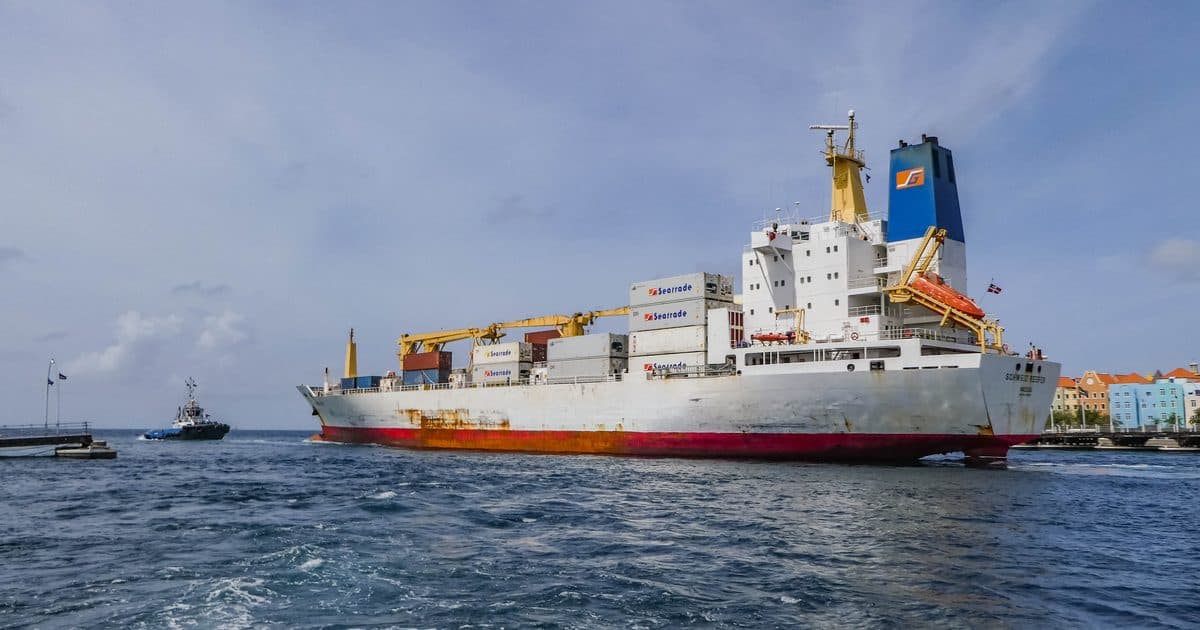
A temperature excursion does not look like anything. The container arrives, the seal is intact, the pallets are upright, the cartons are undamaged. The goods are worthless, and nobody knows it until someone reads the data logger — or until a patient does not respond to a medicine.
That is what makes cold chain different from every other kind of freight. Damage is invisible, and it is established by records rather than by inspection.
Where the chain actually breaks
Not on the vessel. A reefer container at sea is monitored, plugged in and alarmed. The failures happen at the transitions.
At the terminal. A reefer arriving at port must be connected to shore power. The interval between discharge and plug-in is where the first excursion occurs, and it lengthens when the terminal is congested or when the arrival was not announced in advance.
On the terminal, waiting for clearance. A container plugged in is stable. One waiting for a customs file to be resolved is stable only as long as it stays plugged in and the power holds.
At the transfer from container to truck. This is the highest-risk moment of the whole journey. Goods are moved from a reefer container into a refrigerated vehicle, often on an open dock, sometimes in thirty-five degree ambient heat. Every minute of that transfer is an excursion, and pre-cooling the receiving vehicle before the doors open is what separates an operation that works from one that does not.
On the last mile. A refrigerated truck on a fourteen-hundred-kilometre corridor depends on its refrigeration unit, its fuel, and its driver understanding that the set point is not a suggestion.
Temperature records are the claim
For pharmaceutical and biological products, the reference framework is published by the World Health Organization: Technical Report Series Annex 9, on the storage and transport of time- and temperature-sensitive pharmaceutical products, and the WHO good distribution practices. They set out what a compliant transport operation records and demonstrates — qualification of the shipping system, continuous monitoring, and documented handling of any excursion.
In practice, three things determine whether a consignment is accepted or rejected on arrival.
Continuous monitoring, not spot checks. A data logger travelling with the goods, recording throughout, with the record downloadable and readable by the consignee.
A defined excursion protocol. What happens when the record shows a deviation: who is notified, who decides whether the product remains usable, and on what basis. Without a protocol decided in advance, a deviation becomes an argument.
Chain of custody. Who held the goods, when, and at what temperature. A gap in the record is treated as a failure, because it cannot be shown not to be one.
Vaccines and biologicals carry a further constraint that surprises people new to the trade: many are damaged by freezing as well as by heat. Setting a reefer colder than specified is not a safety margin, it is a different way of destroying the product.
Perishable exports have the opposite problem
Fresh mango from Senegal, Mali or Côte d'Ivoire, avocado from Kenya, fish from Dakar or Nouadhibou — here the challenge is not maintaining a cold chain but establishing one, from a field or a landing site to a reefer, fast.
Field heat removed late is quality lost permanently. Pre-cooling before stuffing is the operation that decides shelf life on arrival, and it is the one most often skipped for cost. Nothing downstream recovers it.
These consignments also carry a regulatory layer: phytosanitary certification, and for products entering the European Union, compliance with EU food safety import requirements. A shipment that arrives in perfect condition and fails on documentation is rejected exactly as thoroughly as one that arrives warm.
What we do, and what we do not
We handle port operations, customs and inland transport for temperature-controlled consignments: announcing reefer arrivals so the plug-in happens without delay, preparing the customs file before the vessel berths so the container is not waiting on paperwork, arranging refrigerated road transport, and controlling the transfer so it is short and the receiving vehicle is pre-cooled.
We are a freight forwarder. We do not operate a pharmaceutical-grade storage facility, and we are not a GDP-certified pharmaceutical distributor. Where a consignment requires certified storage or a qualified pharmaceutical distribution chain, we work with parties who hold that qualification rather than claim it ourselves — and on this subject we would rather lose a file than take one we cannot execute to standard.
If you are moving pharmaceutical, biological or perishable product into or out of the region, tell us the product, the temperature range, the origin and destination, and whether monitoring and qualification are contractually required. We will tell you plainly what we handle and where a specialist partner is needed.
Sources
- World Health Organization — WHO Technical Report Series No. 961, Annex 9: model guidance for the storage and transport of time- and temperature-sensitive pharmaceutical products.
- World Health Organization — good storage and distribution practices for medical products.
- International Plant Protection Convention — phytosanitary certification standards, for perishable exports.
Read next
The West African logistics calendar for the seasonal constraints on perishable exports, and quoting DDP into West Africa.